Strategy
Tripwire funnel economics: run the numbers before you build one
Forty front-end sales and the ad account is still underwater. A tripwire funnel lives or dies on the arithmetic after the first sale, and here is the whole of it, line by line.
It is a Tuesday and the dashboard looks like a win. Forty people bought your $27 guide this week. The sales notifications kept pinging, the little counter kept ticking up, and for a day it felt like the funnel had finally caught. Then you open the ad account. It spent $1,340 to get those forty sales. Forty times $27 is $1,080. You are $260 down on the week, the guide is selling, and your first instinct is to turn the whole thing off before it costs you any more.
That instinct is the single most expensive mistake in tripwire funnels, and almost everyone makes it once. You are judging a self-liquidating offer by the one number it was never meant to win on. The front-end sale is not where a tripwire funnel makes its money. It is the bait that turns a cold stranger into a buyer for the price of a coffee, and the money is in what happens in the ninety seconds after they type their card in. Kill the funnel on Tuesday and you never find that out.
This is a pricing teardown, not a pep talk. We are going to open the $27 sale up and show you exactly where every cent of it goes, what the order bump and the upsell actually add, and the point at which the whole thing tips from losing money to paying for its own traffic. Bring your own numbers and run them alongside. If you want the wider map of how these pieces sit inside a funnel first, the anatomy of the GoHighLevel funnel builder lays out the full machine this is one shape of.
What a tripwire funnel is, and what it is not
A tripwire is a low-priced front-end offer, usually somewhere between $7 and $47, whose job is not profit but conversion of identity. It turns a browser into a buyer. That sounds like a semantic trick until you have watched what a buyer does that a free lead never does: they open your emails, they trust the next offer, and they say yes far more readily the second time because they have already said yes once. The industry name for it, when it is priced so the front-end revenue covers the cost of the ad that produced it, is a self-liquidating offer. The ads pay for themselves and you build a buyer list for free.
The page-by-page shape is short and it is fixed. A sales page for the low-ticket offer. An order form that carries an order bump, a small yes-or-no add-on sitting right next to the card field. A one-time-offer upsell page that loads the instant the first payment clears, offering something larger at a price the buyer will only see now. A confirmation page. And behind all of it, the follow-up that carries the new buyer toward whatever you actually sell for real money.
It is worth being precise about what this is not, because the words get used loosely. A tripwire is not a lead magnet: a lead magnet is free and collects an email, a tripwire charges money and collects a buyer, and the difference in downstream behaviour is enormous. If you have never built the free version deliberately, the lead magnet funnel guide covers that path. A tripwire is also not a value ladder. The value ladder is the whole ascending staircase of offers a customer can climb over months; the tripwire is only the first step, the one that gets them onto the staircase at all. The value ladder funnel breakdown shows where this front-end hands off to everything above it. Get those two straight before you build, because pricing a tripwire as if it were a profit centre is exactly how the maths below goes wrong.
The one number that decides everything
Before we build anything up, we have to build one thing down: the cost of a buyer. Everything in a tripwire funnel is measured against what you paid to acquire the person who is buying, and if you do not know that number to the dollar, none of the rest of this means anything. Cost per buyer is simply your ad spend divided by the number of people who bought the front-end offer. Not clicks, not leads, buyers. If you spend $1,800 on traffic and 60 people buy, your cost per buyer is $30, and $30 is the bar every dollar of revenue in this funnel has to clear.
Now watch what happens when the front-end sale tries to clear that bar on its own. Take a single $27 sale and take the costs out of it in order. First the payment processor. Stripe, on its US standard plan, charges 2.9% plus 30 cents on every successful card payment (stripe.com/pricing, checked September 2026), so your $27 hands Stripe a dollar and eight cents before you have seen any of it. Then the cost of actually delivering the thing, which even for a digital product is rarely zero once you count the odd support reply, so call it three dollars. What is left of the $27 is $22.92. Against a $30 cost to acquire that buyer, the front-end sale alone is $7.08 in the red.
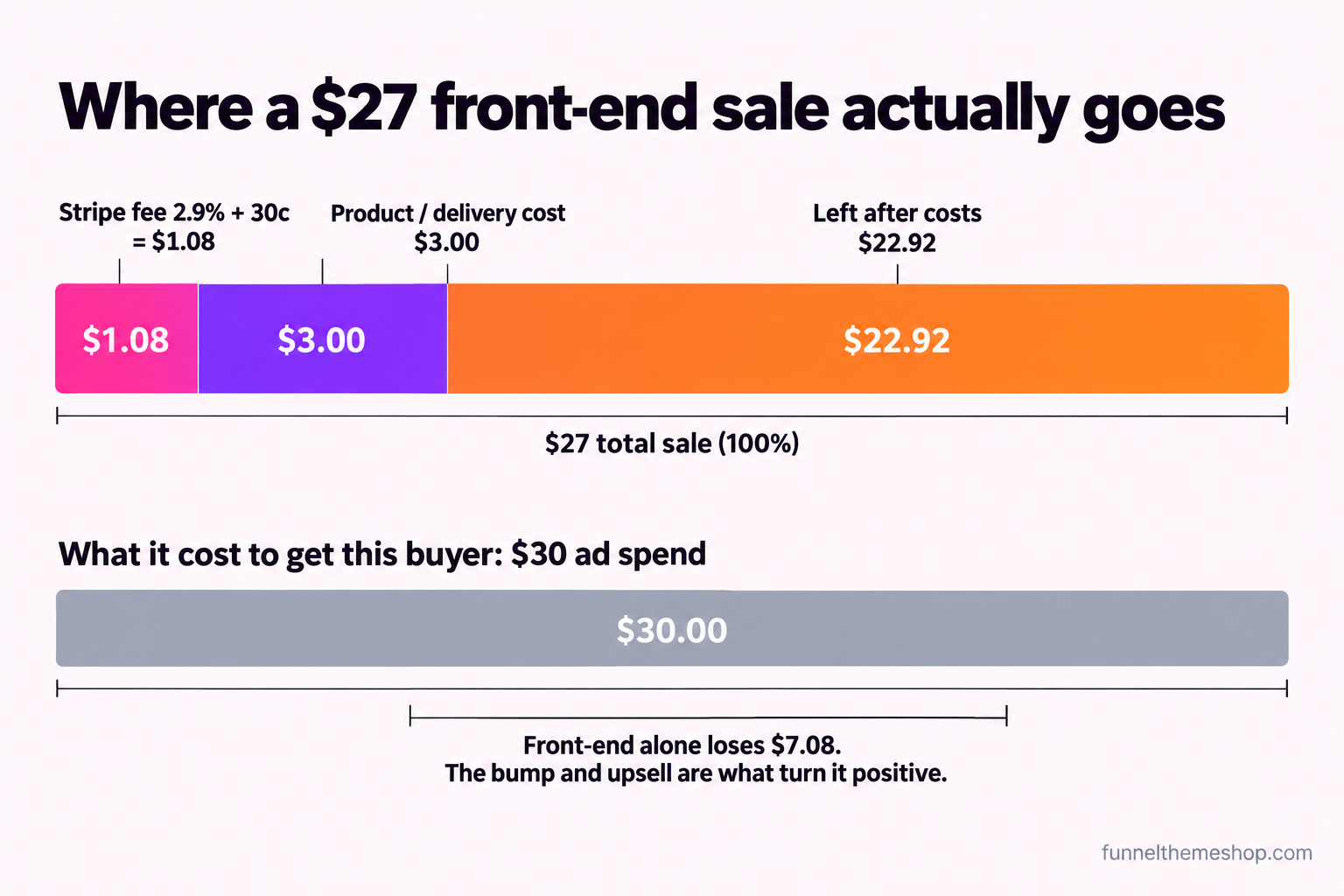
Read that picture carefully, because it is the whole argument. A tripwire priced to make a profit on the first sale is a tripwire priced too high to convert cold traffic, which means it converts almost nobody, which means you never get to the part where the money is. The front-end is supposed to lose a little. The job of everything after it is to turn that small planned loss into a profit before the buyer leaves the page.
The self-liquidating math, line by line
Here is where the order bump and the upsell earn their place, and here is where most people underestimate them by a mile. The bump and the upsell do not just add revenue. They raise your average order value, and average order value is the number that actually competes with your cost per buyer. Let us build it up from the $27 with real, conservative take rates and watch it cross the line.
Start with the order bump. It sits on the order form, it is cheap to say yes to, and a well-matched bump gets taken by around a third of buyers. Say your bump is a $37 companion offer and 30% of buyers add it. Across every buyer, that is 0.30 times $37, which adds $11.10 to your average order. Your average order value is now $38.10. Then the upsell, the one-time offer that loads after the card clears. It is a bigger commitment, so fewer people take it, but they are already buyers with their card out, which is the highest-intent moment they will ever be in. Say the upsell is $97 and 12% take it. That is 0.12 times $97, another $11.64 on average. Your average order value is now $49.74.
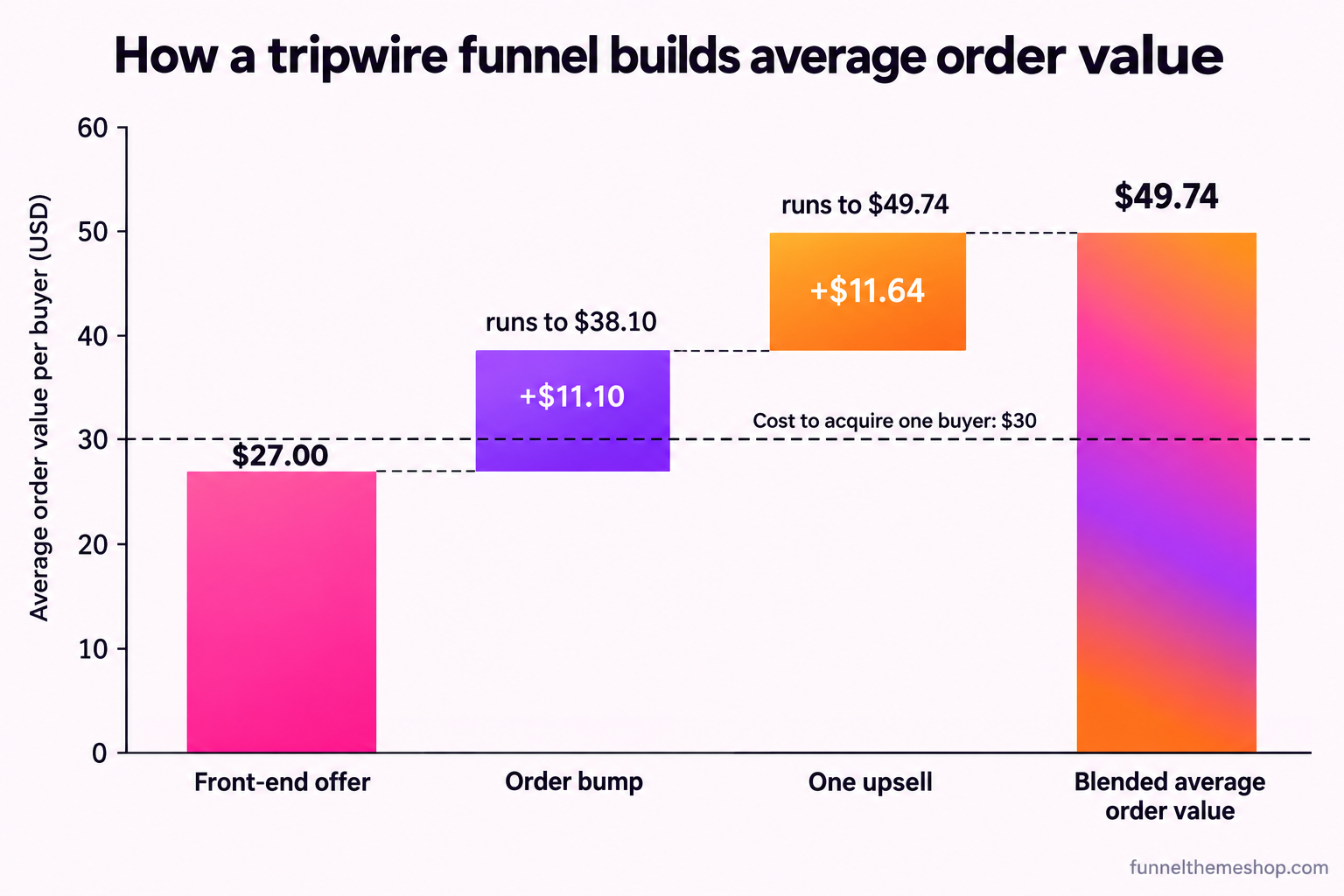
Look at where the dashed line sits. The front-end alone was under it. With the bump and one upsell, the average order clears the $30 cost of a buyer with room to spare. That is the moment a funnel becomes self-liquidating: the average buyer now pays back the ad that produced them, and then some. And notice what did the work. The traffic did not change. The front-end price did not change. You added two offers to the same order form and the same buyer, at the moment they were most willing, and the economics flipped.
The order form itself is where a surprising amount of this leaks away, so it is worth naming. Baymard Institute, aggregating fifty separate studies, puts the long-run average cart abandonment rate at 70.22% (baymard.com/lists/cart-abandonment-rate, checked September 2026). That figure is for ecommerce checkouts rather than tripwire order forms, but the lesson is the same one: the order form is the leakiest surface in the whole funnel, and a bump or an upsell buried under a clumsy checkout never gets the take rate the maths above assumes. If your take rates come in below these, the checkout is usually the reason before the offer is.
Now put real costs against the whole order and see what actually lands in your account. The table below runs the same buyer at three levels of the funnel, all at a $30 cost per buyer, a three-dollar delivery cost and Stripe on the full order. Change any assumption you like; the direction never changes.
| Funnel setup | Blended order value | Cost per buyer (ads, Stripe, delivery) | Net per buyer |
|---|---|---|---|
| Front-end only, $27 | $27.00 | $34.08 | Loses $7.08 |
| Front-end plus a 30% order bump | $38.10 | $34.40 | Makes $3.70 |
| Front-end plus bump plus one 12% upsell | $49.74 | $34.74 | Makes $15.00 |
About fifteen dollars a buyer, on traffic you were told to switch off. Across the sixty buyers from our $1,800 ad spend, that is roughly $900 in the month, and it is the least interesting number on the page. The interesting number is that you now have sixty new buyers, acquired at a profit rather than a cost, sitting at the bottom of a value ladder with your real offer at the top of it. The tripwire did not make you rich on Tuesday. It bought you a buyer list for less than free.
One fixed cost belongs in this picture too, because it is easy to forget. The platform the funnel runs on is a monthly bill, not a per-sale one. GoHighLevel runs $97 a month on Starter, $297 on the Unlimited plan most agencies use, and $497 on the SaaS Pro tier, all with a 14-day free trial (gohighlevel.com/pricing, checked September 2026). That is overhead spread across every funnel you run on the account, so on a single self-liquidating funnel throwing off $900 a month it is a rounding error, but on a funnel that is only just breaking even it is the thing that tips you back under. Count it.
The four ways tripwire economics break
When a tripwire funnel loses money, it is almost never mysterious. It is one of these four, and they are listed in the order they most often do the damage. Find the one that matches your symptom, fix that, and re-run the table above with your own numbers.
1. The front-end is priced too low to survive its own costs
There is a floor under a tripwire, and it is set by the fixed part of the transaction fee, not by conversion psychology. Stripe takes 30 cents off every sale no matter how small it is. On a $7 front-end, that 30 cents plus the 2.9% is over 7% of the sale gone to processing before delivery, and once you add any cost of goods the front-end is not shaving a little off the top, it is handing most of itself away. The symptom is a funnel that converts beautifully and still bleeds, where the take rates look healthy and the net stays negative. The cause is a front-end so cheap that the flat fee eats it. The fix is usually to lift the front-end into the $17 to $47 range, where the 30-cent flat fee is a small fraction rather than a large one, and let the higher price do the qualifying it was quietly doing all along.
2. There is no bump and no upsell, so the average order never clears the buyer
This is the most common break by a wide margin, and the table shows exactly why. A front-end-only tripwire at $27 loses $7.08 a buyer and there is no mechanism anywhere in it to climb out of that hole. People build the sales page, wire the order form, launch, watch it lose money and conclude that tripwire funnels do not work, when what they actually built was the losing row of the table and nothing else. The symptom is a funnel that is stuck a few dollars underwater no matter how you tune the ads. The cause is a missing bump, a missing upsell, or both. The fix is to add them, and to match them to the front-end so the yes is easy: the difference between a bump and an upsell, and how to pick offers people actually take, is the whole of the order bump versus upsell guide.
3. You treat buyers like leads, and the back end never happens
This is the quiet one, and it is the most expensive, because it wastes the entire point of the exercise. A tripwire funnel that breaks even on the front end has done its job, but breaking even is not the prize. The prize is that you now own a list of proven buyers, and if you drop them into the same newsletter as your free leads and never make them a real offer, you have paid to acquire buyers and then declined to sell to them. The symptom is a funnel that self-liquidates and never seems to produce any actual revenue. The cause is that there is no ascension, no next offer, no path from the $27 buyer to the thing that pays your rent. The fix is to build the rest of the ladder before you scale the front-end, so that every buyer the tripwire produces has somewhere profitable to go. The way to assemble that next offer so it is worth climbing to is laid out in the offer stack guide.
4. The order form or the upsell is technically broken
The cruel one, because the offer is right and the money still does not arrive. A one-time-offer upsell that is not actually wired to charge the saved card, so the buyer clicks yes and nothing happens. An order bump whose checkbox does not add to the total. A confirmation workflow left in draft after import, so the buyer pays and hears nothing and asks for a refund out of sheer silence. Worst of all, an upsell configured to create a fresh charge rather than reuse the card on file, which double-charges the buyer and turns your best moment into a dispute. The symptom is a gap between the sales you see in the funnel stats and the money in the account, or a spike in refunds and chargebacks right after the upsell step. The cause is a checkout that was never tested end to end with a real card. The fix is to run one live purchase yourself, all the way through the bump and the upsell, and confirm every charge and every email before you send a dollar of traffic. Watching each step of that with conversion tracking on the funnel turns this from a guess into a reading.
Which front-end offer to actually build
The tripwire is one of three ways to open a funnel, and it is not always the right one. The choice is not about fashion, it is about what you need the front of the funnel to do and how much cash you need on day one. Here is the honest comparison.
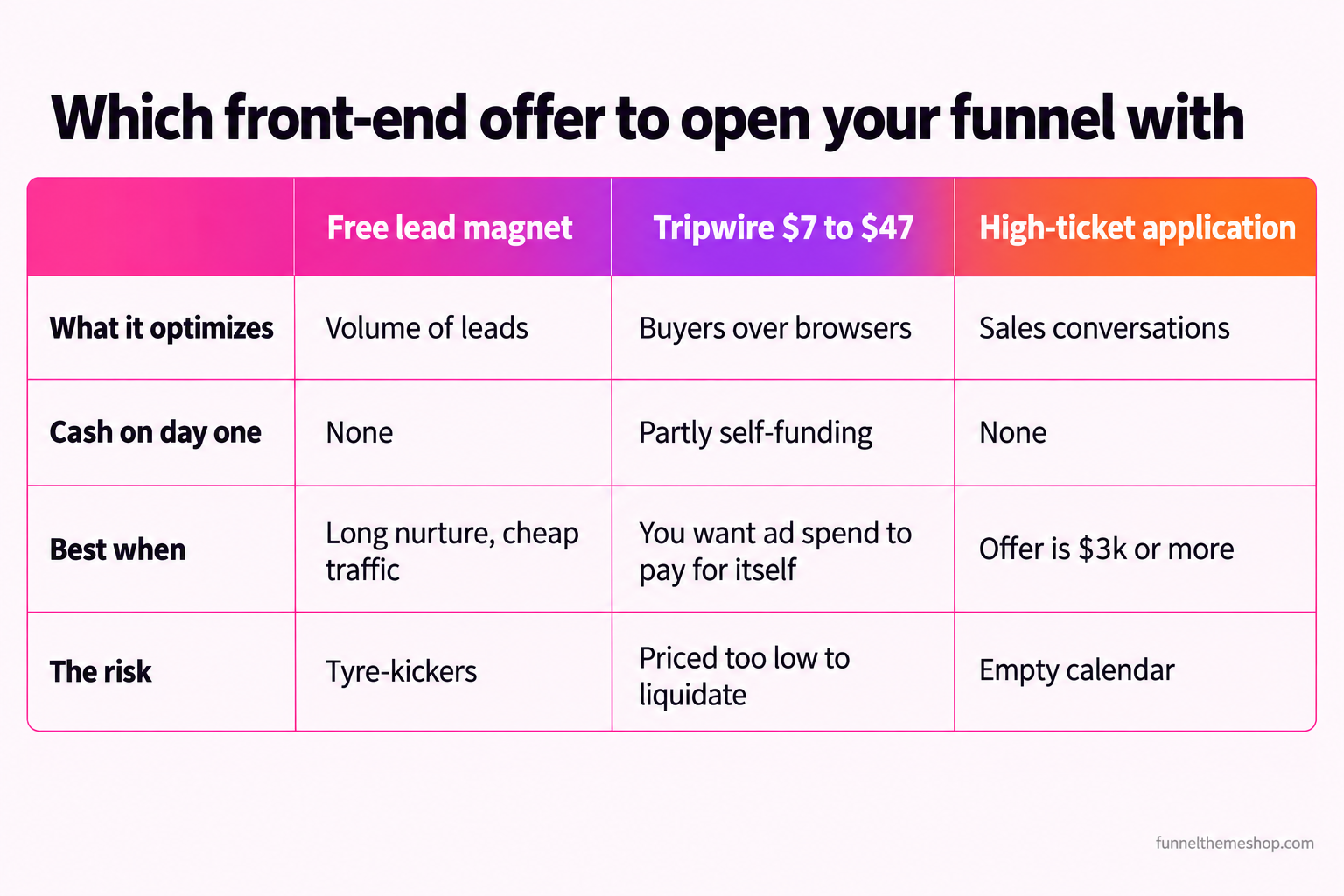
Reach for a tripwire when you want your traffic to fund itself and you have a real offer waiting at the top of the ladder for the buyers it produces. Reach for a free lead magnet instead when your traffic is cheap, your sales cycle is long, and you would rather have volume to nurture than cash on day one. And skip the tripwire entirely when your offer is high-ticket and sold on a call, where a low-ticket front-end just fills your calendar with the wrong people and a straight application funnel does better. If your offer lives in that last column, the high-ticket category is organised around booking conversations rather than taking small payments, and if it lives squarely in the first two, the ecommerce and low-ticket offers category is where the self-liquidating shapes live.
The through-line is that a tripwire is a commercial instrument with a specific job, not a default. It exists to convert cold traffic into buyers at break-even so the buyers are free. If you do not have anything to sell those buyers afterwards, you have built an elaborate way to break even, and a free lead magnet would have got you the same list for less work.
Three objections you are already making
"$27 is too cheap to bother with"
It would be, if $27 were the point. It is not. The $27 is a filter that costs the buyer almost nothing and tells you almost everything: this person will pay you. That single fact changes every number downstream, because a proven buyer converts on the next offer at multiples of what a free lead does. You are not in the business of selling $27 guides. You are in the business of buying qualified buyers at break-even and selling them something real later. The price is deliberately low because a low price is what makes cold traffic cross the line, and cold traffic crossing the line is the entire mechanism.
"I will just sell the high-ticket offer directly"
Sometimes that is right, and the decision table says when: if your offer is genuinely high-ticket and sold on a call, an application funnel usually beats a tripwire, because the low-ticket step just imports the wrong people. But if you have tried selling the big thing to cold traffic and watched the cost per booked call climb past what the deal is worth, the tripwire is doing something the direct route cannot. It lets a stranger buy a small yes first, at a price that does not need a sales call, and it hands you a buyer to make the big offer to when they already trust you. Cold traffic to a high-ticket offer is expensive precisely because you are asking for a large commitment from someone who has never paid you a cent. The tripwire removes that.
"Will a snapshot just do all of this for me?"
Partly, and it is worth being exact about which part. A snapshot built for this shape arrives with the structure already correct: the sales page, the order form with the bump wired to add to the total, the one-time-offer upsell attached to the saved card rather than creating a second charge, and the confirmation follow-up already live rather than sitting in draft. That closes the fourth break above, the technical one, on the day you import, and it hands you take-rate-ready offers slotted into the right pages. What lands in your account is exactly a snapshot share link and a PDF with the full installation instructions, so it is genuinely yours to run. What a snapshot cannot do is invent your economics. It cannot set a front-end price that survives your costs, it cannot choose a bump your particular buyers want, and above all it cannot build the back-end offer that makes the whole exercise worth doing. The structure is the part that is safe to buy. The offer and the ladder above it are still yours to get right, and the arithmetic on this page is how you check them before you spend.
Run the numbers before you run the ads
A tripwire funnel is not a gamble and it is not a growth hack. It is a small, knowable piece of arithmetic: what a buyer costs you, what the average order clears after the bump and the upsell, and whether the gap between those two is positive before you scale. Build the table for your own offer, be honest about your cost per buyer and your take rates, and you will know whether the funnel liquidates before you have spent a serious dollar finding out.
And when the numbers say go, do not let a broken checkout be the thing that sinks a funnel the maths already proved. Wire it once, test it with a real card end to end, and let the bump and the upsell do the work they are there to do.
Frequently asked
What is a tripwire funnel?
A tripwire funnel opens with a low-priced front-end offer, usually between $7 and $47, whose job is to turn cold traffic into buyers rather than to make a profit. It carries an order bump and a one-time-offer upsell to raise the average order, and when the average order covers the cost of acquiring the buyer, the funnel is called self-liquidating: the ads pay for themselves and you build a buyer list for free.
Is a tripwire funnel supposed to lose money on the front-end sale?
Usually yes, and by design. A $27 sale after a Stripe fee of 2.9% plus 30 cents and a small delivery cost leaves about $22.92, which does not cover a $30 cost to acquire that buyer. The front-end is priced low so cold traffic will buy; the order bump and the upsell are what lift the average order above the cost of the buyer and make the funnel break even or better.
How do I calculate whether my tripwire funnel is self-liquidating?
Work out your cost per buyer, which is ad spend divided by front-end buyers, then work out your blended average order value, which is the front-end price plus the bump take rate times the bump price plus the upsell take rate times the upsell price. Subtract your Stripe fees and delivery cost from the average order. If what is left is above your cost per buyer, the funnel self-liquidates.
Why is my tripwire funnel not making money?
Almost always one of four things: the front-end is priced so low the flat processing fee eats it, there is no order bump or upsell so the average order never clears the cost of a buyer, you treat the buyers like free leads and never make them a real back-end offer, or the order form or upsell is technically broken. Check them in that order against your own numbers.
Is a tripwire funnel better than a free lead magnet?
Neither is better in general; they do different jobs. A tripwire produces proven buyers and makes your ad spend pay for itself, which suits offers with a real back end to ascend buyers into. A free lead magnet produces more contacts and suits cheap traffic and a long nurture. Pick the tripwire when you want buyers and cash on day one, and the lead magnet when you want volume to nurture over time.
Related guides
More funnel guides
The Value Ladder Funnel: How to Build One for a Service Business
Most value ladder explanations are drawn for course creators. Here is the version for a business that sends vans out, or books a chair, or takes a case — including the rungs you should not build.
10 min readStrategyThe Offer Stack: How to Build One That Does Not Sound Like a Scam
Stacking has a bad reputation because of the inflated-value tables it is famous for. The underlying mechanic is sound. Here is how to use it without the theatre.
10 min readStrategyOrder Bump vs Upsell: What Goes Where, and Why It Matters
They look like the same idea in two places. They are not. One removes a decision, the other asks for a bigger one, and putting the wrong offer in the wrong slot costs you both.
10 min readFunnel snapshots · done-for-you builds
Pick a funnel, or hand us the offer
Buy the snapshot and it lands within 24 business hours as a share link and an installation PDF, add the $175 install if you would rather not do it yourself, or hand us the offer and we build the whole thing.
All sales final once the snapshot link is sent · free updates for life · one licence covers every sub-account you own