Guides
What is a sales funnel in GoHighLevel?
You opened the funnel builder and hit a blank canvas. Here is the plain version: what a sales funnel is, the five stages, how GoHighLevel assembles one, and which to build first.
You bought GoHighLevel last week. You clicked into Funnels, hit New Funnel, and a blank canvas opened with a single empty step waiting for you. And that was the moment it stopped being obvious. You know what a funnel is supposed to do, roughly, because everyone in this space says the word forty times a day. What nobody actually tells you is what a funnel is as a thing you build, or how it is any different from the website you paid someone to make two years ago.
So this is the plain version. What a sales funnel is, what its stages are, how GoHighLevel assembles one out of pages and pipelines and workflows, what the numbers say it is worth, and the four ways people build something that looks like a funnel and is not. By the end you will know exactly what you are trying to build before you drag a single section onto that empty step. If you want the full operating manual for the tool itself once the concept lands, the GoHighLevel funnel builder guide is the next stop.
What a sales funnel actually is (and what it is not)
A sales funnel is a controlled path. One entrance, one direction, and a single decision to make on every screen. That is the whole idea, and everything else is detail. A visitor arrives, and instead of handing them a menu of twenty things they could do, you give them one thing to do next. Then one more. Then one more, until the only paths left are buy, book, or leave.
Compare that to a website. A website is a building with a lobby and forty doors. The homepage links to About, Services, Blog, Careers, a contact form, three social icons and a login. That is correct for a website, because a website exists to let anyone find anything. A funnel exists to do the opposite. It removes doors on purpose so the one action you care about is the easiest thing on the screen. The difference is not decoration, it is the entire mechanism, and we spelled out when each one is the right build in funnel versus website.
Here is the test that settles it. Count the links a visitor can click on your most important page. If the answer is more than two, and neither of the two is the thing you actually want them to do, you have a website page, not a funnel. A funnel page has one primary action and, at most, one quiet way out.
A website answers every question a visitor might have. A funnel answers one question, at the right moment, and asks for a decision. The skill is knowing which question, and when.
The five stages a lead moves through
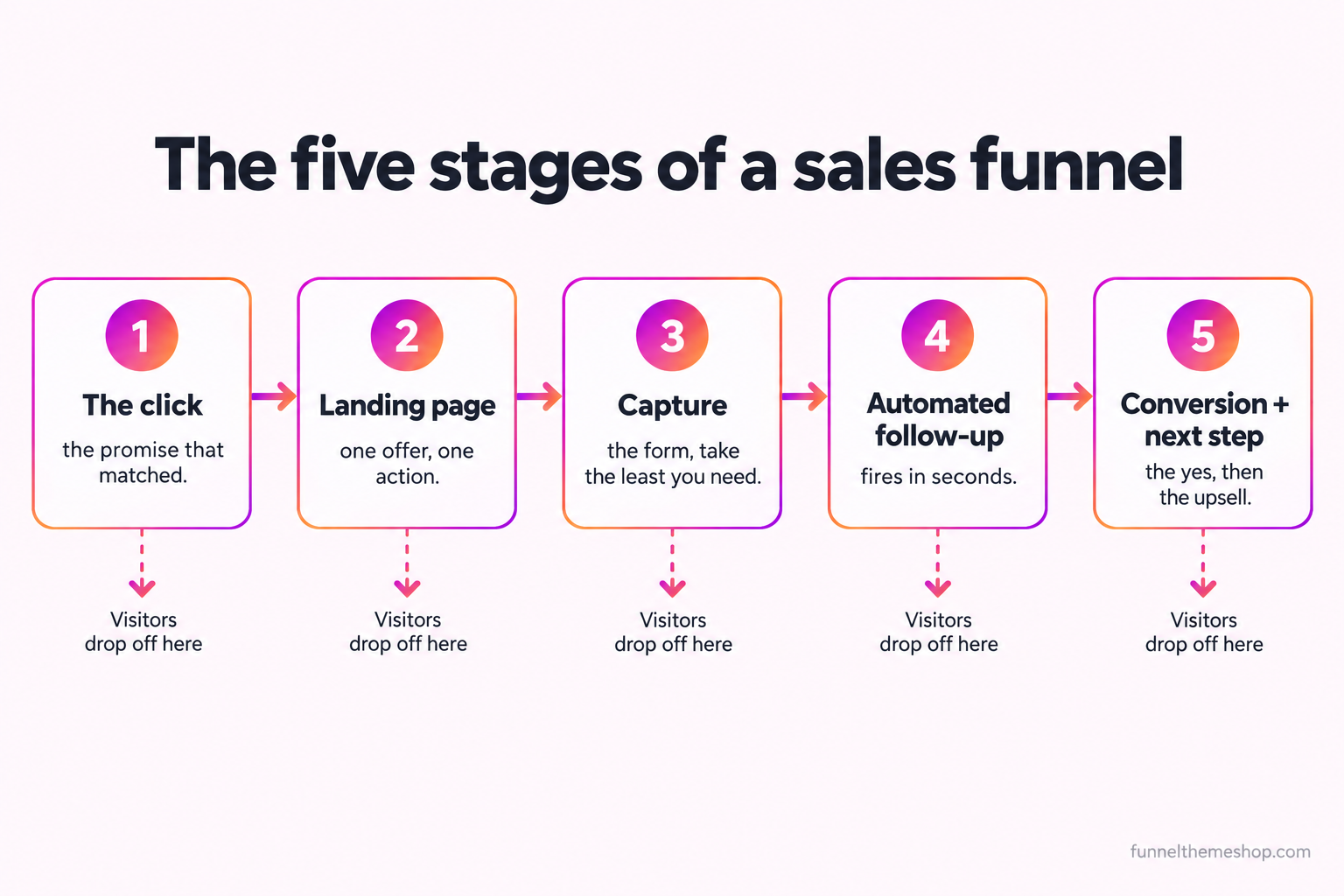
A funnel is a sequence, so it helps to see it as stages rather than pages. Most funnels move a person through five, and each stage has exactly one job. Get the job of each stage right and the pages almost design themselves. Get the sequence wrong and no amount of pretty design saves it.
Stage one: the click and the promise
Every funnel starts with a click from somewhere: an ad, a search result, an email, a link in a bio. The only thing that matters at this stage is that the promise the person clicked on matches the page they land on. If your ad says free roof inspection and the page opens with a paragraph about your company history, you have broken the funnel before the first scroll. This is where most paid traffic is quietly wasted, and it is the cheapest thing on this list to fix.
Stage two: the landing page and the offer
The landing page is where the visitor decides whether to keep going. It carries one offer and one action. Not your services, one offer: the free guide, the quote, the booked call, the discounted first visit. Everything on the page points at that single action, and the copy earns it block by block, which is what the landing page walkthrough lays out top to bottom. The offer itself matters more than the design, and a weak offer is the most common reason a good-looking page does nothing. Choosing that offer is a job of its own, and the lead magnet funnel is the version for when the sale happens later.
Stage three: the capture
Capture is the form, and the form is where the funnel either records the lead or loses it. The rule is take the least you need to take the next step. A booking funnel needs a name, an email and a phone number, not a fourteen-field survey. Every extra field costs you submissions. The moment someone hits submit, they stop being anonymous traffic and become a contact with a name, and that is the hinge the whole funnel turns on.
Stage four: the automated follow-up
This is the stage that separates a funnel from a page, and it is the one beginners skip. The second the form is submitted, the follow-up should fire on its own: a text within seconds, an email with what they asked for, a task for you, a booking confirmation. Speed is not a nicety here, it is the whole game. The Lead Response Management Study out of MIT in 2007, the research behind Harvard Business Review's piece The Short Life of Online Sales Leads (hbr.org/2011/03/the-short-life-of-online-sales-leads), found a lead contacted within five minutes was 21 times more likely to be qualified than one contacted at thirty minutes. A funnel with no automation behind it is a form that emails you eventually. A funnel with automation is a business that answers in seconds while you sleep.
Stage five: the conversion and the next step
The last stage is the decision you built everything for: the purchase, the booked appointment, the signed quote. And then, immediately, the next step. The thank-you page is not a dead end that says thanks, we will be in touch. It is the most valuable page in the funnel, because the person just said yes and is more willing to say yes again than at any other moment. That is where an order bump, an upsell or the next booking lives, and the difference between the first two is worth understanding before you build it, which is what order bump versus upsell is for.
Why GoHighLevel builds a funnel differently from a website builder
Here is the part that is specific to the platform you just opened. In most tools a funnel is a stack of pages and nothing else. The page builder makes pages, and if you want the follow-up, the pipeline and the customer record, you go and buy three more tools and wire them together with duct tape. GoHighLevel folds all of that into one object. When you build a funnel here, you are not just building pages. You are building the pages, the forms, the automation that fires on submit, the pipeline the lead moves along and the contact record it all writes to, in the same account.
That is why a funnel in GoHighLevel is worth more than the sum of its pages. The form on stage three is already wired to the workflow on stage four, which moves the contact into a stage on your pipeline, which shows up on your calendar and in your CRM. Nothing is bolted on later, and nothing falls between two tools that were never meant to talk to each other. Once leads are flowing, conversion tracking is what lets you see which stage is leaking instead of guessing at it.
The numbers: what a funnel is worth versus a page that just sits there
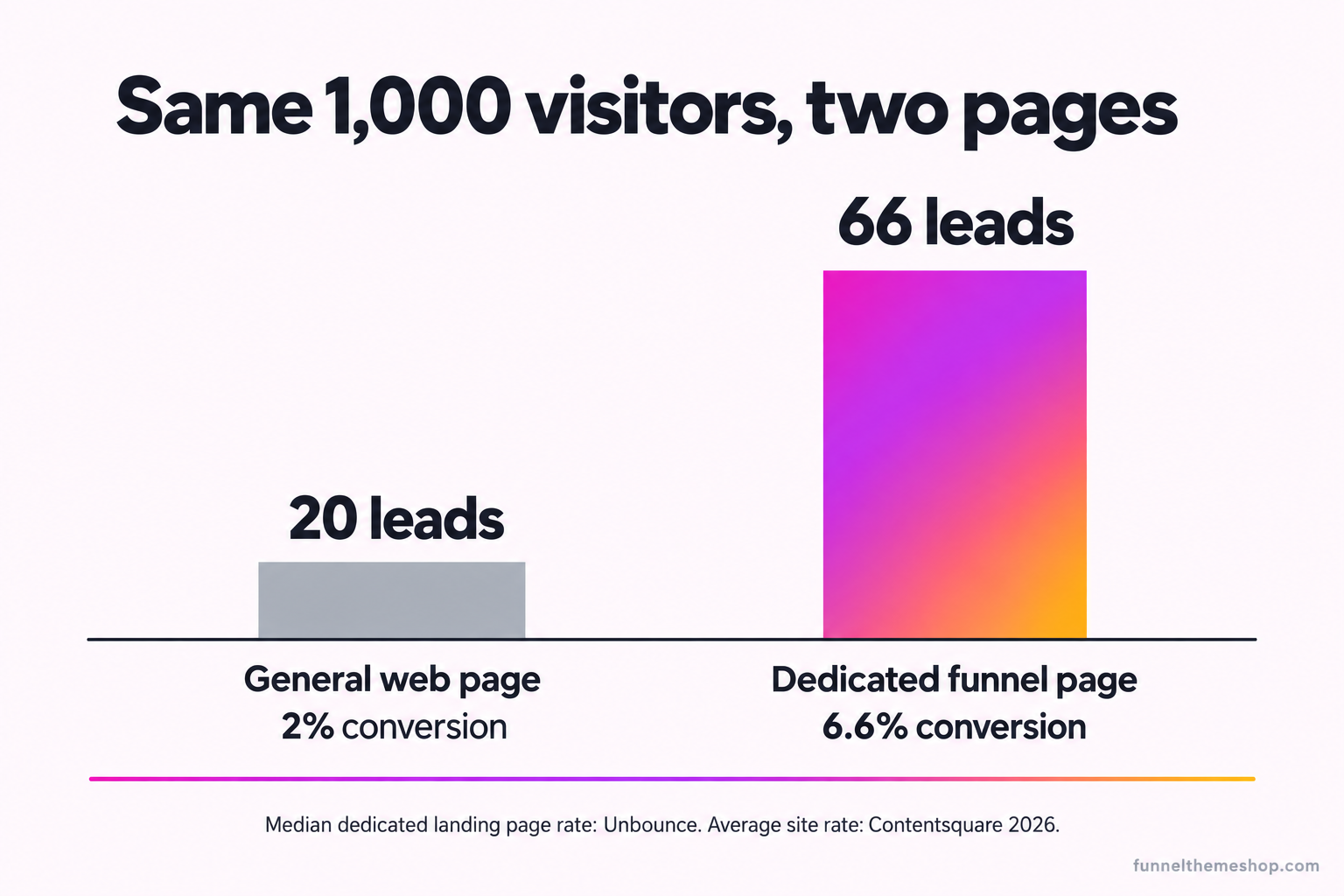
It is fair to ask whether the extra work pays for itself, so here are the numbers with every assumption on the table. Unbounce's Conversion Benchmark Report, built from more than 41,000 landing pages, puts the median dedicated landing page conversion rate at 6.6 percent (unbounce.com/landing-pages/whats-a-good-conversion-rate). A general web page, the kind a homepage or a services page tends to be, sits far lower. Contentsquare's 2026 Digital Experience Benchmark, drawn from 99 billion sessions across more than 6,500 sites, puts the average site conversion rate at 3.4 percent on desktop and around 2 percent on mobile (contentsquare.com/guides/digital-experience-benchmark/conversions).
Put those rates against the same traffic and the gap is the whole argument. Say you send 1,000 visitors to a page this month, and to keep it clean say the traffic is the same quality either way. A general web page converting at 2 percent hands you 20 leads. A dedicated funnel page at the 6.6 percent median hands you 66. Same ad spend, same clicks, more than three times the leads, and the only thing you changed was building a funnel instead of pointing traffic at a page that was designed to do ten jobs at once. These figures are illustrative and your own numbers will differ, but the direction does not: a page built to convert converts, and a page built to inform informs.
The same logic runs all the way to the end of the funnel. Even people who decide to buy leak out at the last step. Across 50 separate studies, the Baymard Institute puts the documented average cart abandonment rate at 70.22 percent (baymard.com/lists/cart-abandonment-rate). That is not a reason to despair, it is the reason the automated follow-up in stage four exists. The funnel that texts the person who abandoned the checkout, or emails the booking they did not finish, recovers a share of that 70 percent that a static page simply waves goodbye to.
Then there is the cost of the funnel itself. Running one in GoHighLevel starts at the platform fee, which is $97 a month on the Starter plan, $297 on Unlimited and $497 on Agency Pro, each with a 14-day trial (gohighlevel.com/pricing). Building the funnel is then either your time or ours. Our snapshots run from $905 for the Salon and Barber system up to $2,105 for the Mortgage system, each one a complete funnel you load into your account, with $175 as an optional installation add-on if you would rather not wire it up yourself. Whether you build it or buy it, the funnel is a one-time cost sitting against a lead flow that runs every month after.
Four ways people build something that looks like a funnel but is not
Most funnels that fail are not built badly. They are built as something other than a funnel, by someone who was sure they were building one. Here are the four that account for nearly all of it, each with the symptom you will notice, the cause underneath it, and the fix.
One: the page has too many exits
Symptom: healthy traffic, almost no conversions, and a bounce rate that looks like a website's. Cause: you kept the full navigation menu at the top of the funnel page, so every visitor has a one-click escape to your blog, your About page and your social profiles before they ever reach the offer. Fix: strip the menu off funnel pages. A funnel page has your logo, the offer, the action, and nothing in the header that leads away. This single change is the most common reason a rebuilt page suddenly converts.
Two: there is no automation behind the form
Symptom: leads come in, but they go cold, and by the time you call them they have booked with someone else. Cause: the form saves the contact and does nothing else, so the follow-up depends on you happening to notice. Fix: build the workflow before you send a drop of traffic. At minimum, an instant text and email to the lead and an instant task or notification to you. Remember the 21 times figure from stage four. The speed is not optional, it is the reason a funnel beats a contact form at all.
Three: the thank-you page does nothing
Symptom: decent conversion into the funnel, then no repeat purchases, no upsells and no reviews. Cause: the thank-you page says thanks and stops, wasting the one moment the customer is most willing to say yes again. Fix: give the thank-you page a job. Ask for the next booking, offer the bump, request the review, or at the very least set the expectation for what happens next and when. It is the cheapest revenue in the whole funnel and almost nobody claims it.
Four: it is one page pretending to be a funnel
Symptom: you have a nice landing page, you call it a funnel, and nothing downstream of it exists. Cause: a funnel is a sequence, and a single page is stage two of five. Without capture wired to follow-up wired to a pipeline stage, there is no funnel, there is a page with a form on it. Fix: build the whole path, even a short one. The shortest real funnel is still a landing page, the capture, an automated follow-up and a next step. If any of those is missing, you have not finished building.
Which funnel to build first
Once you accept that you are building a sequence, the next question is which sequence, and the answer is decided by the offer, not by taste. There are a handful of funnel shapes and each one fits a kind of offer. Pick the shape that matches what you sell and the pages fall into place. The full breakdown of the shapes is in high-converting funnel structure; this is the short version to get you moving.
| Your offer | The funnel to build | Pick this if |
|---|---|---|
| A free guide or checklist | Two-step lead capture | You need contact details and the sale happens later, in nurture |
| A booked call or appointment | Three-step booking funnel | Your sale needs a conversation and a calendar, like most local services |
| A low-priced product or first visit | Direct-response offer with a bump | Someone can buy in one sitting without talking to you first |
| A high-ticket service or program | Application funnel | You want to screen leads before you spend real time on a call |
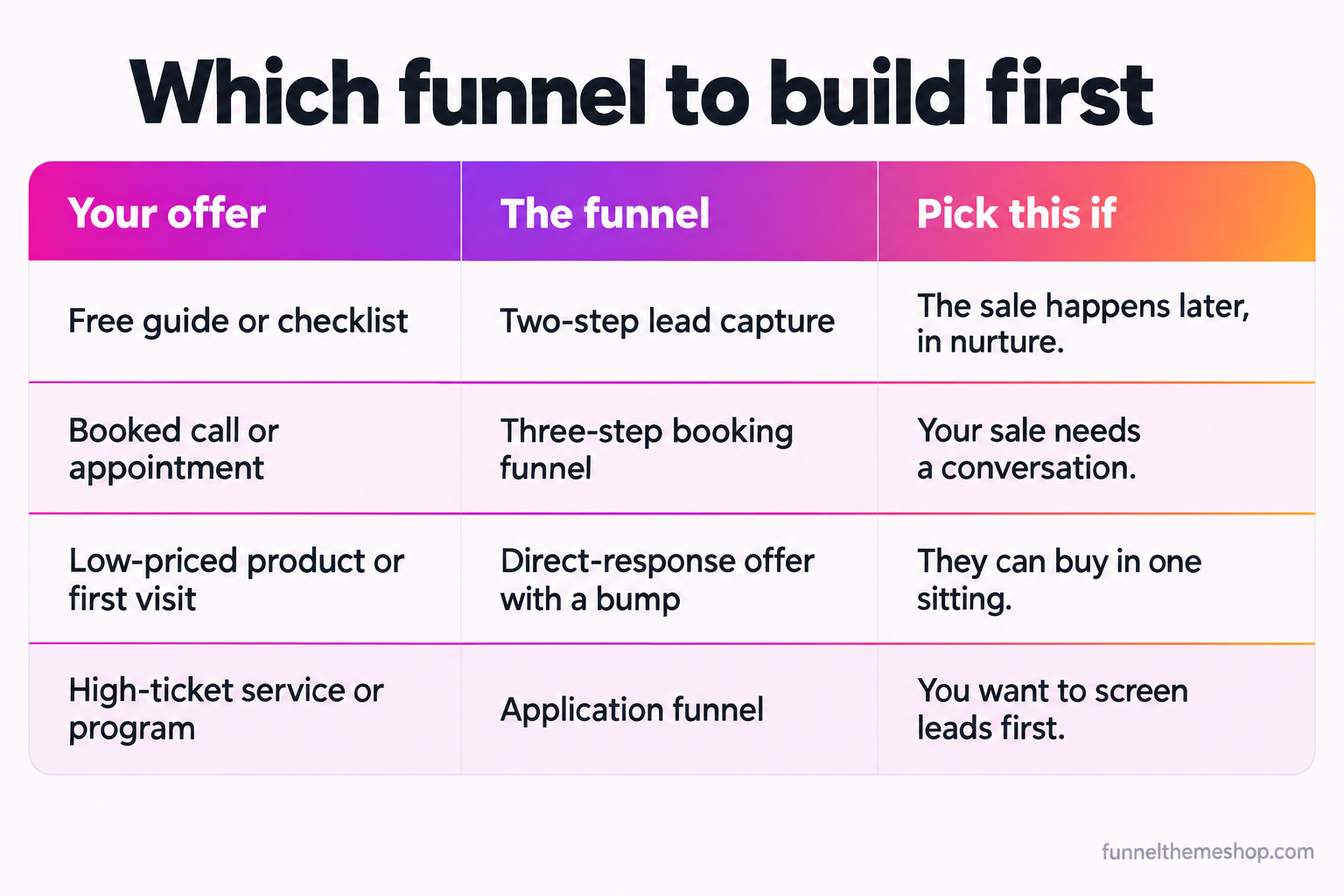
If you are a local service business, the booking funnel is almost always the first one to build, because your sale needs a conversation. If you sell something a person can buy on the spot, the direct-response shape earns its keep faster. And if your time is expensive, the application funnel protects it by qualifying people before they reach your calendar. Start with the one that matches your main offer, get it live, and add the others later. You can browse ready-built systems by the offer you run over on the lead generation category.
The three objections you are already making
I already have a website, so why do I need a funnel
Because they do different jobs, and one cannot do the other's. Your website is where people check that you are real: it ranks, it answers questions, it hosts your blog and your credentials. A funnel is where a specific campaign converts a specific offer. Keep the website. Point your ads and your promotions at a funnel. They work together, and if you are still deciding which to invest in first, funnel versus website makes the call by situation rather than by rule of thumb.
Isn't this just a landing page with extra steps
A landing page is one stage of a funnel, the second one. The extra steps are the entire point. The capture, the automation and the next step are what turn a visitor into a contact and a contact into a customer, and they are exactly the parts a standalone landing page leaves out. If all you ever build is the page, you have built the shop window and forgotten the shop behind it.
Can I not just build it myself
Often, yes, and you should if you have the time and one straightforward offer. The builder is learnable, the pillar guide walks the whole thing, and a single lead-capture funnel is a genuinely doable weekend project. Where people come to us is the second or third funnel, or the one that has to be live this week, or the version that needs the copy written for a specific trade and tested end to end. If you are running one simple offer and you enjoy the tinkering, build it yourself. If the funnel is the thing standing between you and booked revenue, buying a proven one is usually cheaper than the month you would spend learning. Our snapshots are complete systems you load and rebrand, and what a snapshot actually is sets out exactly what does and does not come in the box.
Where to start
So before you drag a single section onto that empty step, you know what you are building: a controlled path, five stages, one decision per screen, with the follow-up and the pipeline wired in because you are building it in GoHighLevel and not in four separate tools. Pick the shape that matches your offer, build the shortest real version first, wire the automation before you send traffic, and give the thank-you page a job. That is a funnel. Everything after it is refinement.
Frequently asked
What is a sales funnel in GoHighLevel, in one sentence?
It is a controlled path built inside GoHighLevel that moves a visitor through a short sequence of stages, from the landing page and offer through capture, automated follow-up and a next step, with the pages, the workflow, the pipeline and the contact record all living in the same account rather than in four separate tools.
How is a sales funnel different from a website?
A website has many pages and many exits so that anyone can find anything. A funnel removes the exits so a visitor has one clear action per screen. Keep the website for being found and answering questions; use a funnel to convert a specific offer from a specific campaign.
How many stages does a sales funnel have?
Most funnels move a lead through five stages: the click and its promise, the landing page and offer, the capture, the automated follow-up, and the conversion with its next step. A short funnel can compress them, but if the capture, the follow-up or the next step is missing, what you have is a page, not a funnel.
Do I have to pay for GoHighLevel to run a funnel?
Yes. A funnel built in GoHighLevel runs on a GoHighLevel account, which starts at $97 a month on the Starter plan and includes a 14-day trial (gohighlevel.com/pricing). The funnel itself is either your time to build or a one-time cost to buy; the platform fee is the recurring part.
Can I turn my existing website into a funnel?
Not directly, and usually you should not. Leave the website doing its job and build a separate funnel for the offer you are promoting. In GoHighLevel that means a new funnel with its own pages, form, workflow and pipeline stage, pointed at your campaign traffic.
Related guides
More funnel guides
The GoHighLevel Funnel Builder: A Complete Working Guide (2026)
The builder is the easy half. This is the whole thing: what a step is, what the box model forces on you, where the money mechanics live, and the eleven decisions to make before you drag a single element.
14 min readStrategyHigh-Converting Funnel Structure: The Four Shapes That Cover Everything
A funnel is not a set of pages. It is a sequence of state changes, and only a short handful of sequences matter for a service business. Here is how to tell which one your offer needs.
11 min readStrategyGoHighLevel Funnel vs Website: Which One Should You Build First?
A funnel and a website answer different questions. Building the wrong one first is the most expensive month a new business can spend.
7 min readFunnel snapshots · done-for-you builds
Pick a funnel, or hand us the offer
Buy the snapshot and it lands within 24 business hours as a share link and an installation PDF, add the $175 install if you would rather not do it yourself, or hand us the offer and we build the whole thing.
All sales final once the snapshot link is sent · free updates for life · one licence covers every sub-account you own