Guides
A2P 10DLC for GoHighLevel funnels, without the guesswork
The form works. The lead arrives. The confirmation email lands. The text that was supposed to book the appointment never shows up, and nobody gets an error. This is almost always A2P 10DLC, and it is fixable.
Here is a Tuesday afternoon that happens every week. A dentist turns on a new booking funnel, runs one ad, and a real patient fills in the form within the hour. The confirmation email arrives. The owner is delighted. The appointment-reminder text that the workflow is supposed to send, the one that was going to cut no-shows, never lands. The owner opens the workflow, sees it published, sees it ran, sees a green tick next to the SMS action, and cannot work out why the phone stayed silent. Nothing is broken in the funnel. The number was never registered for A2P 10DLC, so the carrier swallowed the message before it reached the patient.
This is the single most common reason a GoHighLevel funnel captures leads and then goes quiet, and it has nothing to do with the funnel itself. It is a registration job you do once, on the sending side, before traffic arrives. This guide walks the whole of it: what A2P 10DLC is, the three layers you register in order, what it actually costs, the consent rules that sit on top, and the five ways it quietly fails. None of this is legal advice. It is how the plumbing works, so you can get a real lawyer to sign off your wording and then make sure the funnel captures it.
What A2P 10DLC actually is
A2P stands for application-to-person: a message sent by software rather than typed by a human on a handset. 10DLC means a 10-digit long code, which is the ordinary local phone number your GoHighLevel sub-account sends from. Put them together and A2P 10DLC is the framework the US mobile carriers use to decide whether automated texts from a normal business number get delivered or filtered.
Since 2023 the carriers have required every business sending automated texts from a 10-digit number to register, through a central clearinghouse called The Campaign Registry. Unregistered traffic does not bounce with a loud error. It gets throttled to a trickle or dropped entirely, and the sending platform often still reports the send as successful. That gap between "sent" and "delivered" is exactly why the dentist above spent an afternoon debugging a workflow that was working perfectly.
The important mental shift is this: A2P 10DLC is not a GoHighLevel feature you toggle on. It is a carrier requirement that GoHighLevel helps you satisfy. The funnel builds the sequence; registration is what gives that sequence a working phone line to send down. If you want the wider build order that this sits inside, it is laid out in the GoHighLevel funnel builder guide.
The three layers, registered in this order
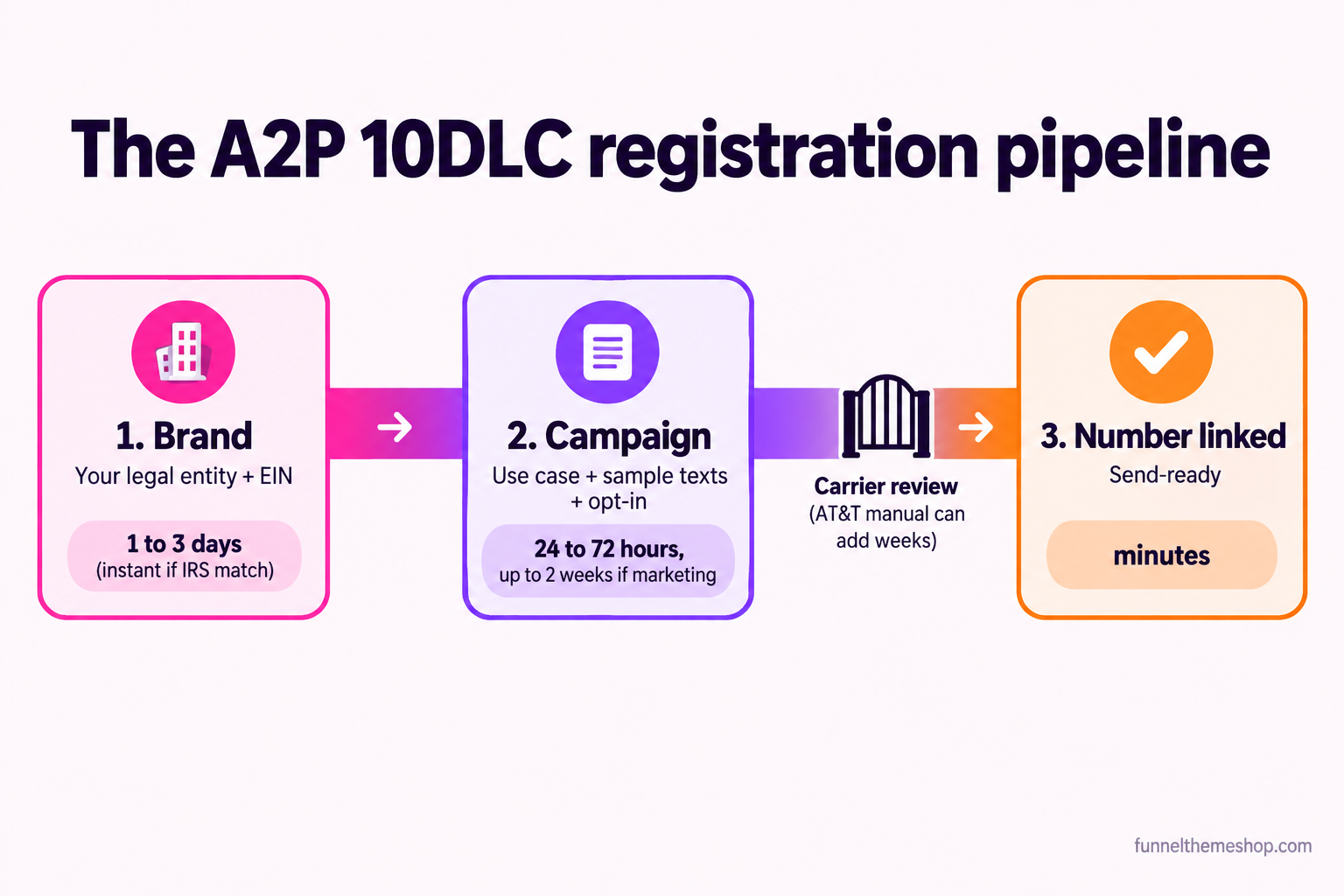
Registration is not one form. It is three linked records, and they have to be created in sequence because each one depends on the one before it. In GoHighLevel you do all three through the Trust Center under the sub-account settings, but it helps to understand what each layer is actually proving.
Layer one: the brand
The brand is your legal business entity. You submit the registered company name, address and EIN, and the registry checks it against public records. If the details match what the IRS holds, brand approval is often instant; if they do not, a human reviews it and that can take a few days. The commonest cause of delay here is a mismatch nobody expects, like a trading name on the form that does not match the entity name on the EIN.
Layer two: the campaign
The campaign describes what you are going to text people about. You declare a use case (appointment reminders, account notifications, marketing, mixed), you provide sample messages, and critically you describe how people opt in. This is the stage that stretches. A clean, clearly described campaign can clear in a day or two; a marketing or mixed use case, or one with a vague opt-in description, gets routed to manual carrier review, and AT&T in particular can take weeks. Every rejection sends you back to the start of this clock.
Layer three: the number
Once the campaign is approved you link your sending number to it. This part takes minutes. The number is now send-ready, and the automated texts your funnel fires will actually arrive. Skip or stall on either of the first two layers and this third one has nothing to attach to, which is the state most silent funnels are stuck in.
The practical read on the whole pipeline: a business with a tidy EIN and an honest, well-written opt-in description is usually fully live in about five to seven business days. A business that treats the campaign form as an afterthought can spend a month bouncing off manual review. The form is not a formality, and that is the single biggest lever you control.
What it costs, with the arithmetic
The fees are small, fixed, and passed straight through from The Campaign Registry and the carriers with no GoHighLevel markup. People over-estimate this cost wildly, usually because they have heard a horror story about damages and conflated the two. Here are the numbers HighLevel publishes on its own support portal, confirmed there in October 2026.
| Item | When | Amount |
|---|---|---|
| Brand + campaign + fast-track (sole proprietor / low volume) | One-time | $22.50 |
| Brand + campaign + fast-track (high volume standard) | One-time | $64.00 |
| Each additional campaign (vetting) | One-time | $15.00 |
| Monthly campaign fee (low volume mixed) | Monthly | $1.50 |
| Monthly campaign fee (standard use cases) | Monthly | $10.00 |
| Per-message carrier fees | Per send | Passthrough, fractions of a cent |
Run the first-year maths on a standard local-service business and it is almost nothing. Call it $22.50 to register, plus a $10 monthly campaign fee, which is $142.50 across twelve months before the per-message pennies. A sole proprietor on the starter tier pays even less, around $2 a month. Source for every figure here is the HighLevel support article on A2P 10DLC messaging fees, read in October 2026.
There is one genuine gotcha for agencies, and it is a structural one rather than a surprise fee. Registration is per legal entity and per sub-account, so an agency running funnels for ten separate clients registers ten brands and ten campaigns and pays that fixed stack ten times, not once. That is not a bug in the pricing; a brand is tied to a real business and its EIN, and ten clients are ten businesses. Budget for it per client rather than treating it as an agency-level overhead you can absorb.
Consent is the part registration does not cover
This is where most people stop reading and get it wrong. Passing A2P 10DLC registration gets the carriers to deliver your texts. It does nothing to prove the recipient agreed to receive them. Those are two separate obligations, enforced by two different parties, and clearing the first does not touch the second. The carriers can be perfectly happy to deliver a message that a court will later find was sent without consent.
Consent is governed in the US mainly by the TCPA, the Telephone Consumer Protection Act. It sets statutory damages at $500 per message for an ordinary violation, rising to $1,500 per message where the violation is willful or knowing, and there is no aggregate cap. Each message counts as its own violation. Those figures sit in the statute itself, 47 U.S.C. section 227, and were confirmed against current legal summaries (ActiveProspect and Plura) in October 2026.
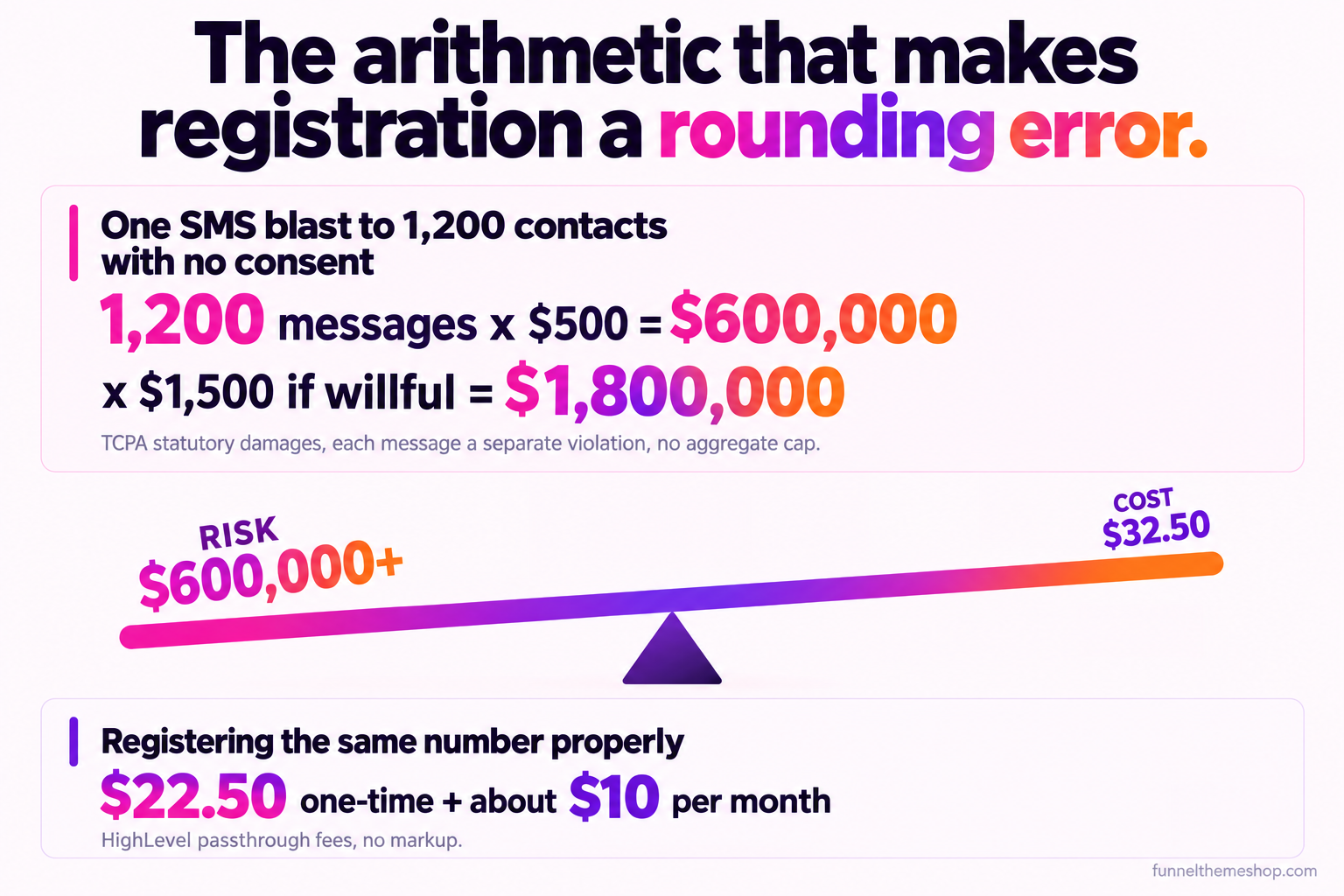
The arithmetic is what makes the point. One well-meant promotional blast to a list of 1,200 people who never explicitly agreed to texts is 1,200 separate violations. At the standard rate that is a theoretical $600,000 of exposure, and at the willful rate $1,800,000. The assumption on the table is deliberately modest: a 1,200-contact list is small for a business that has been collecting leads for a year. Set that against the $22.50 it costs to register the number properly and the decision writes itself.
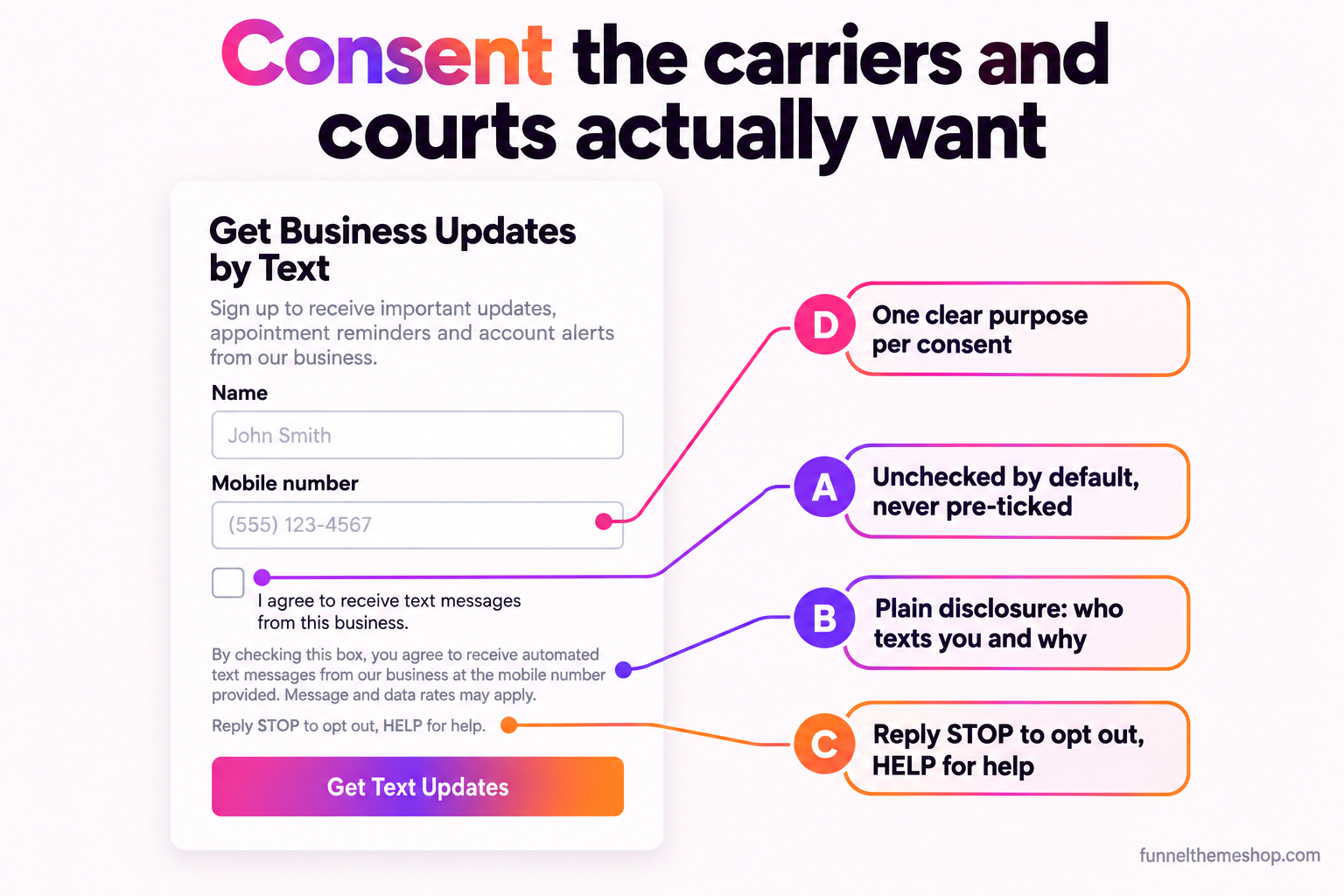
What consent looks like in practice, at the funnel form, is specific and un-clever. An unchecked checkbox the visitor ticks themselves, never a pre-ticked one. A plain disclosure next to it naming who will text them and why. The standard "Reply STOP to opt out, HELP for help" language. And one clear purpose per consent, so an appointment reminder opt-in is not quietly treated as permission to send Black Friday offers later.
Email has its own version of all this and it is worth saying plainly because people assume email is the safe channel. The CAN-SPAM Act requires a real physical address and a working unsubscribe in every marketing email. Separately, your deliverability depends on authenticating the sending domain with SPF, DKIM and DMARC records, and Google and Yahoo now effectively require them for anyone sending at volume. A funnel that fires beautiful emails from an unauthenticated domain is a funnel talking to the spam folder. Getting the form itself right first is covered in high-converting landing page anatomy.
The five ways it quietly breaks
Almost every compliance problem in a GoHighLevel funnel is one of these five. Each has a symptom you can see, a cause you usually cannot, and a fix.
1. Texts send in the workflow but never arrive
Symptom: the workflow runs, the SMS action shows as completed, the recipient gets nothing. Cause: the campaign is not approved yet, or the sending number was never linked to an approved campaign. The platform marks the message handed off even though the carrier dropped it. Fix: check the Trust Center shows the campaign as approved and the number as linked, and send a test to your own phone from the live sub-account before you trust a single report.
2. Delivery is fine for a week, then collapses
Symptom: texts land at first, then the delivery rate falls off a cliff. Cause: carriers watch opt-out and complaint rates, and a campaign that looks more promotional than its declared use case, or that spikes a lot of STOP replies, gets throttled. Fix: match your actual sends to the use case you registered, slow down the cadence, and treat a rising opt-out rate as the early warning it is rather than noise.
3. The whole list turns out to be non-compliant
Symptom: you cannot honestly say how any given contact agreed to be texted. Cause: the opt-in was never captured at the form, or it was captured with a pre-ticked box or no disclosure, which does not count. Fix: fix the form first so new contacts are clean, then segment the old list and re-permission it with a single clearly worded opt-in message rather than assuming consent you cannot evidence.
4. Emails go straight to spam
Symptom: open rates are a fraction of what they should be and replies dry up. Cause: the sending domain has no SPF, DKIM or DMARC records, or you are sending from a generic shared subdomain that other senders have already burned. Fix: authenticate your own domain, warm it up gradually, and never send cold volume from a domain you also use for important one-to-one mail. If the funnel is otherwise sound, this is usually the hidden culprit behind "the funnel gets traffic but nothing converts", which this breakdown of traffic with no opt-ins picks apart in more detail.
5. An agency registers once and shares a number across clients
Symptom: one client complains, and suddenly every client on that number has delivery problems. Cause: brands and campaigns are per legal entity, so stacking several clients behind one registration means one client's behaviour, and one client's complaints, affect them all. Fix: register each client as its own brand with its own number, as the model requires. It is more admin and it is the only version that is both compliant and resilient. Where a build keeps breaking in ways you cannot place, a structured snapshot troubleshooting pass is faster than guessing.
DIY, done-for-you, or rescue: which path fits
There are only really three ways through this, and the right one depends on how much of your own time an afternoon of carrier paperwork is worth and whether anything is already on fire.
| Path | Pick this if | Roughly |
|---|---|---|
| Register it yourself | You have your EIN handy, one business, and an hour to write a clean opt-in description | Your time + the passthrough fees above |
| Our installation add-on | You are buying a snapshot and want the registration and sending setup done with it | The $175 install add-on |
| Snapshot install and customisation | You want the funnel imported, rebranded, the copy rewritten and the sending set up end to end | The $397 service |
| Rescue audit | Texts or emails are already failing and you need the break found fast | The funnel rescue audit |
If you are technically comfortable and patient, doing it yourself is genuinely fine; the fees are trivial and the only real skill is writing an honest campaign description that does not trip manual review. If you would rather hand it over, the snapshot install and customisation service covers the registration as part of a full setup, and the lighter $175 installation add-on handles the A2P 10DLC registration and the sending setup when you just want the snapshot put live correctly. Either way the registration belongs to you and your EIN at the end, not to us.
Three things you are probably already arguing back
Objection one: "I only send email, so none of this applies to me." Half right. A2P 10DLC is specifically about SMS, so if you genuinely never text, you can skip the registration. You do not skip CAN-SPAM, the physical address, the working unsubscribe, or domain authentication, and in practice almost every service funnel that works well texts as well as emails, because the appointment reminder is the single highest-impact message in the sequence. Opting out of SMS entirely usually means opting out of your best no-show recovery, which the system is built to target around seventy percent recovery when it is allowed to run.
Objection two: "I will register later, once the leads actually start coming in." This is the expensive one, because the registration delay and the lead flow collide. Your campaign can sit in carrier review for one to two weeks, and that review does not start until you file it. Launch the ads first and the leads arriving during that window get an email and silence where the booking text should be, which is precisely the conversions you paid for walking out the door. Register during the build, not after the launch.
Objection three: "The snapshot includes all this, so buying it covers me." Here is the honest answer, and it is the one that matters most. A snapshot ships the funnel, the workflows and consent-ready form fields, so the machine is built and the opt-in box is already there to be ticked. It cannot register your brand, because registration is tied to your legal entity and your EIN, which only you hold. Buying the snapshot alone does not file anything with a carrier. That is exactly the gap the $175 installation add-on closes, and it is why we say so on the product pages rather than letting a buyer discover it on their silent Tuesday. The product is a funnel, not a shortcut around the carriers.
A pre-launch compliance checklist
Run this before a single ad goes live. It is the order the failures above would otherwise find you in.
- Brand registered with a business name that matches your EIN exactly, so it clears on the first pass.
- Campaign filed with an honest use case and a clearly described opt-in, and approved, not just submitted.
- Your sending number linked to the approved campaign, and a test text confirmed on your own phone from the live sub-account.
- The funnel form carries an unchecked consent box, a plain disclosure, and STOP and HELP language.
- One consent per purpose, so a reminder opt-in is never reused as marketing permission.
- Sending domain authenticated with SPF, DKIM and DMARC, and warmed up rather than blasted cold.
- A real physical address and a working unsubscribe in every marketing email.
- The whole thing tested end to end with a real lead before any paid traffic reaches it.
Get those eight right and the funnel does what it was built to do: capture the lead, confirm by email, and land the reminder text that turns a form fill into a booked appointment. This matters most in trades where the reminder carries the revenue.
That is why the dental funnel snapshot and the booking-led builds across the local-service catalogue ship with the consent fields and the reminder sequence already wired, so the only thing left between you and a sending number is the registration itself.
Regulated trades carry the same discipline for the same reason, which is why the legal funnel snapshot and the finance-facing builds treat consent capture as part of the funnel rather than a bolt-on.
The full catalogue, sorted by the offer you run rather than by industry, sits in the local service category, and every build in it is written to be registered under your own brand before it sends a thing.
And when the numbers finally do flow, read them against your own baseline rather than a published average, the same way GoHighLevel conversion tracking sets it out, because a delivery rate only means something next to your own last week.
Frequently asked
Does GoHighLevel require A2P 10DLC registration?
GoHighLevel does not require it; the US mobile carriers do. Any business sending automated texts from a 10-digit number has to register the brand and campaign through The Campaign Registry, and GoHighLevel provides the Trust Center where you file it. Unregistered automated SMS is filtered or dropped by the carriers, often while the platform still reports the message as sent.
Why are my GoHighLevel texts not sending even though the workflow is published?
The most common cause is that the A2P 10DLC campaign is not approved yet, or the sending number was never linked to an approved campaign. The workflow runs and the SMS action shows as completed, but the carrier drops the message before delivery. Check the Trust Center shows the campaign approved and the number linked, then send a test to your own phone from the live sub-account.
How long does A2P 10DLC approval take?
A business with an EIN that matches public records is usually fully live in about five to seven business days. Brand registration can be instant, campaign vetting runs from 24 to 72 hours for a clean use case, and marketing-flavoured or vague campaigns can stretch to two weeks or more, with AT&T manual review adding further time. Each rejection restarts the clock, so a well-written campaign description is the biggest lever you control.
How much does A2P 10DLC cost in GoHighLevel?
The fees are passthrough with no GoHighLevel markup. HighLevel lists a one-time bundle of about $22.50 for a sole proprietor or low-volume brand and $64 for high-volume standard, each extra campaign at $15, and a monthly campaign fee from $1.50 to $10 depending on use case, plus small per-message carrier fees. A standard local-service business pays roughly $142.50 in its first year before the per-message pennies.
Does buying a snapshot register my number for A2P 10DLC?
No. A snapshot ships the funnel, the workflows and consent-ready form fields, but registration is tied to your legal entity and EIN, which only you hold, so it cannot be done inside a shared snapshot. You either register it yourself through the Trust Center or take the $175 installation add-on, which handles the A2P 10DLC registration and the sending setup as part of putting the snapshot live.
Related guides
More funnel guides
GoHighLevel Conversion Tracking: Pixels, GA4, UTMs and Attribution
The funnel tells you where people dropped out. It does not tell you which ad paid for them. Closing that gap is a specific piece of plumbing, and most GHL accounts do not have it.
12 min readTroubleshootingGoHighLevel Snapshot Not Working? 11 Fixes That Cover 90% of Cases
Almost every "the snapshot is broken" ticket we receive is one of eleven things, and nine of them take under five minutes to fix.
8 min readGuidesThe GoHighLevel Funnel Builder: A Complete Working Guide (2026)
The builder is the easy half. This is the whole thing: what a step is, what the box model forces on you, where the money mechanics live, and the eleven decisions to make before you drag a single element.
14 min readFunnel snapshots · done-for-you builds
Pick a funnel, or hand us the offer
Buy the snapshot and it lands within 24 business hours as a share link and an installation PDF, add the $175 install if you would rather not do it yourself, or hand us the offer and we build the whole thing.
All sales final once the snapshot link is sent · free updates for life · one licence covers every sub-account you own