Strategy
The high-ticket application funnel: filter before you book the call
A calendar full of unqualified calls is not a win, it is a tax on your week. An application funnel puts the filter before the booking, not after it.
It is Tuesday, and a business coach opens her calendar to eleven booked discovery calls for the week. By Friday she has spoken to six of them. Two could not afford the programme and said so in the first four minutes. Three wanted free advice and had no intention of buying anything. One was a genuine fit who booked a second call. So eleven slots, each an hour of her most expensive time, produced one real conversation. The funnel did its job. It booked calls. The problem is that booking calls was the wrong job.
This is the failure mode of a high-ticket offer sold through a plain opt-in. You optimised the page to get the most bookings, so you got the most bookings, and most of them were people who would never pay $3,000. The fix is not a better closing script or a longer nurture sequence. It is moving the filter. An application funnel asks the qualifying questions before the call is booked instead of discovering the answers during it, and that one change is the difference between a calendar that drains you and one that pays you.
What an application funnel actually is
An application funnel is a sequence where the prospect earns the call. Instead of a two-field form that hands over a calendar the moment someone types an email, the prospect answers a short set of questions about their situation, their budget and their readiness, and only applicants who clear the bar see the booking page. Everyone else gets a polite off-ramp. The funnel is deliberately harder to get through, and that is the point: friction here is a feature, because it moves the unqualified prospect out of your calendar and into an email sequence where they cost you nothing.
This sits at the opposite end of the spectrum from the high-converting landing page you would build for a lead magnet or a low-ticket offer, where every extra field is a leak to be sealed. Both are correct funnels. They just answer to different numbers. A lead magnet is scored on volume. An application funnel is scored on the quality of the calls it books, and it will happily throw away three quarters of its traffic to raise that quality. If you want the wider map of where each funnel type belongs before you commit to one, the GoHighLevel funnel builder guide lays out the full set and when each one earns its place.
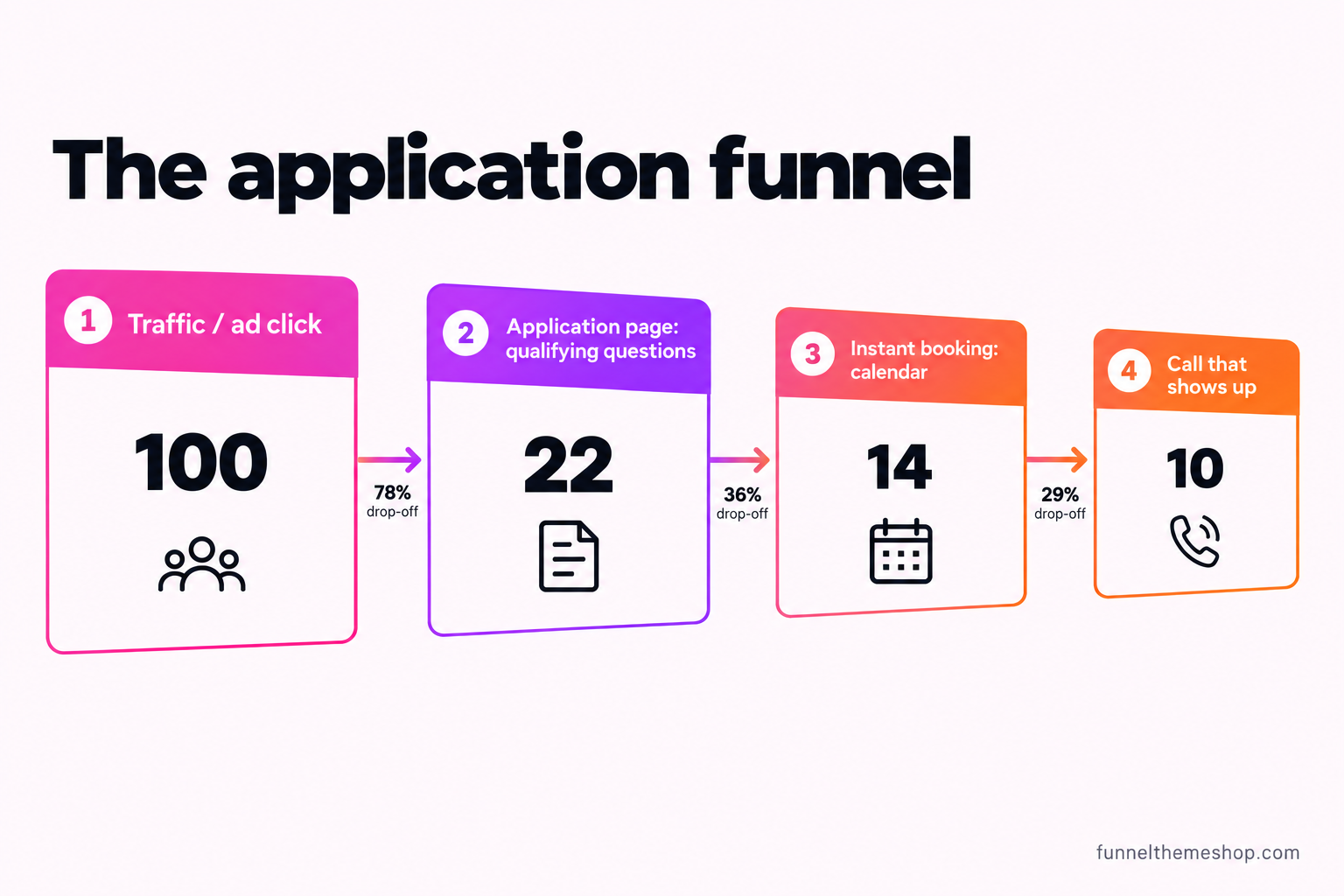
The four pages, built in order
An application funnel is four pages doing four distinct jobs. Build them in this order, because each one assumes the one before it did its work. Skip the order and you get the usual mess: a booking calendar with no qualifying in front of it, or a thank-you page that just says thanks and lets a hot prospect cool for three days.
1. The application page: the offer above the form
The application page has to do two contradictory things at once. It has to make the offer desirable enough that a qualified person wants it badly, and it has to make the form itself a small test of commitment. The copy above the form does the first job. It names who the programme is for, the specific result it produces and, crucially, who it is not for. Telling the wrong prospect to leave is the single most under-used line on an application page. A coach who writes "this is not for people looking for their first client, it is for people at $8k a month who want to reach $25k" has just saved themselves a week of calls.
The form underneath carries the qualifying questions, and the number of them is a real decision rather than a default. Too few and you are back to a glorified opt-in that filters nothing. Too many and you lose the qualified applicant along with the tyre-kicker. Six to eight questions is the working range for most high-ticket offers. Ask the current state (revenue, team size, stage), the desired state, the obstacle in between, a budget or timeline question phrased as a range rather than a raw number, and one open text box that reveals how seriously they took the application. The open box is the cheapest qualifier you have: a one-word answer and a three-sentence answer tell you more about readiness than any dropdown.
2. The instant-booking page: never "we will be in touch"
This is where most application funnels quietly die. The prospect finishes the form, hits submit, and sees "thanks, we will review your application and get back to you." That sentence has just taken your hottest moment, the thirty seconds after someone decided to raise their hand, and spent it on nothing. A qualified applicant should land straight on a calendar. The review, if you do one, happens in the background through conditional logic, not as a human bottleneck that makes a ready buyer wait.
The mechanism in GoHighLevel is a conditional redirect. The form scores the answers, and the thank-you step routes the applicant by that score: clears the bar, go to the calendar; falls short, go to a softer page with a lower-commitment next step such as a resource or a group offer. The booking page itself should show real availability inside the next two or three days, because a call booked for next Thursday is a call half of those people will not show up for. Speed is not a nicety here, it is the whole economic argument, and the data backs it hard.
3. The confirmation and reminder sequence
A booked call is a promise, and promises made to a funnel decay fast. The moment the slot is taken, three things should fire: an instant confirmation email with the call added to the prospect's calendar, a short note on what to bring or prepare, and the first reminder scheduled. For a high-ticket offer, the pre-call sequence is also where you do your last qualifying. An email that says "here is a short case study of the kind of client I take, have a read before we talk" lets a mismatched applicant disqualify themselves before they cost you the hour. The prospect who reads it and still shows up is pre-sold in a way no opening small talk achieves.
This sequence is also your defence against the single biggest leak in any call-based funnel: the no-show. More on the recovery mechanics below, but understand the principle now. The reminder sequence is not admin. It is the part of the funnel that turns a booking into an attendance, and attendance is the only number upstream of revenue that you fully control.
4. The call, and what the booking confirmation is really for
The call is the one page that is not a page. Everything the funnel did was to make this hour worth having, which means the prospect arrives already filtered, already informed and already expecting a specific conversation. Your confirmation and reminder content sets that expectation. If the page and the emails promised a strategy conversation, do not run a hard pitch. If they promised a fit assessment, do not pretend it is a free consult. The funnel's credibility carries into the call, and a mismatch there undoes every filter you built upstream.
Opt-in or application: which one your offer actually needs
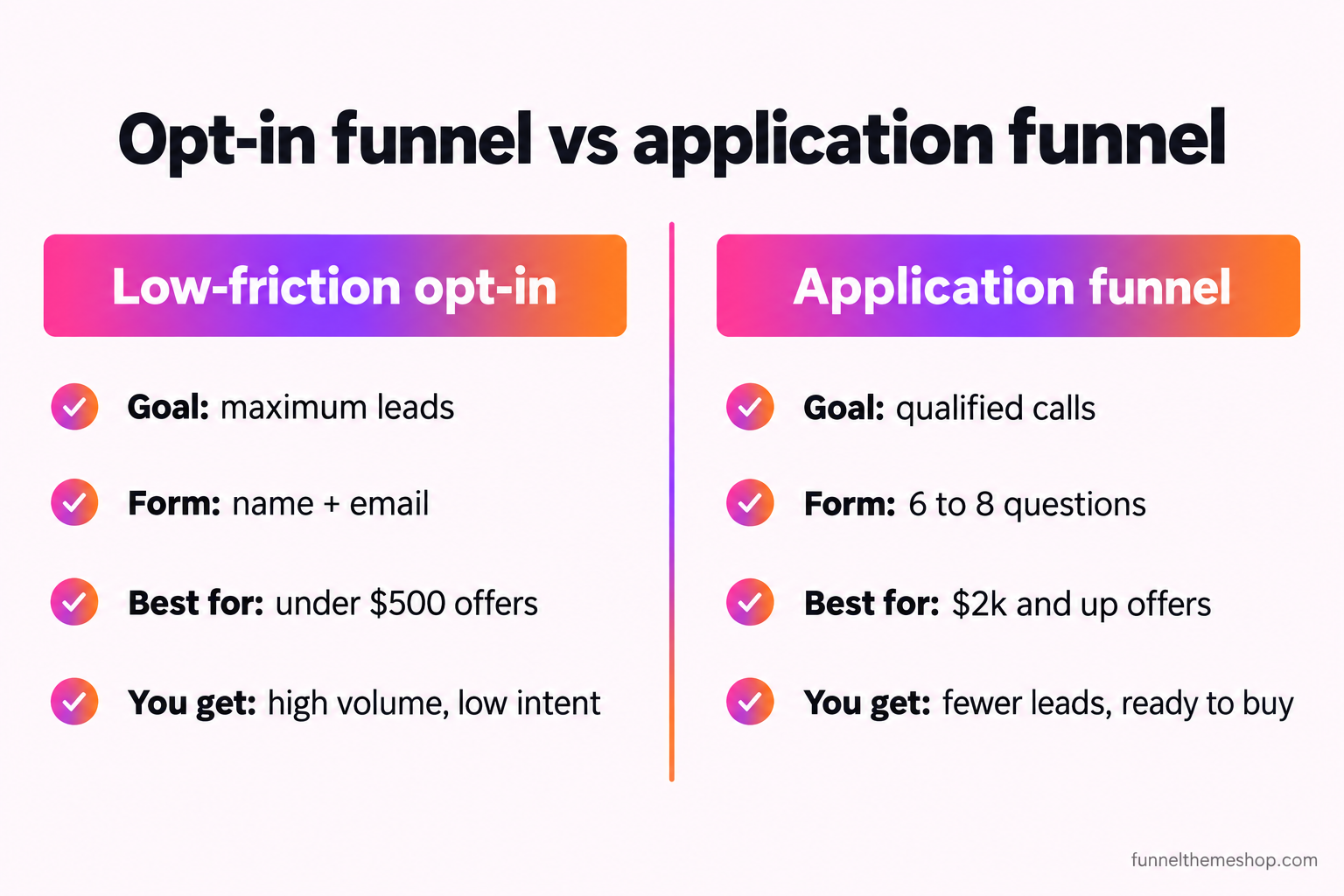
The deciding factor is price, with a second factor of sales motion. Below roughly $500, the cost of a sales call usually exceeds the margin, so you want volume and a self-serve checkout, and friction is your enemy. Above roughly $2,000, a call is almost always part of the sale, the margin easily covers the hour, and the expensive mistake is wasting that hour on someone who was never going to buy. Between those two is a judgement call that depends on your close rate and how much your time is worth. Here is the decision laid out.
| Offer price | Funnel to run | Where the filter sits | What you are protecting |
|---|---|---|---|
| Under $500 | Low-friction opt-in, self-serve checkout | No filter, you want everyone | Conversion rate and volume |
| $500 to $2,000 | Opt-in to a call, light qualifying | A question or two on the booking page | A balance of volume and fit |
| $2,000 to $10,000 | Application funnel | The application, before the calendar | Your calendar and your close rate |
| $10,000 and up | Application plus a manual review step | The application, then a human check | Every single hour of your time |
Notice the filter moving earlier as the price climbs. That is the whole idea. The more a call is worth, the sooner you want to know whether it is worth taking. If your offer sits in the local-service world rather than coaching or consulting, the same logic applies to a booked estimate or a design consult, which is why the booking-funnels category and the application pattern overlap more than they look. A roofer booking a $20,000 re-roof wants the same filter a coach booking a $20,000 mastermind does.
The numbers: what qualifying does to your cost per call
This is where an application funnel stops being a philosophy and starts being arithmetic. Work it with your own figures, but here is the shape of it with visible assumptions you can swap out.
Say a click from your ad costs $8 and you send 100 of them to the funnel. (Your real cost per click is whatever your ad account reports; use that.) At the illustrative rates in the diagram above, 22 people start the application, 14 qualify and reach the calendar, and 10 of those actually show up for the call. Your $800 of ad spend bought 10 qualified, filtered conversations, which is $80 per call that shows up. If you close one in four of those qualified calls on a $3,000 offer, you spent $800 to make roughly three sales, and your cost to acquire a client lands near $270. The numbers are illustrative, but the mechanism is not: every unqualified person the application turned away was a call you did not waste and an hour you did not spend.
Compare that to the opt-in version of the same offer. The lighter form converts more of the 100 clicks into bookings, say 30 instead of 14, which looks better on a dashboard. But if two thirds of them cannot afford the offer or were never serious, you are now running 20 calls to find the same handful of buyers, and each of those calls is an hour. At that point the funnel is not cheaper. It is quietly the most expensive thing in your week, priced in the only currency you cannot refill.
Speed is the multiplier on all of it, and the research on response time is blunt. Harvard Business Review's study "The Short Life of Online Sales Leads" (hbr.org/2011/03/the-short-life-of-online-sales-leads), which looked at roughly 1.25 million leads, found that firms making contact within an hour were nearly seven times more likely to have a meaningful conversation with a decision maker than those that waited just an hour longer, and more than sixty times more likely than those that waited a full day. The same study found the average company took around 42 hours to respond and that 23 percent never responded at all. An application funnel that drops a qualified applicant straight onto a calendar inside the next two days is acting on exactly that finding, automatically, every time. (These figures are confirmed via search snippet this run on 2026-10-08, not independently fetched from the original report.)
The platform cost is the part people overestimate. You do not need a per-funnel licence or a stack of separate tools. The pages, the form logic, the calendar, the reminder emails and the recovery texts all live inside one GoHighLevel account. HighLevel's own plans run from $97 a month on Starter to $297 on Unlimited and $497 on Agency Pro, with a 14-day trial on each (gohighlevel.com/pricing, confirmed via search snippet on 2026-10-08). One account runs the whole application funnel and every other funnel you own, so the marginal cost of adding this one is close to zero. The comparison with a standalone page builder and a separate scheduler and a separate SMS tool is covered in GoHighLevel vs ClickFunnels if you are still weighing the platform itself.
Where application funnels break
Four failure modes account for almost every application funnel that gets built and then quietly underperforms. Each has a clear symptom, a cause and a fix.
Break 1: the form that qualifies nothing
Symptom: your calendar is full again and the calls are still unqualified. Cause: the application asks for name, email and phone and nothing that actually separates a buyer from a browser. You built an opt-in and called it an application. Fix: add the budget-range question and the open text box. The budget range does the hard filtering and the text box reveals effort. If every applicant still clears the bar, your bar is set too low. Raise the stated minimum in the copy above the form until the funnel starts turning people away, because a filter that never rejects anyone is not a filter.
Break 2: the "we will be in touch" dead end
Symptom: people complete the application and then go cold before you reach them. Cause: there is no instant booking. A human is reviewing applications on a Monday-morning batch, so a Thursday applicant waits four days, and by then the HBR decay above has done its work. Fix: automate the review with form scoring and conditional redirects so a qualified applicant sees a live calendar the instant they submit. Keep the manual review only for offers above $10,000 where the hour genuinely warrants a human read, and even then, book the call first and cancel the rare mismatch rather than making everyone wait.
Break 3: the booked call that never happens
Symptom: strong booking numbers, weak attendance, and a close rate that looks terrible because you are dividing by the wrong denominator. Cause: no reminder and recovery sequence, so a call booked on Monday for Thursday is a call half those people forget. Fix: the sequence in the next section. No-shows are not a people problem, they are a sequencing problem, and they are the most recoverable leak in the entire funnel. A snapshot built for a booking-heavy trade targets recovering up to 70 percent of no-shows through exactly this kind of reminder and rebook automation, and that target is the difference between a funnel that books calls and one that holds them.
Break 4: the funnel that submits but never fires
Symptom: the application looks perfect, the applicant swears they submitted, and nothing reaches your calendar or your inbox. Cause: the form is live but the workflow behind it was never connected, or its trigger is filtering the submission out. This is common enough on this platform that it has its own diagnosis: the form submits but the workflow never fires guide walks the exact checks, from trigger filters to published versus draft state. Fix: test the whole path end to end with a real submission before you send a dollar of traffic, and watch the contact actually appear with the right tags. An application funnel that silently drops applications is worse than no funnel, because you do not even know you are losing them.
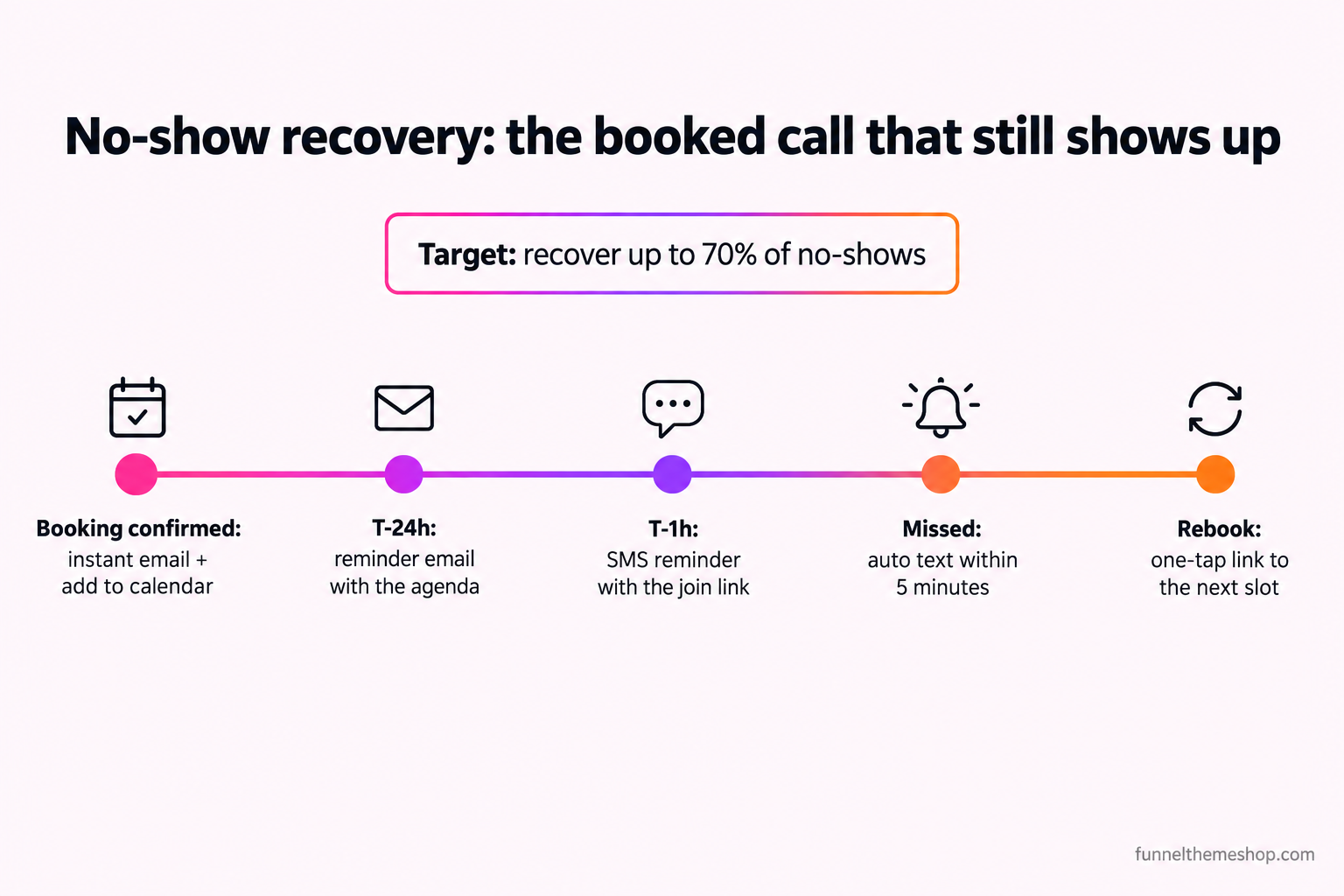
The no-show recovery sequence, step by step
Attendance is engineered, not hoped for. The sequence in the timeline above is the baseline, and it is worth stating in order because the timing is the mechanism. At the moment of booking, send the confirmation and push the event to the prospect's own calendar, because a call that lives in their calendar is one they plan around. Twenty-four hours out, an email reminder that carries the agenda, not just the time, so they arrive knowing what the conversation is. One hour out, an SMS with the join link, because by then email is losing and the phone is winning. If the slot passes with no attendance, an automatic text inside five minutes while the intent is still warm, with a one-tap link to rebook. That last step is the one most funnels skip, and it is the one that recovers the most.
The recovery automation is also where the system quietly keeps your reputation working for you. A funnel built for a service trade will often pair the attendance sequence with a review request after a completed call or job, targeting a steady five to ten reviews a month without anyone remembering to ask. Both numbers, the no-show recovery and the review cadence, are targets the system is tuned to hit rather than guaranteed outcomes, and they both come from the same place: automation that runs on every booking without a human in the loop.
Three objections worth answering honestly
If you are weighing whether to rebuild your offer around an application funnel, three arguments usually come up. They deserve straight answers, including the one where this is the wrong move.
"Fewer leads sounds like a downgrade"
It is fewer leads and more revenue, and those are not in tension for a high-ticket offer. A lead you cannot sell is not an asset, it is a cost: it occupies a call slot, a follow-up sequence and your attention. The application funnel trades lead count for lead quality on purpose, and the only number that should move is the one that matters, which is sales per hour of selling. If your lead volume drops and your revenue holds or rises, the funnel is working exactly as designed. If both drop, your bar is set too high and you tune it down, which is a dial, not a redesign.
"My offer is not expensive enough for this"
Maybe, and the table above is the honest test. Under $500, you are right, an application funnel is over-engineered and a self-serve checkout will serve you better. But the threshold is lower than most people assume. The question is not only the price, it is whether a sales call is part of how you close. A $1,200 offer sold on a call has the same problem as a $12,000 one: every unqualified call is a wasted hour. If you are selling on calls at all, some amount of pre-qualifying almost always pays for itself. Where the offer is genuinely self-serve and needs no call, skip all of this and build the value ladder instead, because the application is solving a problem you do not have.
"Can I not just add two questions to my current opt-in?"
You can, and for an offer in the middle of the table that is often the right first step. Two well-chosen questions on the booking page will filter out a meaningful slice of the worst-fit prospects for very little work. But understand what you are not getting: without the scoring, the conditional redirect and the recovery sequence, you have a lightly filtered opt-in, not an application funnel. It will help, and it may be enough at your price point. The full build earns its complexity when the offer is expensive enough that the difference between a qualified calendar and a full one is worth real engineering. Start light, measure, and upgrade when the maths says so.
Build it, or start from a snapshot that already has it
You can build every piece of this by hand in GoHighLevel. The application page, the form scoring, the conditional redirect to the calendar and the reminder-and-recovery sequence are all native to the platform, and the four-page order above is the blueprint. Give yourself an afternoon for the pages and a second one for testing the automation end to end, and do not send traffic until a real test submission lands on your calendar with the right tags attached.
The alternative is to start from a snapshot where the structure is already wired and spend your time on the part only you can do, which is the offer and the qualifying questions. A snapshot built for a call-driven offer imports with the application page, the booking calendar and the no-show recovery already connected, so the technical build is done on the day it lands. The business coaching funnel snapshot is built around exactly this application-to-call motion, and the broader high-ticket category collects the ones tuned for offers in this price band. What arrives is a snapshot share link and a PDF with the full installation instructions, delivered within 24 business hours, and the import itself is an optional $175 add-on if you would rather we did it than you.
Whichever way you build it, the principle does not change. For a high-ticket offer, the most valuable thing a funnel can do is tell the wrong person no before they reach your calendar. Put the filter first, automate the attendance, and the hour you spend on a call becomes an hour you spend with someone who is actually ready to buy. That is the entire job, and it is worth doing well.
Frequently asked
How many questions should a high-ticket application funnel have?
Six to eight is the working range for most offers. Ask the current state, the desired state, the obstacle between them, a budget or timeline question phrased as a range, and at least one open text box. Fewer than that and the form filters nothing; many more and you lose qualified applicants along with the unqualified ones.
Should the calendar be on the application funnel or a separate page?
Qualified applicants should land on the calendar instantly after submitting, routed there by conditional logic that scores the answers. Making people wait for a manual review kills the momentum of the moment they raised their hand. Keep a human review step only for offers above roughly $10,000, and even then book the call first.
What counts as high-ticket for an application funnel?
The deciding factor is whether a sales call is part of the sale, not a fixed price. As a rough guide, offers above $2,000 almost always justify an application funnel, offers between $500 and $2,000 are a judgement call that usually wants at least light qualifying, and anything under $500 is better served by a low-friction opt-in and a self-serve checkout.
How do I stop no-shows on booked calls?
Engineer attendance with a sequence: an instant confirmation with a calendar invite at booking, an email reminder with the agenda 24 hours out, an SMS with the join link one hour out, and an automatic rebook text within five minutes of a missed call. A snapshot built for a booking-heavy trade targets recovering up to 70 percent of no-shows through this automation.
Do I need a VSL or webinar before the application?
Not necessarily. A strong application page with clear copy above the form can qualify perfectly well on its own. A video or webinar in front of it raises intent before the application, which can be worth it for higher prices or colder traffic, but it is an addition, not a requirement. Start with the four-page build and add a video stage only if your numbers ask for it.
Related guides
More funnel guides
High-Converting Funnel Structure: The Four Shapes That Cover Everything
A funnel is not a set of pages. It is a sequence of state changes, and only a short handful of sequences matter for a service business. Here is how to tell which one your offer needs.
11 min readStrategyThe Offer Stack: How to Build One That Does Not Sound Like a Scam
Stacking has a bad reputation because of the inflated-value tables it is famous for. The underlying mechanic is sound. Here is how to use it without the theatre.
10 min readStrategyHigh-Converting Landing Page Anatomy: Every Block, Top to Bottom
A landing page is nine blocks doing nine jobs. Get the order right and the copy has somewhere to live. Get it wrong and you are decorating a page that argues with itself.
12 min readFunnel snapshots · done-for-you builds
Pick a funnel, or hand us the offer
Buy the snapshot and it lands within 24 business hours as a share link and an installation PDF, add the $175 install if you would rather not do it yourself, or hand us the offer and we build the whole thing.
All sales final once the snapshot link is sent · free updates for life · one licence covers every sub-account you own