Strategy
Black Friday funnels when you have nothing to discount
A plumber cannot put "40% off" on a boiler service without teaching every customer to wait until November next year. Here is the Black Friday funnel that works when the thing you sell is your own time.
It is the third week of September and a house-cleaning company owner is staring at her inbox. Every retailer she has ever bought from is already warming up a Black Friday email, and she is wondering what hers is supposed to say. She has no warehouse and no stock. The thing she sells is a two-person crew and a Tuesday morning. She cannot mark down a Tuesday morning by 40% without doing two things at once: destroying the margin on the one job she was going to get anyway, and teaching a good customer that her real price is a lie she drops every November.
This is the whole problem with Black Friday for a service business. The mechanics that make it work for a product seller, a discount deep enough to move slow inventory, run backwards when the product is your own time. Your time does not go stale on a shelf. Discounting it does not clear a warehouse, it just trains demand to wait. So most service owners either skip the season entirely and watch competitors hoover up the attention, or they panic-discount and spend December regretting it.
There is a third option, and it is a funnel problem before it is a discount problem. The right Black Friday offer for a service business does not cut the rate at all. It pulls cash forward, fills a quiet January, or sells a block of your time at full price with a reason to buy it now. The funnel is what makes that offer feel like a deal without it being a discount. This piece is the playbook: the offers that work, the funnel that carries them, the places the money leaks, and when to switch the whole thing off.
What a service business is actually selling in November
Start with what Black Friday is for, from the buyer's side. A shopper is not really hunting for a lower price. They are hunting for permission to buy something they already wanted, right now, without feeling careless about it. The urgency and the ending date do the emotional work. The discount is just the most common way product sellers manufacture that urgency, because a product has a fixed cost and a marked-down price is legible in one glance.
You can manufacture the same urgency without touching your rate. A service business has three levers a product seller does not: capacity (you can only take so many jobs), timing (some months are dead and some are slammed), and the future (you can sell time you have not delivered yet). Every good service Black Friday offer pulls one of those three levers. None of them requires the word "off".
The mistake is treating the offer and the funnel as one decision. They are two. The offer decides what changes hands. The funnel decides whether the person who lands on the page actually completes, and during a promotion that second job gets harder, not easier, because you have driven a spike of colder, more distractible traffic at a single page. Get the offer right and a weak funnel still leaks most of it. The two have to be built together, which is the same logic the whole GoHighLevel funnel builder approach is built on: the offer and the page that sells it are one system, not a headline bolted onto a template.
The discount trap, in numbers
Before the offers, look at why the obvious move is the wrong one. Say a deep clean sells for $200. The direct cost of delivering it, the crew's time and the supplies, is $120. That leaves $80 of contribution on every job, the money that actually pays your overhead and your own wage.
Now run the Black Friday reflex: 25% off, so the job sells for $150. Your cost did not move. It still takes the same crew the same three hours and the same supplies, so it is still $120. Your contribution just fell from $80 to $30. To make the same total contribution you would have made from a normal week of ten full-price jobs, $800, you now need to sell twenty-seven discounted jobs instead of ten. A 25% price cut did not cost you 25% of anything. It cost you nearly two thirds of your margin per job and asked you to almost triple your volume to stand still.
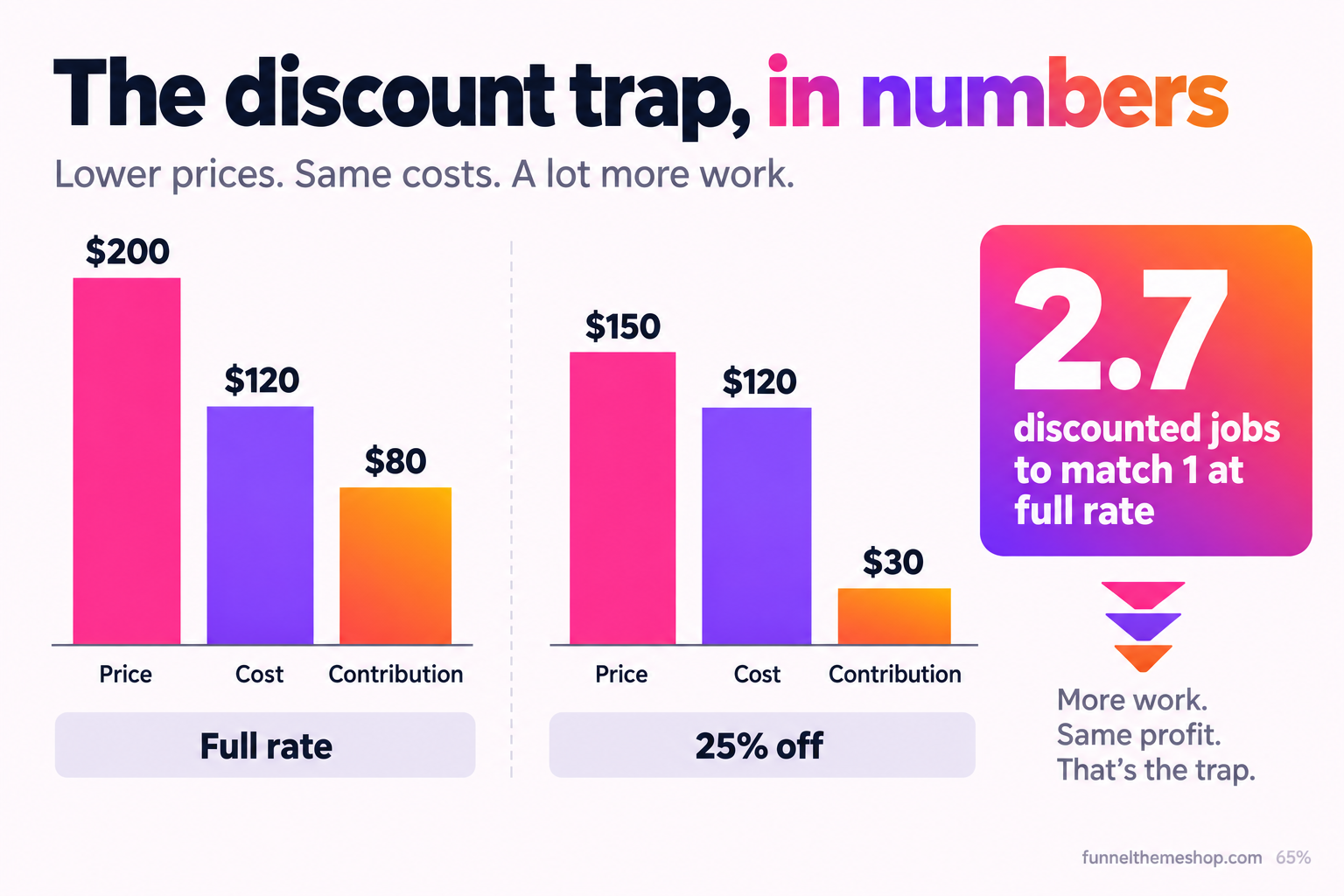
And that is only the visible cost. The invisible one is the anchor. Every one of those twenty-seven buyers now believes your deep clean is a $150 job. When you go back to $200 in December, a share of them feel the increase as a price rise on you, not a return to normal. You have spent margin to make your next sale harder. A discount on a service is a loan you take out against your own future pricing, and the interest is paid in every renewal conversation after the promotion ends.
The way out is to stop thinking about price and start thinking about what else you can change: quantity, timing, or what is bundled in. That is where the five offers come from.
Five offers you can run without cutting your rate
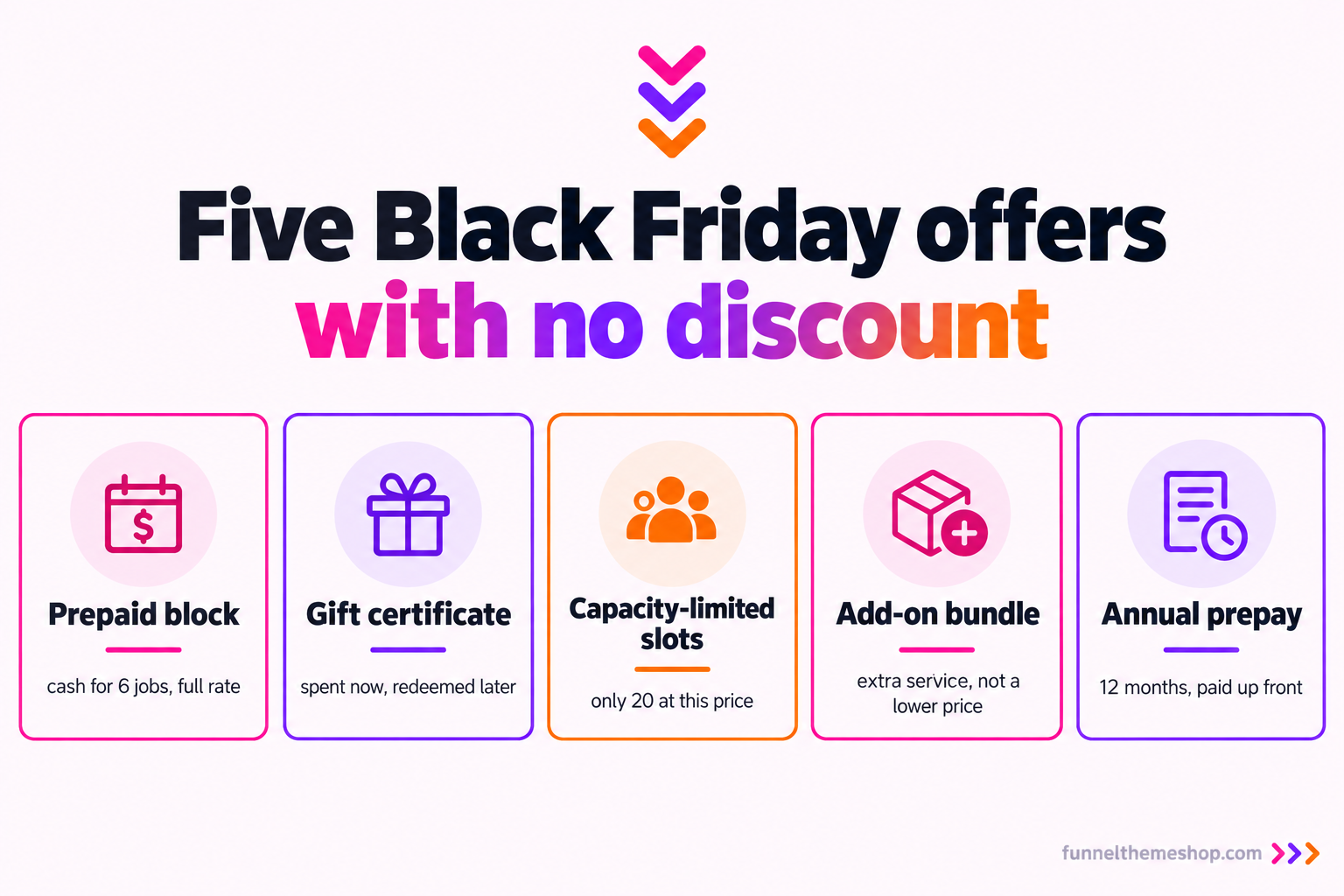
Here are the five that consistently work for service businesses, each pulling one of the three levers. None of them discounts the core service. Every one of them gives the buyer a genuine reason to act inside the window.
The prepaid block
Sell a bundle of your service, at full rate, paid in full now. A cleaner sells six deep cleans for $1,200 instead of one for $200. The "deal" is not a lower price per clean. It is a bonus that costs you little and a rate locked in before your January increase. Add one fridge-interior clean that lists at $40 but costs you fifteen minutes and a cloth, and the buyer feels they got something extra while your contribution across the block barely moves. You have converted one $200 decision into a $1,200 decision and taken the cash today. That is the single most valuable thing Black Friday can do for a service business, and it does not involve the word discount anywhere.
The gift certificate
A spa or a salon sells a fixed-value certificate that gets spent now and redeemed later, usually by someone else. The buyer is not price-shopping their own haircut, they are solving a Christmas present, so the sensitivity to a discount disappears entirely. You take the cash in November for work you deliver in January and February, which are the two months you most want filled. A portion of certificates are never redeemed at all, which is real upside you should not plan your margin around but will quietly receive.
The capacity-limited slot
Instead of a lower price, sell scarcity honestly. "We are taking twenty new gutter-clearing jobs at our current rate before the January price goes up. When the twenty are gone, they are gone." No discount, a real reason to move now, and a counter on the page that means it. This one only works if the limit is true, which is the whole point: a service business genuinely has finite capacity, so the scarcity is not manufactured, it is just finally being stated out loud.
The add-on bundle
Keep the core service at full price and stack extra value around it rather than cutting into it. A pest-control company sells its standard annual plan and throws in a free winter rodent inspection that would normally be a separate visit. The core contract holds its margin, the bonus is low cost to deliver, and the offer reads as generous. This is the same offer-stack logic that makes a year-round funnel convert, pointed at a two-week window: raise the perceived value instead of lowering the number.
The annual prepay
For any business that already runs on a monthly retainer or membership, offer twelve months paid up front as the Black Friday move. A gym, a chiropractic clinic on a care plan, a marketing retainer: the member pays for the year now, you might hand back one month's value as the incentive, and you have locked a year of retention and a year of cash in a single decision. One free month against twelve prepaid is a far cheaper incentive than a rate cut, and it fixes the thing service businesses actually struggle with, which is churn, not acquisition.
Which one fits depends on how your business makes money. Use this to decide rather than running all five at once, because a page selling five things sells none of them.
| Offer | Lever it pulls | Best for | The catch to watch |
|---|---|---|---|
| Prepaid block | Quantity, cash forward | Repeat services: cleaning, lawn care, detailing | Set an expiry or you owe the work for years |
| Gift certificate | Timing, gifting demand | Spa, salon, personal training, experiences | Track liability; unredeemed is not free money you can spend |
| Capacity-limited slot | Scarcity, timing | Trades with real job limits: roofing, HVAC, plumbing | The limit has to be real and the counter has to move |
| Add-on bundle | Perceived value | Contracts and plans: pest control, maintenance | The bonus must be cheap to deliver, not a second full job |
| Annual prepay | Retention, cash forward | Memberships and retainers: gyms, clinics, agencies | One free month is the ceiling; more and you are discounting |
If you sell a repeat visit, the prepaid block is almost always the answer. If your service is a natural gift, the certificate wins. If you are a trade with genuinely finite capacity, state the limit. The offer is a choice about your business model, not about how brave you feel in November.
The funnel, page by page
The offer is half the job. The other half is a funnel that survives a spike of cold, distracted, holiday-brain traffic and turns it into completed orders. During a promotion you are not sending your usual warm audience to a page they trust. You are pushing a burst of colder clicks at a single decision, and the average checkout leaks badly under that load. Across fifty separate studies the Baymard Institute puts the average shopping-cart abandonment rate at 70.22% (baymard.com/lists/cart-abandonment-rate, confirmed via search snippet September 2026). Seven in ten people who start do not finish, on a normal day. A Black Friday rush makes that worse, so the funnel has to be built to hold them.
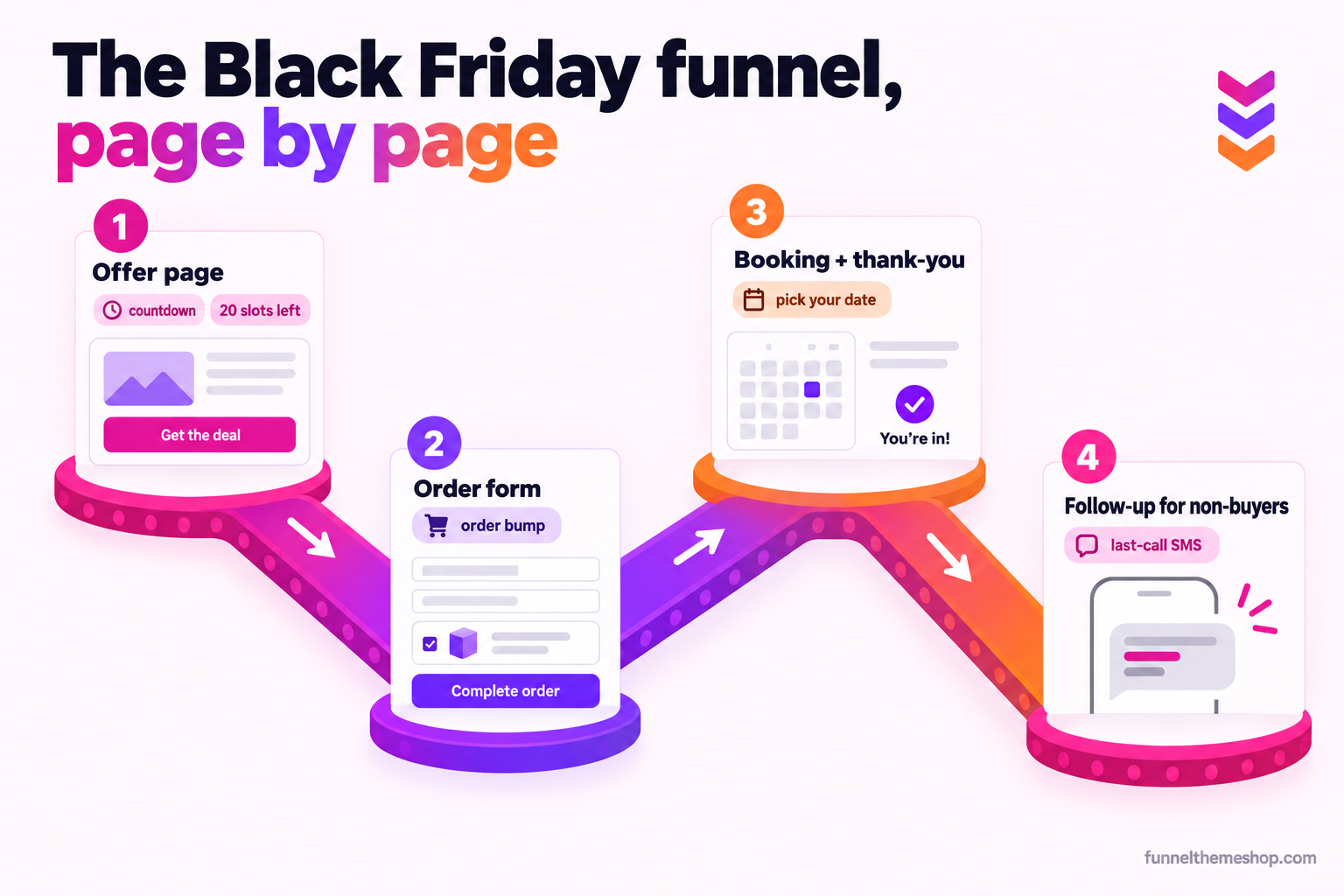
Stage one: the offer page
One page, one offer, one action. This is not the place for your full service menu. The headline names the offer and the deadline in one line. Below it, the reason to act now (the price goes up in January, only twenty slots, the certificate is redeemable through March). A live countdown to the deadline and, where the offer is capacity-limited, a counter that actually decrements as slots sell. Everything else on your normal site is a distraction here, which is why the whole build follows the landing page anatomy rule of one page doing one job.
Stage two: the order form and the one bump
The order form is where the abandonment happens, so keep it short and put the payment step on the same page as the decision. Add exactly one order bump, a single tick-box that raises the average order without adding a second decision to agonize over. A cleaner selling the six-clean block offers a one-click add of an oven deep-clean for $60. A spa selling certificates offers a gift-wrapped physical card posted out for $8. One bump, not a gauntlet. The difference between an order bump and an upsell matters here and the order bump versus upsell breakdown is worth reading before you build it, because a Black Friday buyer will forgive one extra tick and abandon a three-step upsell wall.
Stage three: booking and the thank-you page
The thank-you page is not a dead end that says "thanks". For a service business it is where the sale becomes a scheduled job. If the offer is a prepaid block or a slot, the buyer picks their first date right there on the confirmation page. That single move turns an abstract purchase into a diary commitment, which is what stops a Black Friday impulse-buy quietly becoming a January refund request. If the offer is a certificate, the thank-you page is where you ask them to forward it, which is free reach into exactly the audience you want.
Stage four: the people who did not buy
This is the stage almost everyone skips and it is where half the money is. Most people who click your Black Friday ad will not buy on the first visit. If your only offer surface is the page, they are gone. The funnel has to capture an email or phone number before the order form, so a started-but-not-finished order and a clicked-but-not-started visit both drop into a short, dated sequence: a reminder the morning after, a "slots are going" note mid-week, and a genuine last-call the night the deadline hits. The deadline is what makes this sequence work. Without a real ending, "last call" is a lie the reader has heard a hundred times.
Where the money leaks
Four failure modes account for most of a wasted Black Friday. Each has a symptom you can see and a cause you can fix.
The fake deadline
The symptom is a countdown that resets when you reload the page, or a "sale ends Monday" that is still running on Wednesday. The cause is a timer built on the visitor's own clock rather than a real fixed date, or a promise the business could not bring itself to keep. The fix is to make the deadline true and enforce it: the page comes down, the offer stops, the price genuinely changes. A funnel that cries wolf on the deadline trains your best customers to ignore the next one, and they will remember.
The bundle that owes work for years
The symptom shows up in March, when a customer books the fifth clean from a block they bought in November and you have long since spent the money and forgotten the commitment. The cause is a prepaid block with no expiry. The fix is a clear redemption window written into the offer, "use within twelve months", so the liability has an end date and your January cash does not become a year of unpaid obligations. A prepaid offer is only cash forward if the work it commits you to is bounded.
The single page with no capture
The symptom is a lot of ad clicks, a handful of orders, and no way to reach the rest. The cause is a funnel that only exists as a checkout, so anyone who hesitates leaves no trace. The fix is to lead with the offer but capture the contact before the payment step, which is the exact mechanism laid out in why a funnel with traffic gets no opt-ins. If the only people you can follow up with are the ones who already bought, your Black Friday is a fraction of the size it could be.
The promo that eats January
The symptom is a strong last week of November followed by the deadest December and January you have ever had. The cause is an offer that simply pulled forward demand you would have won anyway, at a worse margin, with no new customer attached. The fix is to design the offer so it either brings in someone new (a gift certificate spent by a stranger) or locks in future retention (an annual prepay), rather than handing a discount to the loyal customer who was going to rebook in January regardless. Pulling your own future revenue forward and calling it a win is the quietest way to lose money on a busy fortnight.
The follow-up that pays for the whole thing
A Black Friday promotion delivers a compressed spike of new bookings, which is exactly the situation your automations should be built for and almost never are. Two of them turn a good fortnight into a good quarter.
The first is no-show recovery. A rush of impulse bookings has a higher flake rate than your usual pipeline, because some of these people bought on urgency and have not fully committed. A reminder-and-rebook sequence that chases the ones who miss their slot is aiming to claw back the majority of them; the system we ship targets around 70% no-show recovery as its design goal, not a number we can promise you, and during a Black Friday spike that recovery is the difference between a full January and a diary full of gaps where impulse-buyers evaporated.
The second is reviews. Every one of those Black Friday customers is a review you have not asked for yet. An automation that requests a review at the right moment after the service is delivered turns a November spike into social proof that sells for you in the quiet months, and the target we build to is a steady five to ten reviews a month rather than one big burst. The promotion is the acquisition event. The follow-up is what makes it compound instead of evaporate, and it is the half of the funnel that is still working long after the countdown has hit zero. This is the same value-ladder thinking from the value ladder funnel guide: the first sale is the beginning of the relationship, not the end of it.
Objections you are already making
Three arguments come up every time a service owner reads this, and all three deserve an honest answer rather than a sales one.
"My customers do not shop on Black Friday for a service like mine."
Some do not, and if your service is a genuine emergency purchase, a burst pipe, an emergency dental appointment, then you are right and Black Friday is not your event. But most local services are discretionary and forward-plannable: the deep clean before the in-laws visit, the gym membership for the new year, the year of lawn care. For those, the buyer is absolutely in a spending mood in late November, and the only question is whether you gave them a reason to spend it with you or let the moment pass. The offer that fits an emergency service is a different one, and sometimes the honest answer is that your business should sit this season out and spend the budget in January instead.
"Discounting cheapens my brand."
It does, which is the entire argument of this piece. Every offer here is built specifically so you do not discount. A prepaid block at full rate, a gift certificate at face value, an honest capacity limit: none of these tells the market your real price is lower than you claim. If your only mental model of Black Friday is "take a percentage off", then yes, you should skip it. The point is that the percentage off was never the only model, and it was always the worst one for a business that sells its own time.
"I do not sell a product, so a snapshot funnel is not for me."
A funnel is not a product-seller's tool. It is a page that carries one offer to one completed action, and a service business needs that more than a store does, because your offer is harder to make legible than a photo of a thing with a price on it. That said, be honest about scope: if you already have a page that converts and an automation stack that follows up, you may only need to point them at a seasonal offer for a fortnight, not buy anything. The local service funnel category is where the snapshots that already have the booking, the bump and the follow-up wired in live, so the only thing you are building is the offer on top. If you have that infrastructure already, use it. If you are staring at an empty funnel builder three weeks before the busiest sales window of the year, that is what a snapshot is for.
What to build now, and when to turn it off
The calendar is the last piece, and mid-September is the right time to be reading this, not the week before. Decide the offer this week, because the offer decides everything downstream. Build the page and the follow-up sequence through late October so you have two weeks to test a real order through the whole thing, including the payment step and the thank-you-page booking, before any traffic hits it. Turn it live in the third week of November, run it hard for the window you set, and then honour the deadline exactly: the page comes down, the price returns, the countdown was true.
Then do the thing almost nobody does, which is turn the follow-up back on in January for the people who clicked and did not buy. They told you they were interested at the worst possible time to close them, when their inbox was a war zone of competing sales. A quiet, no-urgency note in the second week of January, with no discount and no countdown, just the offer at its normal rate, catches a surprising share of the ones who genuinely wanted it and simply could not decide in November. The Black Friday funnel and the January follow-up are one build, and the second half costs you almost nothing because you already made it.
A service business does not need a discount to win a sales holiday. It needs an offer that respects its own margin, a funnel that carries that offer without leaking, and the discipline to keep the promise the countdown makes. Build those three, and Black Friday stops being the season you dread and becomes the fortnight that pays for a slow January.
Frequently asked
Can a service business run Black Friday without discounting?
Yes, and for most service businesses discounting is the wrong move because your delivery cost does not fall when your price does. Instead of a rate cut, run an offer that pulls a different lever: a prepaid block at full rate, a gift certificate spent now and redeemed later, an honest capacity-limited slot, an add-on bundle, or an annual prepay. Each creates real urgency without training your customers to wait for a sale.
What is the best Black Friday offer for a local service business?
It depends on how you make money. If you sell a repeat visit like cleaning or lawn care, a prepaid block at full rate is usually best because it pulls cash forward and locks your rate. If your service is a natural gift, a face-value gift certificate wins because the buyer is not price-shopping a present. If you are a trade with genuinely limited capacity, state that limit honestly and sell the last slots at your current rate before a January increase.
Why does a 25% discount hurt a service business so much?
Because your cost to deliver does not move. On a $200 job with $120 of direct cost, you keep $80 of contribution. Cut the price to $150 and you still spend $120, so your contribution drops to $30. You would need to sell roughly 2.7 discounted jobs to make the same money as one job at full rate, and every one of those buyers now anchors to the lower price for next time.
How early should I set up a Black Friday funnel?
Decide the offer in September, build the page and follow-up sequence through October, and test a real order end to end, including the payment and the thank-you-page booking, before any traffic arrives. Go live in the third week of November. Building it the week before means the abandonment leaks and the fake-deadline mistakes go straight to live traffic with no time to catch them.
What follow-up should run after a Black Friday promotion?
Two follow-up sequences matter most. A no-show recovery sequence chases the impulse bookings that flake, which happens more with urgency-driven buyers, and a review-request sequence turns the spike of new customers into social proof for the quiet months. Then reopen the follow-up in January at the normal rate for everyone who clicked in November but did not buy, because their hesitation was about timing, not interest.
Related guides
More funnel guides
The Offer Stack: How to Build One That Does Not Sound Like a Scam
Stacking has a bad reputation because of the inflated-value tables it is famous for. The underlying mechanic is sound. Here is how to use it without the theatre.
10 min readStrategyThe Value Ladder Funnel: How to Build One for a Service Business
Most value ladder explanations are drawn for course creators. Here is the version for a business that sends vans out, or books a chair, or takes a case — including the rungs you should not build.
10 min readStrategyHigh-Converting Landing Page Anatomy: Every Block, Top to Bottom
A landing page is nine blocks doing nine jobs. Get the order right and the copy has somewhere to live. Get it wrong and you are decorating a page that argues with itself.
12 min readFunnel snapshots · done-for-you builds
Pick a funnel, or hand us the offer
Buy the snapshot and it lands within 24 business hours as a share link and an installation PDF, add the $175 install if you would rather not do it yourself, or hand us the offer and we build the whole thing.
All sales final once the snapshot link is sent · free updates for life · one licence covers every sub-account you own