Strategy
What a GoHighLevel sales funnel actually costs, built three ways
Ask three people what a funnel costs and you get $0, $97 a month and $4,000, all of them right. A funnel is not one price. It is four costs stacked, paid in one of three ways, and here is the whole of it.
Ask three people what a sales funnel costs and you will get three answers that are all correct. One says nothing, you build it yourself inside the tool you already pay for. One says ninety-seven dollars a month, the price of the platform. One says four thousand dollars, what the agency quoted. Nobody is lying. They are answering different questions, because a funnel is not a thing with a price tag. It is four separate costs stacked on top of each other, and the reason the quotes range from free to four figures is that each person is counting a different stack and paying for it a different way.
This is a pricing teardown. We are going to pull the four costs apart, put a real number against each one, and then price the three ways people actually pay for a GoHighLevel funnel: building it yourself, buying a snapshot and importing it, or hiring the whole thing out. Every platform figure here was checked this month and the source is named next to it. The arithmetic you can change, because your hourly rate and your offer are yours, but the shape of the decision does not change, and by the end you will know which of the three you are actually looking at.
If you want the map of what a funnel is made of before you price it, the complete working guide to the GoHighLevel funnel builder lays out the machine. This page is about what that machine costs to put in the ground.
The four things you are actually paying for
Before any of the three paths makes sense, you have to see that a funnel is never one purchase. It is four, and they behave completely differently. Two of them recur forever and two of them are one-time, and the single most common pricing mistake is comparing a one-time cost on one path against a recurring cost on another and thinking you have compared like with like.
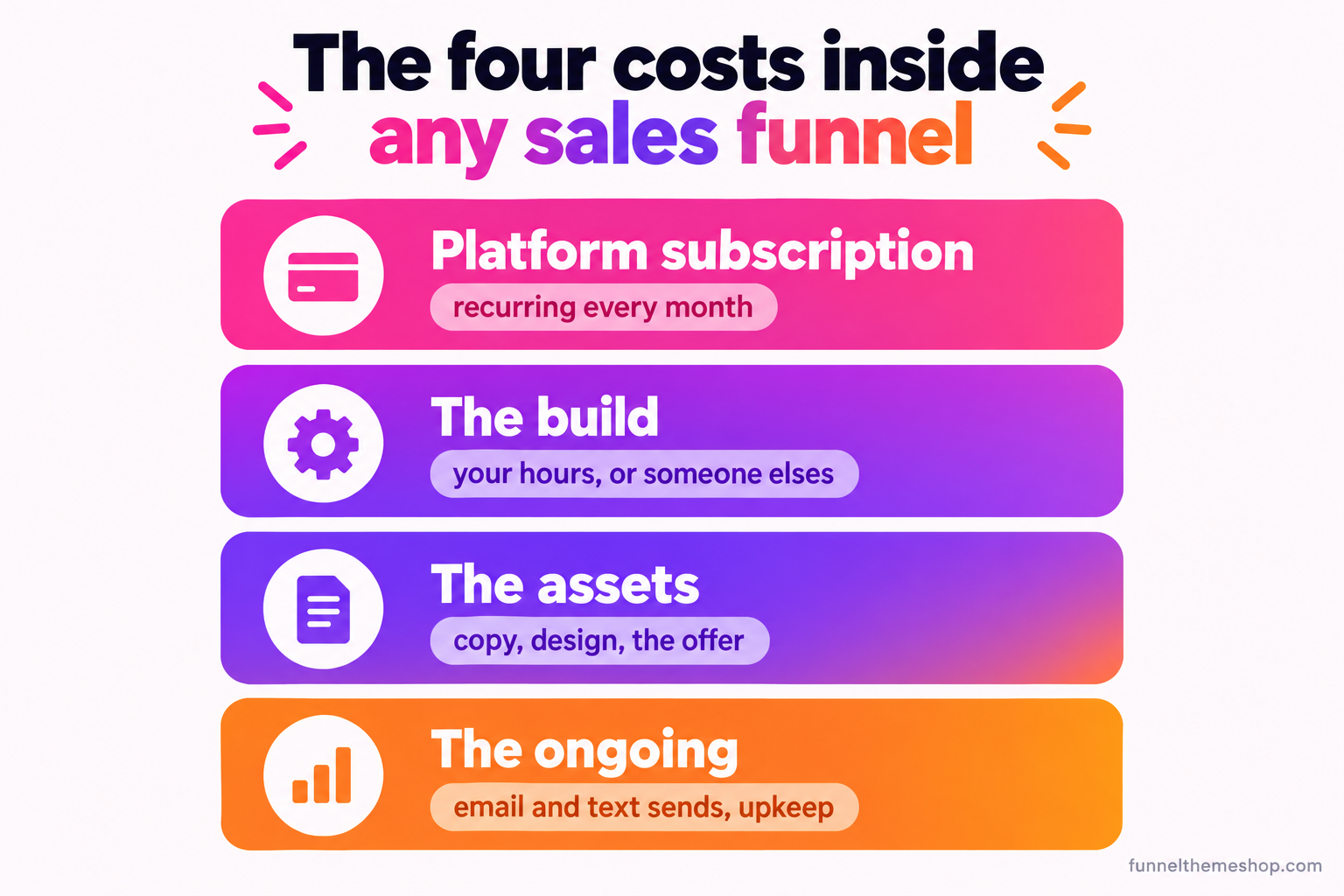
The first cost is the platform. GoHighLevel is a monthly subscription, and it is the floor under everything else because the funnel physically cannot run without it. The second cost is the build: the hours it takes to assemble the pages, wire the forms, connect the automations and test the thing end to end. Those hours are real money whether you pay them to yourself in evenings or to someone else in an invoice. The third cost is the assets: the copy that goes on the pages, the design, and above all the offer itself, which is the one part no tool and no template can hand you. The fourth cost is the ongoing: the email and text sends the funnel burns through every month, the registration fees behind the texting, and the slow drip of maintenance when something breaks or the offer changes.
Hold those four in your head as we go, because the three paths are really just three different ways of paying for the same four things. Nobody escapes any of them. You can shift the build cost from money to time, or the assets cost from your Saturday to a copywriter, but the stack is always there.
The platform bill, which never goes away
Start with the floor, because it is the one cost that is identical on all three paths and the one people forget to count. Whatever else you do, the funnel runs on a platform and the platform is a monthly bill. On GoHighLevel the plans run $97 a month on Starter, $297 on the Unlimited plan most agencies settle on, and $497 on the Agency Pro tier that adds reselling, all with a 14-day free trial (gohighlevel.com/pricing, checked October 2026). Those figures cover the software. They do not cover usage: phone, text and email are metered on top of the plan, and HighLevel adds a small markup on the phone charges, so a funnel that sends a lot of SMS carries a usage bill the plan price never shows you.
It is worth seeing the platform cost next to the two tools people most often weigh GoHighLevel against, because the sticker prices look similar and the models are not. The table is the plan price only. Usage sits on top of all three.
| Platform | Entry | Middle | Top | What recurs on top |
|---|---|---|---|---|
| GoHighLevel | $97/mo Starter | $297/mo Unlimited | $497/mo Agency Pro | Phone, text, email metered, small phone markup |
| ClickFunnels | $97/mo Launch | $197/mo Scale | $297/mo Optimize | Email sends about $0.675 per 1,000 |
| Systeme.io | $0 free tier | $47/mo Webinar | $97/mo Unlimited | 0% transaction fees on all plans |
ClickFunnels lists Launch at $97, Scale at $197 and Optimize at $297 a month, with email sends charged on top at roughly 67 cents per thousand (clickfunnels.com/pricing, checked October 2026). Systeme.io is the odd one out with a genuinely free tier, a $47 webinar plan and a $97 unlimited plan, and no cut of your sales (systeme.io/pricing, checked October 2026). The lesson in the table is not which is cheapest. It is that the platform is a cost you pay every month for as long as the funnel is live, on every path, and a funnel you run for two years costs you the subscription twenty-four times over before anyone has touched the build. That recurring floor is exactly why the one-time costs below matter more than they look. The fuller feature-by-feature comparison, if the platform choice itself is what you are stuck on, is in GoHighLevel versus ClickFunnels.
Three ways to pay for the build
Now the part that actually varies. The platform is fixed, the assets are mostly yours to write either way, so the real fork in the road is the build, the hours of assembly that turn an empty account into a working funnel. There are three ways to pay for those hours, and they are genuinely different products, not three prices for the same thing.
Path one: build it yourself
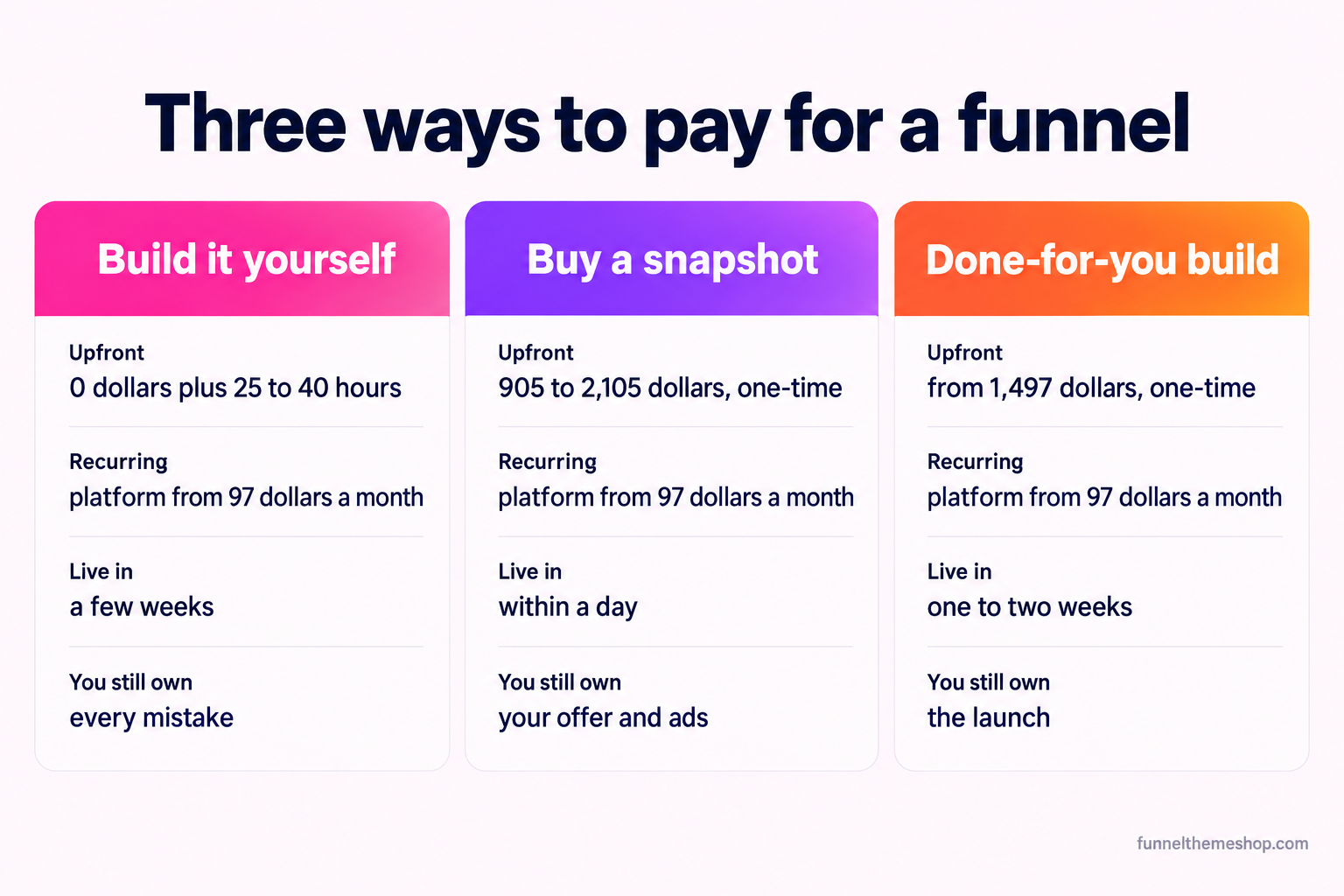
The headline cost is zero, and the headline cost is the lie. You already pay for the platform, so building your first funnel inside it feels free, and it is free the way cooking for yourself is free: only if your time is worth nothing. A first funnel built by someone learning the builder as they go realistically takes somewhere between 25 and 40 hours once you count the restarts, the automation that will not fire, and the mobile layout that breaks after it looked fine on the desktop. Put your own number on an hour. If an hour of your time is worth $50, that first funnel cost you somewhere between $1,250 and $2,000 of time you did not invoice, and you paid it in evenings. The cash cost was nothing. The real cost was a fortnight.
That is not an argument against building it yourself. It is an argument for counting the hours honestly, because the next funnel is far faster once you know the tool, and if you are going to run many funnels the learning is an investment rather than a tax. Build it yourself when you have more time than money, when you want to understand the machine, or when you are going to do this enough times that the first slow one pays for itself.
Path two: buy a snapshot and import it
A snapshot is the build, done once and handed to you as a file you import into your own account. You are not renting it and you are not paying monthly for it. You pay once, you import it, and the pages, forms, automations and follow-up arrive already assembled and already wired to each other. On this site the snapshots run from $905 for the Salon and Barber funnel up to $2,105 for the Mortgage funnel, one-time, and what lands in your inbox is a snapshot share link and a PDF with the full installation instructions, within 24 business hours of the order. Installation is not required, because the PDF is a real self-install path rather than a courtesy attachment, but if you would rather hand the import off it is an optional $175 add-on. There is no monthly fee on the snapshot itself, ever. You still pay the platform, and you still write the offer, but the build, the one cost that eats a fortnight on path one, is already paid.
The thing to understand about a snapshot is what it is not. It is not the offer, it is not your market, and it is not your ad spend. It is the structure, the part that is identical whether a hundred businesses or one runs it, built correctly so nothing is sitting in draft when the first lead arrives. If you have never imported one, what is a GoHighLevel snapshot walks through exactly what travels in the file and what does not. Buy a snapshot when you want a proven structure live this week and you are confident about the offer you are going to pour into it.
Path three: hire the whole thing out
The third path is paying someone to do the build and, usually, the assets with it. This is where the quotes get large and also where they get vague, so it pays to know what you are buying. A one-time done-for-you build on this site is the custom funnel build at $1,497, which is the structure plus the funnel copy rewritten for your specific offer and a tested end-to-end pass before it goes live. That is a different and larger job than the standard import, which is why the snapshot install and customisation service sits lower at $397: one rebrands and tests a snapshot you already bought, the other builds and writes from your offer up. If an existing funnel is losing money and you want eyes on why before you rebuild anything, the funnel rescue and audit is $697 and is the cheapest honest first step when you are not sure the problem is the build at all.
Where done-for-you gets genuinely expensive is the retainer, the monthly arrangement where someone owns the funnel and keeps working on it. The monthly funnel retainer is $1,997 a month, and it buys something the one-time paths do not: ongoing optimisation, new funnels as you need them, and someone whose job is the thing you would otherwise do at midnight. It is the right answer for a business that runs many funnels and wants none of them to be its problem. It is the wrong answer for a business that needs one funnel built once, and confusing the two is the single most expensive mistake in this whole teardown.
The one-time versus recurring trap
Here is the arithmetic that quietly decides which path is cheap and which is ruinous, and it has nothing to do with the sticker prices. It is whether the cost is one-time or recurring, run out over the time you will actually keep the funnel. A one-time cost is a line that jumps once and then goes flat. A recurring cost is a line that climbs every month forever. Compare them at a single point in time and the recurring one often looks cheaper, because one month of it is smaller than the one-time number. Run them out over two years and the lines cross early and then diverge hard.
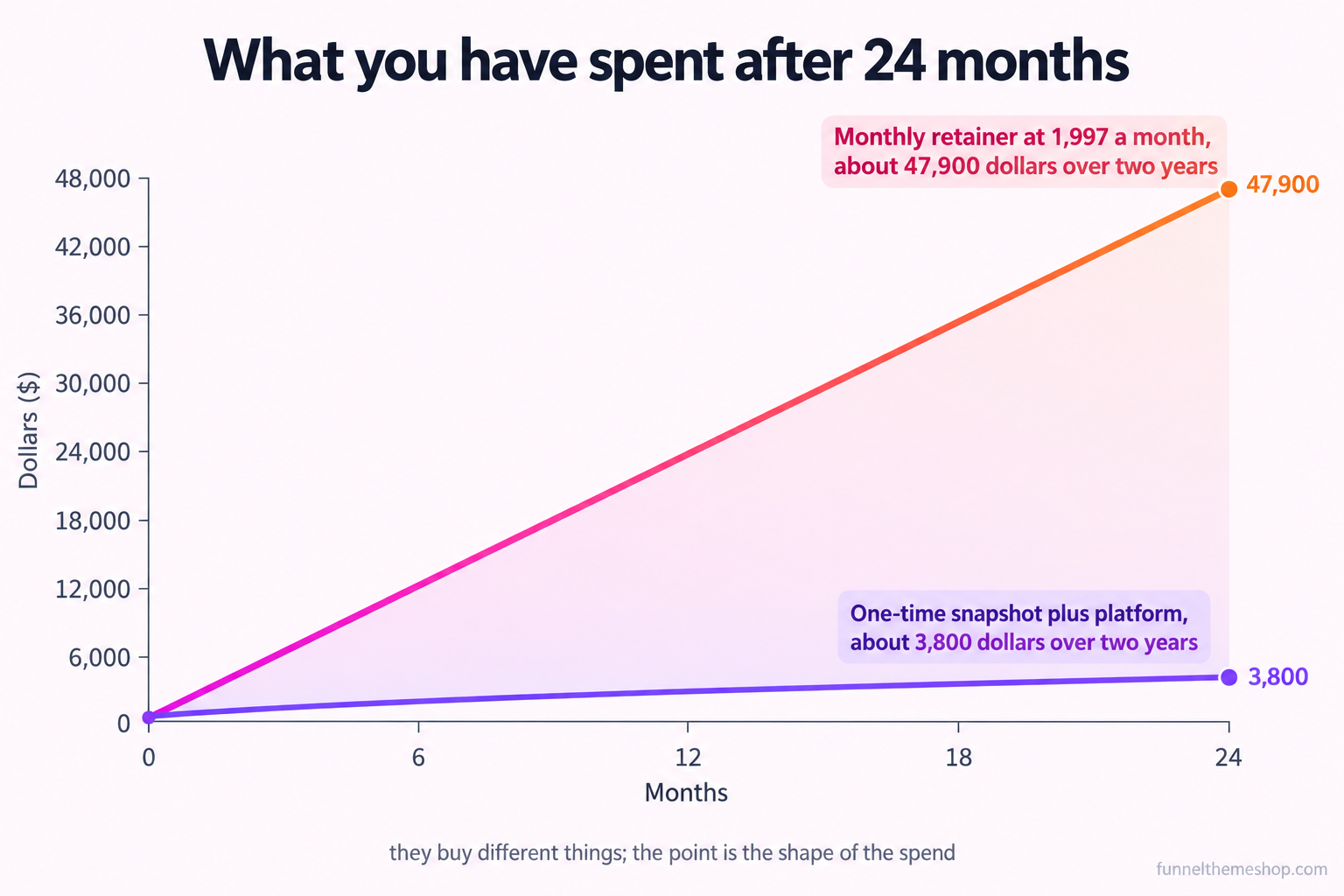
Put real numbers on it. Say you run the HVAC funnel for two years. On the snapshot path you pay $1,305 once for the build, optionally $175 to have it imported, and then the GoHighLevel Starter plan at $97 a month across the twenty-four months, which is $2,328 of platform. The whole two years lands around $3,800, and almost all of that is the platform you would have paid on any path. On a $1,997 a month retainer the same two years is $47,928. Those two numbers are not describing the same product, and that is the point to hold onto: the retainer is buying ongoing work and new funnels, the snapshot is buying one build. But if what you need is one build, paying for one build and then paying it again every month for two years is how a funnel that should have cost less than four thousand dollars ends up costing forty-eight.
This is also the honest answer to the person who swears GoHighLevel is expensive because a template tool is cheaper a month. The platform is recurring on every path, so it is a wash. What is not a wash is paying a monthly fee for the build itself, over and over, for an asset you could have bought once. Run the cost out over the life of the funnel before you decide anything.
Four ways a funnel budget blows up
When a funnel costs far more than it should, the overspend is almost never in the sticker price. It is in one of these four places, and they are listed in the order they most often do the damage. Find the one that matches your situation and fix that before you spend another dollar.
1. The cheap platform and the expensive learning curve
The symptom is a build that is technically free and has quietly eaten a month of your life. You picked the cheapest tool, you are building it yourself to save money, and three weekends in the automations still do not fire the way you expected and you have rebuilt the opt-in page twice. The cause is that you moved the build cost from money to time without counting the time. The fix is to put your real hourly number on the hours you have already spent, compare it honestly against the one-time cost of a built structure, and decide whether the next twenty hours are an investment in a skill you will reuse or a tax you are paying out of stubbornness. Both answers are legitimate. Paying the tax by accident is not.
2. The free snapshot that costs a rebuild
The symptom is a funnel you imported for nothing that you are now rebuilding for a week. The free-snapshot circuit in the Facebook groups is real and some of the files are genuinely useful, but free means no installation instructions written for that specific funnel, no updates when something in the platform changes underneath it, and no way to tell whether the automations were left in draft by whoever exported it. The cause is treating acquisition cost as total cost. The fix is to count what the rebuild costs you in the same hours as path one, because a file you spend thirty hours repairing was not free, it was a build you paid for in time and then had to debug blind. A paid snapshot is partly buying the thing the free one never includes: the PDF that tells you the import order, and a known-good state on the day you load it.
3. The retainer with no exit
The symptom is a monthly invoice for a funnel that has not changed in six months. A retainer is the right tool for ongoing work, but it only earns its price while there is ongoing work to do. The cause is signing up for a monthly arrangement to get a one-time thing built, then never cancelling because the funnel is working and nobody wants to touch it. The fix is to be honest about whether you are buying a build or buying a relationship. If the funnel is built and stable and you are not launching new ones, you are paying rent on an asset you already own, and a one-time build followed by the platform fee alone would have cost a fraction of it. Keep the retainer when it is producing new work. Drop it the month it stops.
4. The integration you did not know was separate
The cruel one, because the funnel itself is priced correctly and the bill still comes in higher than the quote. Connecting the funnel to an outside CRM, a job-management tool, an accounts package or any software that lives outside GoHighLevel is real engineering rather than configuration, and on this site it is explicitly quoted separately rather than bundled into any package. Installation is an optional $175 add-on rather than a requirement, and that add-on covers importing, rebranding, the texting registration and the domain email setup, but third-party integrations, third-party software and custom development sit outside it on purpose. The cause is assuming the funnel price includes wiring it into your existing stack. The fix is to ask for the integration to be priced before you buy anything, so it is a known line with a date rather than a surprise after launch. The honest version of a quote tells you where this line is up front, which is the whole reason the scope is published rather than discovered halfway through.
Which path to actually pick
The decision is not about which path is cheapest in the abstract, because they buy different things. It is about matching the path to your situation: how much time you have against how much money, how many funnels you are going to run, and how confident you are about the offer you are pouring in. Here is the honest version.
| Your situation | Best path | What it costs | What is still yours to get right |
|---|---|---|---|
| Time to spare, one funnel, and you want to learn the builder | Build it yourself | Platform from $97/mo, plus 25 to 40 hours | Every decision, and every mistake along the way |
| You want a proven structure live this week and will run your own offer | Buy a snapshot | One-time $905 to $2,105, optional $175 install | The offer, the copy for your market, the ad spend |
| You want it built, written and tested around your specific offer | Done-for-you build | From $1,497, one-time | The traffic and the follow-up after it goes live |
| Many funnels, ongoing work, and you want none of it to be your problem | Monthly retainer | $1,997/mo while there is work | Deciding, each month, whether the work still justifies the fee |
Read the last column, not the third. The money you spend on any path is the small part. The part that decides whether the funnel makes money is the offer and the traffic, and no path buys you those. A snapshot hands you a correct structure so that the only things left to get right are the things only you can get right. A done-for-you build hands you the structure and the copy so the only thing left is the traffic. A retainer hands you all of it for as long as you pay. None of them hands you a market that wants what you sell, which is why the cheapest honest first step, when you are not sure, is usually a conversation rather than a purchase.
Three objections you are already making
"A snapshot costs more than a month of ClickFunnels"
It does, and it should, because they are not the same thing. A month of ClickFunnels is the platform, the recurring floor you pay on every path including the one where you buy a snapshot. The snapshot is the build, the one-time cost that a platform subscription never includes no matter how many months you pay it. You are comparing a recurring rental against a one-time asset. Run both out over the two years you will keep the funnel and the snapshot is a single line early on while the subscription climbs the whole way, on either platform. The snapshot does not replace the subscription. It replaces the fortnight you would otherwise spend building on top of it.
"I can get snapshots free in Facebook groups"
You can, and some are worth having. The question is what free leaves out, and it leaves out exactly the parts that cost you time later: instructions written for that funnel, a known-good state on import, updates when the platform shifts, and any assurance that the automations are live rather than sitting in draft. The failure mode above is the whole answer here. A file you spend thirty hours repairing cost you a build in hours, you just paid it after the download instead of before. Free is the right call when you have the time to debug it and the skill to tell a good file from a broken one. If you have neither, free is the most expensive path on the page.
"Why not just hire a cheap VA to assemble it"
Sometimes that is exactly right, and the honest version of a services quote will tell you when the work is repetitive rather than technical and put a trained VA on it because it is cheaper. A VA can import a snapshot, rebrand the pages and connect the obvious pieces perfectly well. What a VA cannot do, and what nobody cheap can do, is set the front-end price that survives your costs, choose the offer your particular market will actually buy, or diagnose why the funnel that looks right is losing money. That is the expensive judgement, and it is the part worth paying for. The assembly is the part worth paying as little as possible for. Problems come from paying VA rates for judgement or agency rates for assembly, and the fix is to know which one you are buying. The unit economics underneath that judgement, for a low-ticket offer at least, are laid out in tripwire funnel economics.
Run the total, not the sticker
A funnel does not have a price. It has four costs, two that recur and two that do not, and three ways to pay for them that buy genuinely different things. The number that matters is not any single sticker on any single path. It is the total: the platform across the months you will run it, plus the build however you choose to pay for it, plus the assets you will write either way, plus the ongoing sends and upkeep. Add those up over the real life of the funnel, be honest about what your own hours are worth, and the right path is usually obvious once the comparison is finally like for like.
If you already know the offer and you want the structure correct on day one, a snapshot is the cheapest route to a funnel that is not fighting you. If you are not sure the problem is even the build, a short honest conversation costs less than any of the paths and will tell you which one you are actually looking at.
Frequently asked
How much does a GoHighLevel funnel cost in total?
There is no single figure, because a funnel is four costs: the platform subscription (GoHighLevel from $97 a month), the build, the assets and the ongoing sends. The build is the part that varies: free if you spend 25 to 40 of your own hours, a one-time $905 to $2,105 for a snapshot you import, or from $1,497 for a done-for-you build. The platform recurs on every path.
Is it cheaper to build a funnel myself or buy a snapshot?
It depends on what your time is worth. Building it yourself has no cash cost but a first funnel realistically takes 25 to 40 hours. At $50 an hour that is $1,250 to $2,000 of time. A snapshot is a one-time payment that hands you the build already assembled, so you only pay with time for the offer and the launch, not the structure.
Does a snapshot have a monthly fee?
No. A snapshot is a one-time purchase. You pay once, import the share link into your own GoHighLevel account, and there is no recurring charge on the snapshot itself. You still pay the GoHighLevel platform subscription, which is the same on every path, but the snapshot is bought outright and the updates are free.
What is not included in the price of a funnel?
On this site the snapshot price covers the build and a self-install PDF. The optional $175 add-on covers importing, rebranding, the A2P texting registration and domain email setup. Third-party integrations, third-party software and custom development are real engineering jobs and are quoted separately, with a fixed price and a date before anything starts.
When is a monthly retainer worth it over a one-time build?
A retainer at $1,997 a month earns its price while there is ongoing work: new funnels, continual optimisation, someone owning the whole thing. It is the wrong tool for a single funnel built once, where a one-time build plus the platform fee costs a fraction of the same two years. Buy the retainer for a relationship, not for one asset.
Related guides
More funnel guides
GoHighLevel vs ClickFunnels: Which One Your Business Actually Needs
Both build funnels. They disagree about what happens after the form is submitted, and that disagreement is the entire comparison.
11 min readStrategyTripwire Funnel Economics: What a $27 Offer Really Costs
Forty front-end sales and the ad account is still underwater. A tripwire funnel lives or dies on the arithmetic after the first sale, and here is the whole of it, line by line.
13 min readStrategyThe Best Funnel Builder for Agencies: 5 Tools Scored on the 8 Things That Matter
You have a client waiting and a tab open on five funnel builders, all of them shouting "unlimited". Here is the same five scored on the eight things that decide it, with the yearly cost of running ten client funnels worked out in full.
14 min readFunnel snapshots · done-for-you builds
Pick a funnel, or hand us the offer
Buy the snapshot and it lands within 24 business hours as a share link and an installation PDF, add the $175 install if you would rather not do it yourself, or hand us the offer and we build the whole thing.
All sales final once the snapshot link is sent · free updates for life · one licence covers every sub-account you own