Strategy
January intake funnels for gyms and clinics
A gym signs up 200 people in the first two weeks of January and half of them have vanished by March. That is not a marketing problem. It is a funnel with no floor under it, and this is how to build the floor.
It is the second week of January and a gym owner is looking at the best two weeks of signups she has had all year. The New Year rush is real. People decided over the holidays that this was the year, and the door has not stopped moving since the 2nd. She adds it up and it looks like a record quarter. Then she checks the same list at the start of March. More than half of the people who joined in that rush have stopped coming, and a good chunk of them have cancelled the direct debit too. The record quarter was a record fortnight with a long, quiet tail.
This is the shape of January for almost every gym, studio, chiropractic clinic, physio room and med-spa that runs on repeat visits. The demand arrives in a wave you did not have to earn, and then it drains out through a hole in the floor. Owners treat the wave as the whole story and spend December planning how to catch more of it. The wave is the easy part. The floor is the whole game, and the floor is a funnel job, not an ad job.
A January intake funnel is not a landing page you switch on for two weeks. It is the whole path from the first click to the second month of membership, built so the person who joins on impulse on January 3rd is still showing up when the impulse has worn off. This piece is that build, page by page: the offer that decides everything downstream, the pages that carry it, the arithmetic that tells you what a January joiner is actually worth, the four places the money leaks out, and the honest cases where a funnel is not your problem.
What actually happens to a January cohort
Start with the buyer, because the whole funnel is built around what is going on in their head. A New Year joiner is not a normal customer. A normal customer has a specific problem and goes looking for a fix this week. A January joiner has a resolution, which is a much weaker thing. It is a wish with a date attached. They are buying the feeling of having started, and that feeling is fully delivered the moment they hand over the card. The workout has not happened yet and the feeling is already banked.
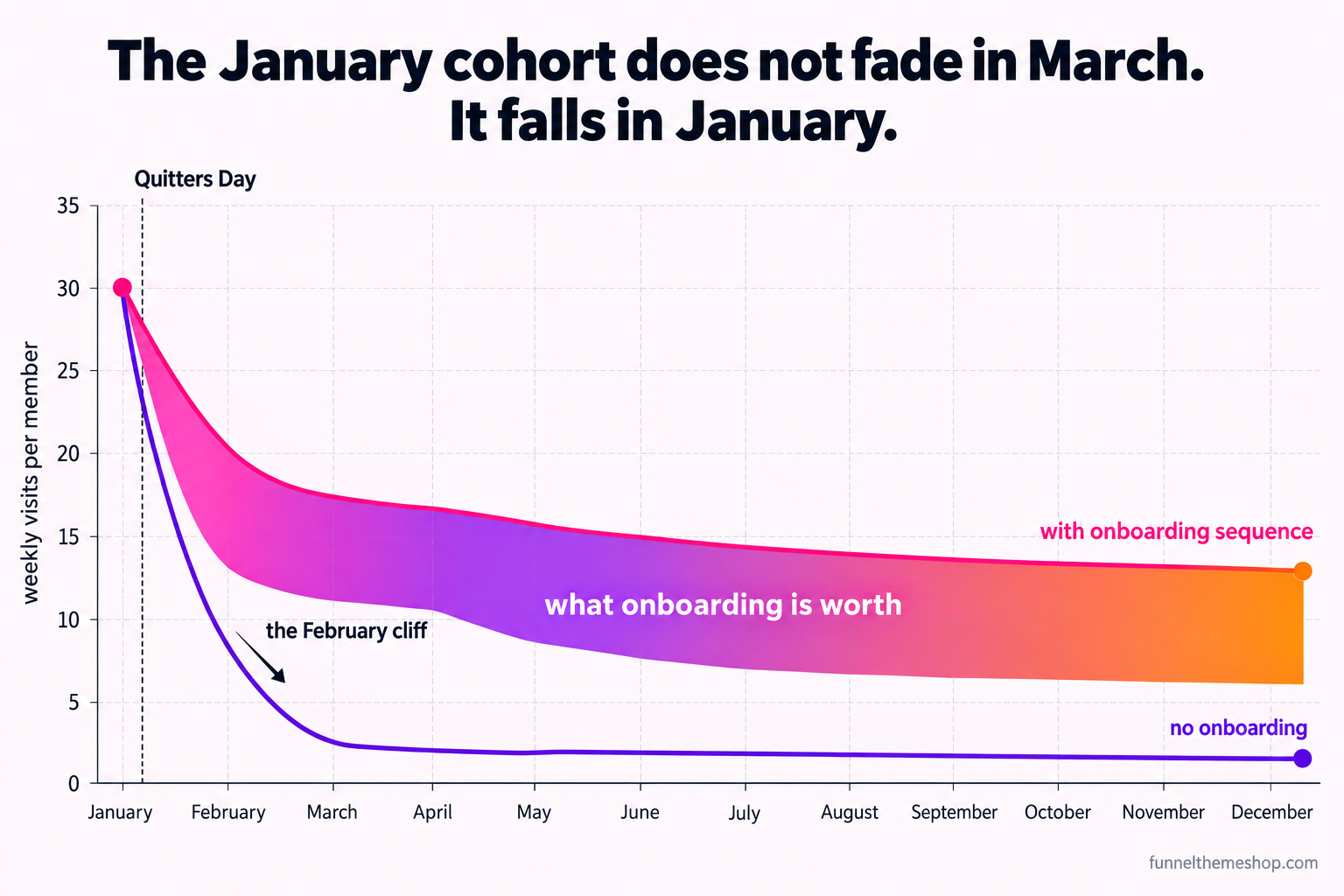
That is why the cliff is so steep. The purchase satisfied the emotion that drove it. Every week after that, the membership has to be justified by something real, an actual visit, an actual result, an actual habit, and most people never get far enough for the real thing to take over from the feeling. Strava, off its own members' activity data, named the point where resolutions collapse "Quitter's Day" and puts it on the second Friday of January (Strava, reported via search snippet, not independently fetched, September 2026). The gym does not lose the cohort in March. It loses them in the second week of January and finds out in March when the payments stop.
So the funnel has two jobs that pull in different directions. The front of it has to convert a low-commitment impulse fast, before the person talks themselves out of it. The back of it has to manufacture the real reason to stay before the impulse fades. A funnel that only does the first job is a machine for collecting cancellations. Most January funnels only do the first job.
The clinics have a gentler version of the same curve. A chiropractic practice or a physio room gets a New Year wave of people who have decided to finally deal with the back that has bothered them for a year, and a med-spa or wellness studio gets the "new me" bookings. Same psychology, same cliff, one extra wrinkle: a clinic sells a course of care, not a monthly habit, so the drop shows up as people who book the first assessment and never rebook the plan. The funnel job is identical. Convert the wave, then build the reason to come back before the wave forgets why it came.
The intake funnel, page by page
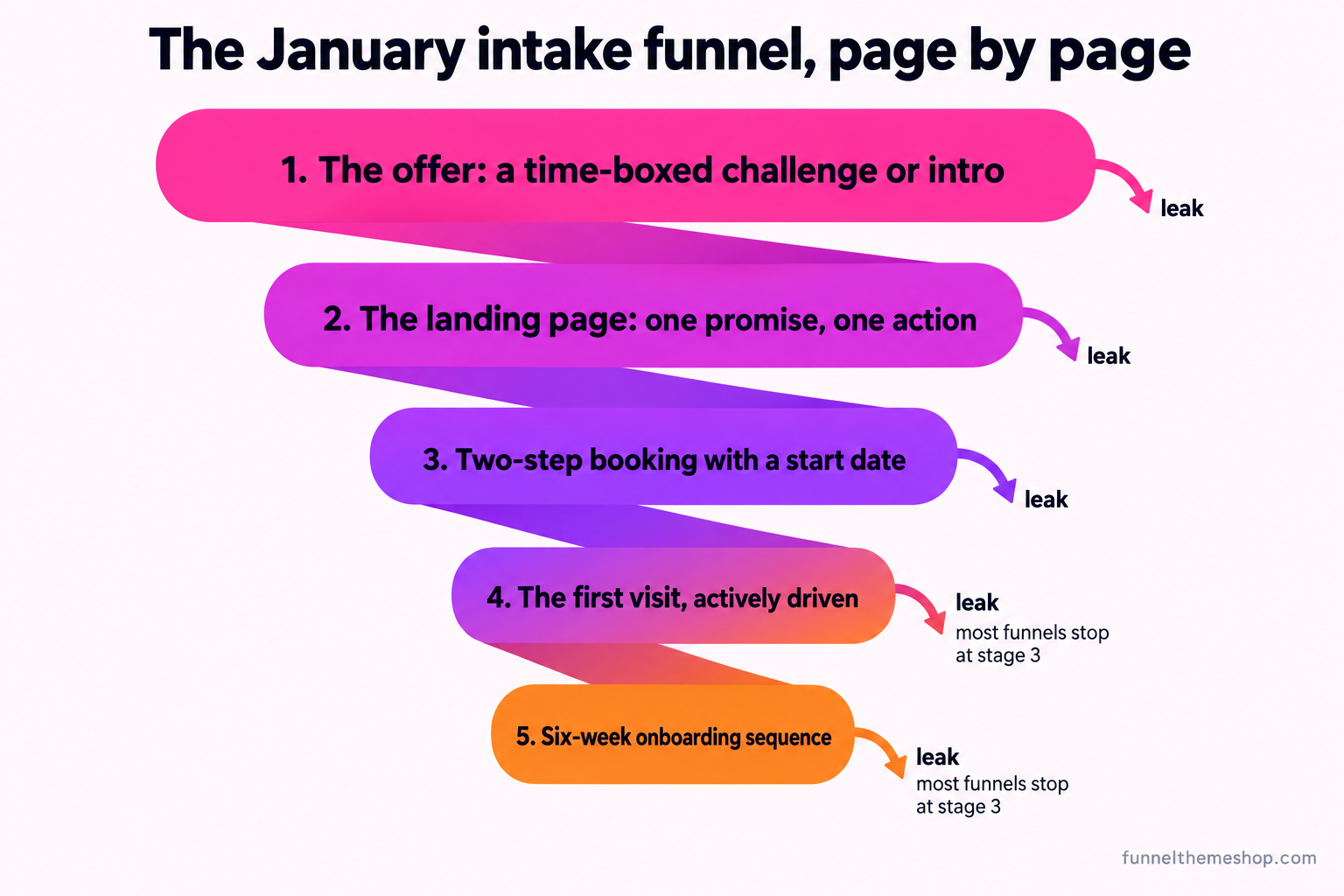
Here is the whole path. Five stages, and the two that owners skip are the two that decide February. This is the same logic the rest of the GoHighLevel funnel builder approach runs on: the offer and every page that carries it are one system, and a step you leave out does not disappear, it just leaks quietly.
The offer decides everything else
The single biggest choice you make is what the January offer actually is, because it sets the ceiling on everything downstream. A plain "join now, first month half price" is the worst option, and it is the one everyone runs. It discounts the thing you most want at full price, it attracts the most price-driven and least committed buyers, and it gives them nothing to finish, so they drift the moment the discount month ends.
The offer that works is time-boxed and has a finish line. A six-week challenge. A 21-day reset. A "new year, four sessions and a plan" intro for a clinic. The finish line is the point. It gives the impulse a container it can succeed inside, it lets you sell at close to full value because a challenge is a program rather than a discount, and it hands you a natural moment to sell the ongoing membership, which is the day the challenge ends and the person has a result they do not want to lose. You are not selling a year on January 3rd. You are selling six weeks, and using the six weeks to earn the year. That is a value ladder, and it is worth reading how the rungs connect in the value ladder funnel before you price the January step.
The landing page: one promise, one action
January traffic is colder and more distracted than any other time of year. People are clicking from a phone, on the sofa, half-watching something, driven by a vague resolution rather than a sharp need. A landing page that asks them to think loses them. The page carries one promise in the headline, the challenge or the intro and what they will have at the end of it, one block of proof that real people like them have done it, one clear statement of what it costs and when it starts, and one button. Everything else is a leak. The full anatomy of a page that holds cold traffic is in the high-converting landing page breakdown, and January is when its rules matter most, because the traffic has the least patience of the whole year.
The one January-specific rule: put the start date on the page. "Starts Monday the 12th" does more work than any urgency badge, because it turns a someday decision into a this-week decision, and it is true, which a fake countdown is not. A cohort with a start date also gives you a reason to follow up with the people who did not finish signing up: the start date is coming, the group is filling, decide now.
The two-step booking, and where it bleeds
Whether the next step is a checkout for a paid challenge or a booking for a free assessment, split it into two steps and put the small ask first. Step one asks for the name and email or phone only. Step two asks for the payment or the appointment slot. This is not a cosmetic choice. The moment someone completes step one you have their contact details, so if they abandon at step two you can still reach them, and a meaningful share of January signups abandon at step two because the sofa-and-phone buyer gets interrupted, not because they changed their mind.
That abandonment is not a small tax. Across fifty separate studies the Baymard Institute puts the average documented shopping-cart abandonment rate at 70.22% (baymard.com/lists/cart-abandonment-rate, confirmed via search snippet, not independently fetched, September 2026). Seven in ten people who start a checkout do not finish it on a normal day, and a distracted January rush runs worse. The two-step form is what lets you win a portion of those seven back, because you captured them before the step they bled out on. A one-step form that asks for the card first captures nobody who does not finish. If your funnel is getting traffic and not converting it, the diagnostic path in traffic but no opt-ins is the place to start, and the two-step form is usually the first fix.
The first visit is a funnel step, not an afterthought
This is the stage nobody builds, and it is the hinge of the whole thing. Signing up is not the conversion. The first visit is the conversion, because the first visit is where the abstract resolution becomes a real experience that can either take root or confirm the person's quiet suspicion that this was a waste. A person who joins and never comes in even once is gone, and they are the largest single group in a lapsed January cohort.
So the funnel has to treat "booked the first visit" as a step it actively drives, not a thing it hopes happens, which is exactly what a booking funnel is built to do. The confirmation page books the first session there and then, with a specific time, not "come in whenever". The automated follow-up in the hours and days before that first visit does the job a good front-desk person would: confirms the time, says what to bring, tells them where to park, names the coach or clinician they will meet. This is exactly where a fast, automatic response earns its keep. Fresh intent decays fast, and the practices that reach a new lead while the decision is still warm convert far more of them than the ones who follow up the next day, which is the whole finding behind the Harvard Business Review study "The Short Life of Online Sales Leads" (hbr.org/2011/03/the-short-life-of-online-sales-leads, confirmed via search snippet, not independently fetched, September 2026). The gym or clinic snapshots we build carry that first-visit sequence as standard, and its no-show recovery is tuned toward a 70% recovery target rather than left as a hopeful reminder.
The onboarding sequence that beats February
The last stage is the one that separates a gym that grows in January from one that just churns faster in January. The first six weeks after a person joins is a sequence, planned in advance, that manufactures the real reasons to stay before the impulse runs out. A check-in after the first visit. A nudge when someone has not been in for five days, before they have mentally quit rather than after. A small win marked and celebrated at two weeks. The offer to roll from the challenge into a membership landed on the day the challenge ends, when the result is fresh, not a fortnight later when it has faded. None of this is heavy. All of it is automatic. All of it is the difference between the low line and the high line on that first chart.
Build this in October, not on January 2nd. The intake funnel that works is the one that is already tested, already connected to your calendar and your payment provider, already sending real confirmations, before the wave arrives. A funnel you are wiring up on the 2nd while signups are coming in is a funnel that drops its first cohort on the floor.
The numbers, with the assumptions showing
Owners chase the wrong number in January. They count signups. Signups are the vanity number. The number that pays the rent is how many of those signups are still paying in month three, and a funnel with a strong back end can double that without adding a single new lead. Here is the arithmetic, with every assumption on the table so you can swap in your own.
Say a gym sells a membership at $49 a month and signs up 200 people across January off the back of a six-week challenge. Say, with the usual front-loaded funnel and no real onboarding, 35% of them are still paying at month three. That is 70 members, worth $3,430 a month, or about $41,000 over the twelve months if that group holds. Now say the same 200 signups run through a funnel with the first-visit sequence and the six-week onboarding above, and month-three retention lifts to 55%. That is 110 members, worth $5,390 a month. Same wave, same ad spend, same 200 people. The back end of the funnel just added 40 members and roughly $23,500 of annualised revenue, and it did it with automation that was built once.
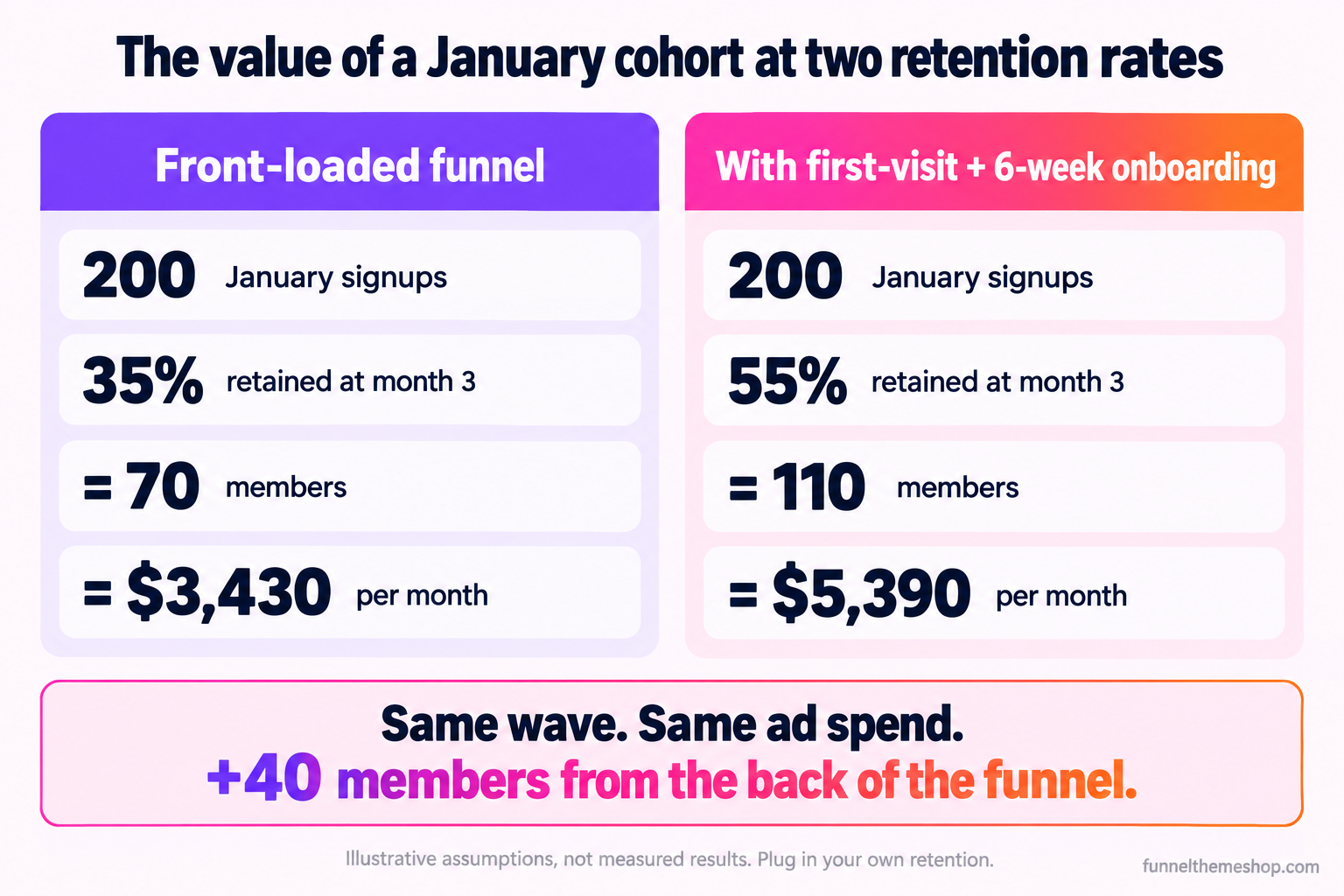
The retention percentages above are illustrative. They are not a promise and they are not measured results from our snapshots, they are round numbers to show the shape of the maths. For a sense of scale on the real industry, the Health & Fitness Association put average annual member retention at 66.4% in its 2025 benchmarking report, which is roughly a third of members lost across a full year on average, and January cohorts churn faster than the average because of everything above (healthandfitness.org, confirmed via search snippet, not independently fetched, September 2026). Pull your own month-three retention from last January and run the same sum. The conclusion does not depend on the exact figures. Because the cost of acquiring the January wave is largely fixed and mostly already spent, almost every point of retention you add drops straight to the bottom line. Spending December fighting for 10% more signups is far harder and far less valuable than spending October building the sequence that keeps 20% more of the signups you were going to get anyway.
The clinic version runs on a different unit but the same principle. A chiropractic new-patient offer might sell an assessment and first adjustment at a low intro price, where the real value is the care plan that follows. If the intro converts a wave of 60 new patients and 40% take the plan, that is 24 plans. Lift the intro-to-plan conversion with a proper first-visit experience and a follow-up that books the second appointment before the patient leaves the first, and the same 60 assessments carry more plans without a single extra ad. The unit changes from a monthly membership to a care plan. The leak, and the fix, are the same.
Where January intake funnels leak
Four failure modes account for most of the money that runs out of a January funnel. Each has a symptom you can see, a cause underneath it, and a fix that lives in the funnel rather than in working harder.
Signups are strong and nobody comes to the first session
The symptom is a full member list and empty classes in week two. The cause is almost always that the funnel ended at the payment. It collected the card and said "welcome" and did nothing to drive the specific act of turning up for the first session. The fix is the first-visit stage above: book a named time on the confirmation page, not "come in soon", and run the confirmation and reminder sequence toward that time. A booked, confirmed first session at a set time shows up. A vague open invitation does not.
The challenge sells and nobody converts to a membership
The symptom is a great January and a dead February, with the challenge cohort simply evaporating when the six weeks end. The cause is that there was no planned moment to make the ongoing offer, so it either never got made or got made two weeks too late over a limp email. The fix is to build the rollover into the funnel: the membership offer is presented on the last day of the challenge, in person and in the automation, framed as keeping the result they just earned rather than starting something new. The day the challenge ends is the highest-intent moment you will get with that person all year. A funnel that does not have an offer waiting there is leaving the entire point of the challenge on the table.
Leads sit for hours before anyone responds
The symptom is a pile of form fills that never became bookings, and a nagging sense that the leads were low quality. Usually they were not low quality, they were cold by the time anyone reached them. New intent has a short shelf life, and a January lead who filled a form on Sunday night and heard nothing until Tuesday has already joined the place that texted back in five minutes. The fix is an automatic first response the instant the form is submitted, day or night, that does something useful rather than saying "we will be in touch". Book the slot, answer the first question, send the start date. The automation does not replace the human follow-up, it buys the time until the human can call.
The funnel fills classes the business cannot staff
The symptom is a January that worked too well: overbooked classes, a waitlist for the assessment, and a first experience that is worse than usual precisely because so many people showed up. This one is a good problem that a funnel can quietly make worse, because a funnel with no capacity awareness will keep selling a start date it cannot honour. The fix is to cap the cohort and say so on the page. A capacity limit that is real does two jobs at once: it protects the first-visit experience that decides retention, and it is the most honest urgency there is. "Twenty places in the January intake, then the next cohort is March" converts better than any discount and never trains a customer to wait for a lower price.
Which intake offer fits your business
The January offer is a choice about how your business makes money, not about how bold you feel. A membership business and a course-of-care clinic want different structures, and running the wrong one is how a good funnel produces a bad January. Use this to pick one, then build the whole funnel around it rather than hedging across three.
| Business | The January offer that fits | What the funnel must nail | The rollover that pays for it |
|---|---|---|---|
| Gym or fitness studio | A time-boxed challenge at close to full value | First-visit booking, then a five-day no-show nudge | Membership offered on the final day of the challenge |
| Chiropractic or physio | A low intro assessment plus first treatment | Booking the second appointment before the first ends | The care plan, presented at the first visit not by email |
| Med-spa or wellness | A new-year package or a prepaid series of visits | A firm start date and a real capacity cap | A membership or a rebooked series at the last visit |
| Dental practice | A new-patient exam-and-clean at a set intro price | Fast response and a booked, confirmed first appointment | The treatment plan and a booked recall at the exam |
The through-line across all four is the same: a front offer that has a finish line, a first visit the funnel actively drives, and a rollover offer waiting at the exact moment the front offer ends. Change the noun and the numbers, keep the shape. The gym runs it on a membership, the clinic on a care plan, the spa on a series, the dental practice on a recall, and every one of them lives or dies on stages four and five rather than on the headline.
The objections you are already making
Three arguments come up every time an owner reads this, and all three are worth taking seriously rather than waving away.
"January joiners are low quality, they always quit, so why invest in the funnel." Half true, and it is the wrong lesson. January joiners quit at a high rate under a funnel that does nothing to keep them, which describes most funnels, so the observation is accurate about the status quo. It is not a law of nature. The whole argument of this piece is that the quit rate is a property of the back of your funnel, not of the people. A cohort that gets a booked first visit, a five-day nudge and a real onboarding quits at a materially lower rate than the same cohort left to drift. You are not fighting the people. You are fixing the machine that was always going to lose them.
"I do not need a funnel, walk-ins and word of mouth fill January for me." Then January is exactly the month a funnel earns the most, because you already have the demand and you are almost certainly losing a chunk of it at the points above. A funnel does not have to manufacture the wave to be worth building. Catching 15% more of a wave you already get, and keeping more of what you catch, is a bigger number than most owners expect, and it does not require a single extra advert.
And the honest one: "a pre-built snapshot cannot know my specific January offer." Correct, and it is not supposed to. A snapshot gives you the funnel structure, the pages, the two-step forms, the first-visit sequence and the onboarding automation, already built and tested, so you spend your December writing your offer into a working machine instead of building the machine from scratch while the wave arrives. If you genuinely have no January offer worth running, and no capacity to serve a wave, then a funnel is the wrong purchase, and it will only help you lose people faster. A funnel accelerates whatever you point it at. Point it at a real offer with room to deliver, or do not point it at all.
That last case is real and we would rather say it than sell around it. The gym and fitness snapshot, and the chiropractic and spa ones beside it, exist to save you the build, not to invent a business you do not have. If you have the offer and the room, the structure is the slow part and it is the part that is already done.
Frequently asked
When should I build my January intake funnel?
In October, not January. The funnel that works is the one already tested and connected to your calendar and payment provider before the wave arrives. A funnel you are wiring up on the 2nd while signups come in drops its first cohort on the floor. Building it in the autumn also gives the page time to be found before the season peaks.
What is the best January offer for a gym?
A time-boxed challenge at close to full value, not a discounted first month. A six-week challenge gives the impulse a finish line to succeed inside, lets you charge for a program rather than mark down a membership, and hands you a natural moment to sell the ongoing membership: the day the challenge ends and the member has a result they do not want to lose.
Why do so many January members quit by February?
Because signing up satisfies the emotion that drove it. The resolution is banked the moment the card is handed over, and every week after that the membership has to be justified by a real visit and a real habit. Most people never get far enough for the real thing to take over, which is why cohorts collapse in the third week of January and the payments stop in March. A first-visit sequence and a six-week onboarding are what carry people past that point.
Do I need a paid ad budget to run a January intake funnel?
No. The New Year demand largely arrives on its own through search, walk-ins and word of mouth. The funnel exists to catch more of a wave you already get and to keep more of what it catches. If you do run ads, the same funnel converts them, but the back-end retention work is where the return is, not the ad.
What does a gym or clinic snapshot include for January?
The funnel structure built and tested: the landing page, the two-step booking or checkout, the first-visit confirmation and reminder sequence, and the onboarding automation across the first weeks. You write your specific offer and branding into it. It arrives as a share link and a PDF with the full installation instructions, and installation is an optional add-on rather than a requirement.
Related guides
More funnel guides
High-Converting Landing Page Anatomy: Every Block, Top to Bottom
A landing page is nine blocks doing nine jobs. Get the order right and the copy has somewhere to live. Get it wrong and you are decorating a page that argues with itself.
12 min readStrategyThe Value Ladder Funnel: How to Build One for a Service Business
Most value ladder explanations are drawn for course creators. Here is the version for a business that sends vans out, or books a chair, or takes a case — including the rungs you should not build.
10 min readStrategyThe Offer Stack: How to Build One That Does Not Sound Like a Scam
Stacking has a bad reputation because of the inflated-value tables it is famous for. The underlying mechanic is sound. Here is how to use it without the theatre.
10 min readFunnel snapshots · done-for-you builds
Pick a funnel, or hand us the offer
Buy the snapshot and it lands within 24 business hours as a share link and an installation PDF, add the $175 install if you would rather not do it yourself, or hand us the offer and we build the whole thing.
All sales final once the snapshot link is sent · free updates for life · one licence covers every sub-account you own