Guides
The GoHighLevel VSL funnel, page by page
A video sales letter is one recorded argument carrying the whole sale. The funnel around it decides when the buy button appears, who reaches it, and what happens to the people who stopped watching at minute three.
It is a Tuesday afternoon and an agency owner is looking at a funnel that is quietly failing. Her client sells a $500 online course, and three weeks ago they launched a page with a recorded sales video on it. The ad is working. Four hundred people have clicked through this week. The video has been played. And the sales report says four. Not four percent. Four people. She scrolls the page again and finds the quiet culprit sitting right under the player: a bright orange "Buy the course" button that has been visible since the second the page loaded, before the video said a single word about why anyone should want the thing. The button is not the mistake. The mistake is that there is no funnel around the video. There is a video, and a button, and a hope.
A video sales letter funnel is not a video on a page. It is a page built so the recorded argument carries the whole sale, a buy button timed to appear at the moment the argument lands, and a follow-up sequence keyed to how much of the video each person actually watched. Those three things are what separate a VSL funnel that returns five times its ad spend from a page that gets plays and no orders. This guide builds the whole machine in GoHighLevel, in the order you should build it, with the numbers that tell you whether it is working.
What a VSL funnel actually is
A video sales letter is one recorded video that does the entire pitch: it names a problem, makes the case that the problem is worse or more fixable than the viewer thinks, presents your offer as the answer, handles the obvious objections, and asks for the sale. The funnel is the page it lives on and the automations behind it. The video is the salesperson. The page is the room you walk them into, and the sequences are the follow-up calls your salesperson never has time to make. If you want the wider map of where a VSL sits among the other funnel types before you commit, the GoHighLevel funnel builder guide lays out the full set and the single job each one is built for.
It helps to say what a VSL funnel is not, because the three things it gets confused with each want a different build. It is not a webinar: there is no live event, no hour-long teaching session, no scheduled start time. It is not a plain landing page with a video stuck near the top for decoration, because on a VSL page the video is the argument and the written copy is the backup, not the other way round. And it is not a YouTube link you paste into a page, because a public video player sends people to the sidebar of related clips and strips you of the watch-time data the whole funnel depends on. A VSL funnel is a self-hosted video, a page that holds attention on it, and the tracking that tells you who watched what.
When a VSL is the right funnel, and when it is not
Pick a VSL funnel when the sale needs an argument before the price makes sense. If a stranger cannot understand why your offer is worth the money in a headline and three bullet points, you have an offer that needs teaching, and a recorded video is the cheapest way to teach the same argument to every visitor without you repeating yourself on sales calls. It fits best in the rough band of $200 to $3,000, where the price is high enough to need persuasion but low enough that people will still buy from a page without a human call. Coaching offers, courses, done-for-you services and software all tend to sit here.
Do not reach for a VSL when the buyer already knows exactly what they want and just needs to act. A homeowner whose water heater burst at 6am is not going to watch a twelve-minute video about the philosophy of plumbing. They want a phone number and a booking slot, which is a job for a booking funnel, and the block-by-block anatomy of the page that does it best is in high-converting landing page anatomy. A VSL is also the wrong tool for a true impulse buy under about fifty dollars, where the friction of watching costs you more sales than the argument wins back. The honest version of this advice is that our own product is not always a VSL: several of the snapshots in the catalogue are built around a fast booking page precisely because their trade sells on speed, not on persuasion.
| Funnel type | Best when | Buyer temperature | What does the selling |
|---|---|---|---|
| Plain landing page | The offer is self-explanatory and cheap | Warm or ready to act | A headline and a form |
| VSL funnel | The offer needs an argument, $200 to $3,000 | Cold to warm | One recorded video |
| Webinar funnel | The offer needs teaching plus live urgency | Warm, willing to book a time | A live or evergreen event |
| Application funnel | High price, you want to screen before a call | Warm, high intent | A qualifying form, then a human |
The two rows next to the VSL are the ones people confuse it with. A webinar does a similar job but asks the viewer to commit to a time and sit through an hour, and that structure is covered end to end in the GoHighLevel webinar funnel if the teaching genuinely needs an hour. An application funnel is what you graduate to when the price climbs past a few thousand and you want to filter before a human ever gets on the phone. A VSL sits in the middle: more persuasion than a landing page, less commitment than a webinar, no human required like an application.
The pages, built in order
A VSL funnel is fewer pages than a webinar, which is part of its appeal. There are three pages doing real work and one decision that comes before any of them. Build in this order, because each page assumes the one before it did its job.
1. The first fork: gated or ungated video
Before you build a page, decide whether the video plays immediately or sits behind an email opt-in. An ungated VSL plays the moment the page loads, so a cold visitor can start watching with zero friction, which gets more eyeballs on the argument but hands you no contact details until they buy. A gated VSL asks for a name and email first, then reveals the video, which costs you some viewers at the gate but means every watcher is a lead you can follow up even if they never reach the end. The rule of thumb: ungate when your traffic is cold and you are buying volume, because the video itself is your qualifier. Gate when your traffic is warmer, your offer is higher priced, or your follow-up sequence is where most of your sales actually close. A lot of mature funnels run ungated on paid cold traffic and gated on an email list that already knows the brand.
2. The VSL sales page
This is the page that does everything. At the top, a headline that names the outcome, not the video. "How we fill a coaching roster to capacity without discounting the offer" beats "Watch our sales video" because one is a reason to stay and the other is a chore. Directly under it, the player, large and central, with as little around it as possible so nothing competes for attention. Below the player, the buy button, which stays hidden until the video reaches the pitch. Under that, the written version of the argument for the people who will not watch video at all: the same proof, the same objections handled, the same offer, in copy. The page is the video with a safety net under it.
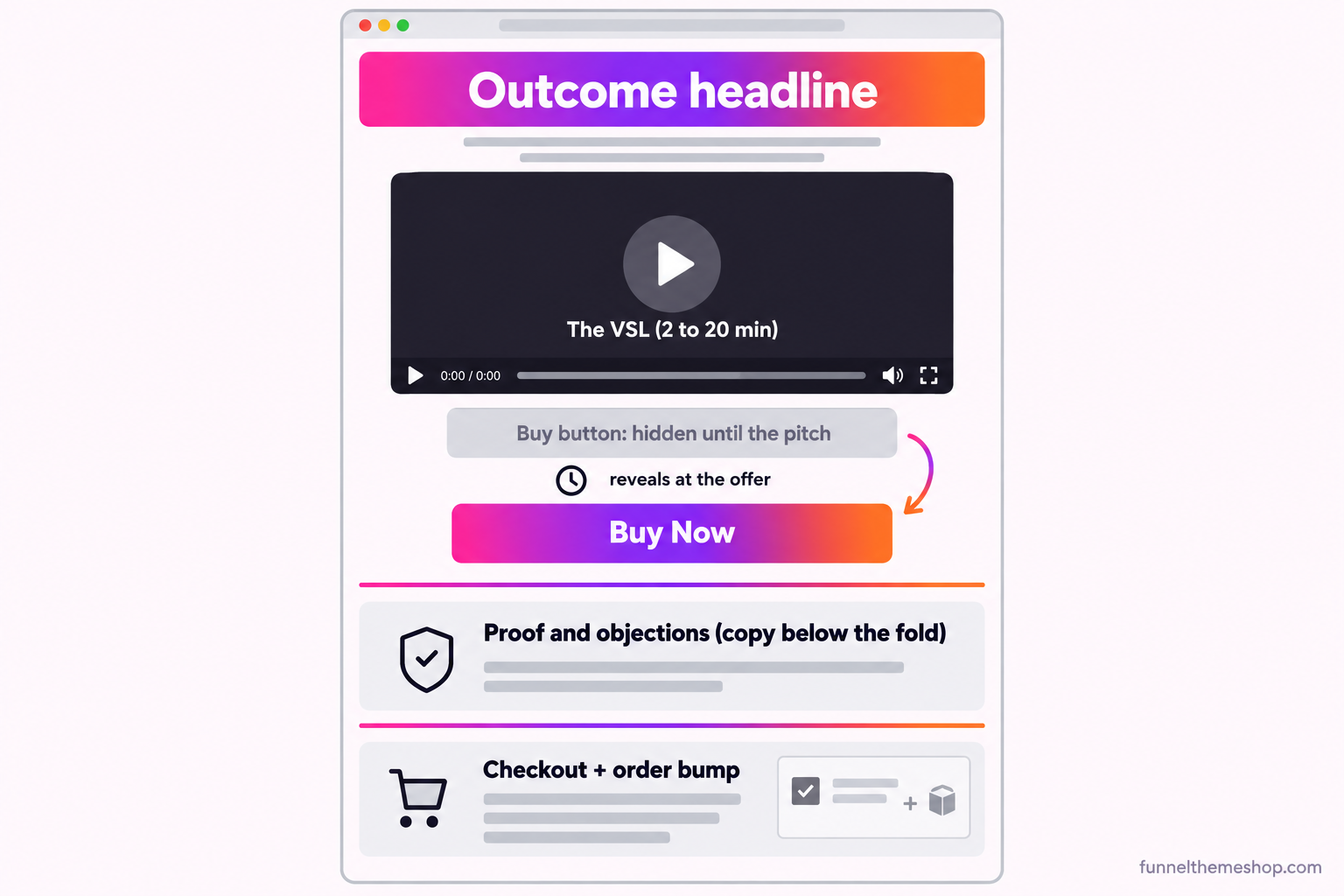
Two details on this page are worth getting exactly right. The player should be self-hosted or run through a video tool that reports watch time, not a bare public embed, because the watch-time data is what powers the follow-up later. And the page should have almost no navigation: no menu bar, no footer full of links, no other offers. Every link that is not the buy button is an exit, and on a VSL page you have paid to get attention onto one video and one decision. Strip everything that lets the visitor wander off before the argument finishes.
3. How long the video runs, and when the button appears
There is no single right length, but there is a shape to the data. Wistia, which hosts millions of business videos, found that average engagement holds roughly flat from one minute up to about five minutes, then starts dropping noticeably past five, and for straight sales presentations they suggest keeping to around three minutes (wistia.com/blog/optimal-video-length, confirmed via search snippet, not independently fetched). That does not mean a VSL has to be three minutes. It means that if yours runs twelve or twenty, every minute past the first five has to earn its place with an early hook that makes people want to stay, because the default behaviour of a viewer is to drift. Open with the single most surprising or useful thing you have, not with a two-minute throat-clearing introduction about your background.
The buy button should appear at the moment the video makes the offer, not before and not long after. Revealing it at second zero, which is the mistake in the Tuesday story at the top, tells cold viewers to decide before they have any reason to, so they leave. Hiding it until the very end, by contrast, frustrates the warm viewer who was ready to buy at minute four. The clean solution is a delayed button on cold traffic, timed to the offer in the script, and an always-visible button on warm retargeting traffic, because those people already decided and just need somewhere to click. If you are serious about finding the right reveal time, run it as a proper test rather than a guess, which is what GoHighLevel split testing is for.
4. The checkout, the order bump and the final-sale line
When the button is pressed, the viewer should land on a checkout that asks for as little as the sale allows, because every extra field is a chance to reconsider. This is the natural home for an order bump, the small tick-box add-on that rides along with the main purchase, and the difference between a bump and an upsell and where each belongs is laid out in order bump vs upsell. One rule that is not optional: if your terms are final-sale, the buyer has to see that before they pay, in the sentence they tick, not afterwards on the confirmation. A final-sale term disclosed only after the money has moved is unfair and, in much of the world, unenforceable.
5. The thank-you page and what happens next
The confirmation page is the most wasted page in most funnels, and a VSL funnel is no exception. A buyer who just paid is the warmest person you will ever talk to, and most pages reward them with a dead "thank you for your order" and nothing else. Use it: confirm the purchase plainly, set the expectation for what arrives and when, and give one clear next step, whether that is booking an onboarding call or watching the first lesson. The full argument for what that page is for is in your GoHighLevel thank-you page is doing nothing, and it applies doubly here because a VSL buyer bought on the strength of a video and now needs the real thing to live up to it.
The watch-time split: one video, four audiences
This is the part that turns a VSL page into a VSL funnel, and it is the thing almost nobody sets up. Your video tool can tell GoHighLevel how far each viewer got. Someone who bounced at eight seconds and someone who watched all nineteen minutes and did not buy are two completely different people, and sending them the same follow-up email wastes both. So you tag each viewer by the furthest point they reached, and you send a different sequence to each tag. Four buckets covers it cleanly.
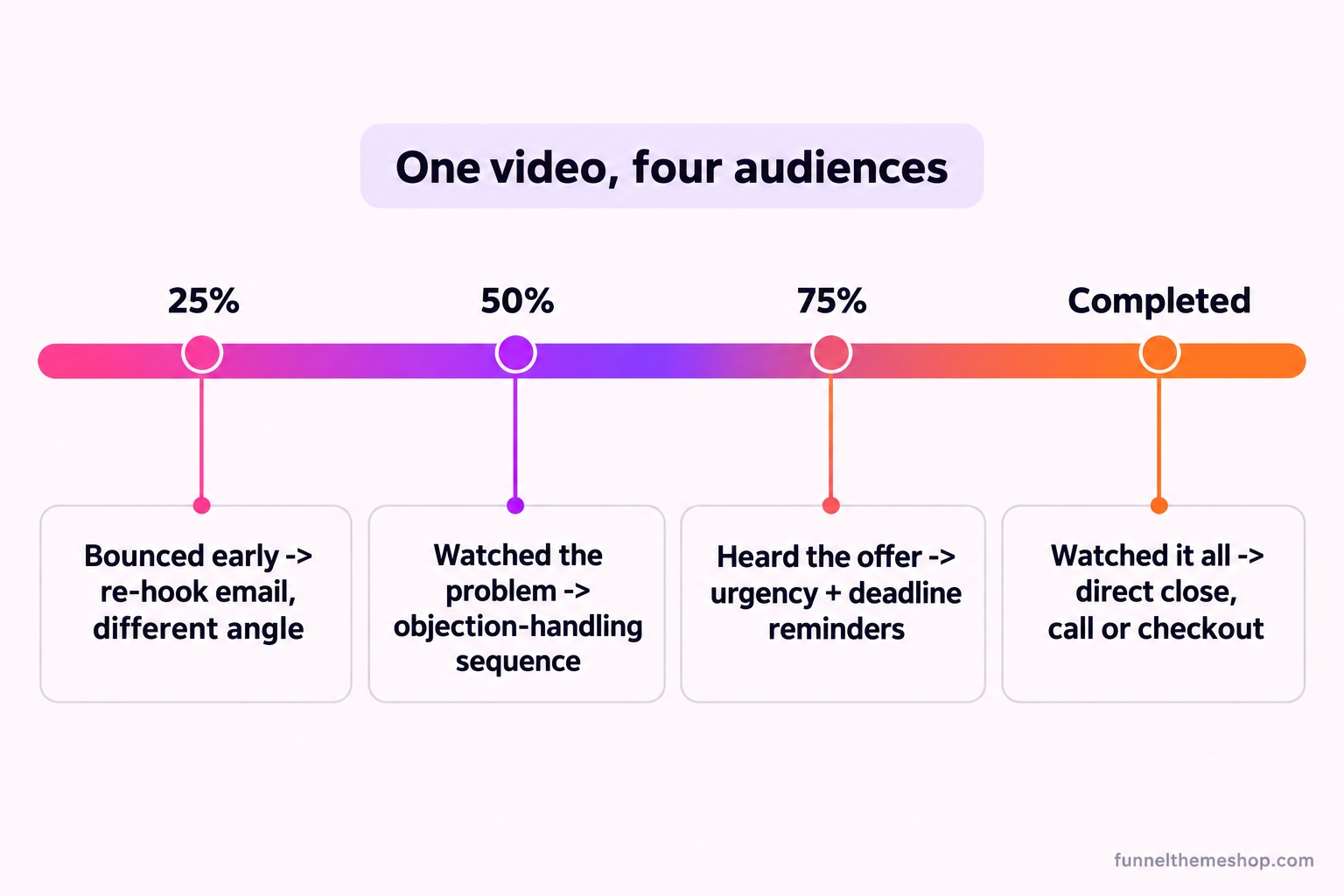
Setting it up in GoHighLevel is a workflow keyed off the video-tracking events your player sends. Someone who bounced before 25 percent never heard the problem, so a re-hook email with a fresh angle is worth more than a discount they do not understand yet. Someone who reached half heard the problem but left before the offer, so they get the objections handled in writing. Someone past 75 percent heard the offer and did not act, which is usually a timing or urgency issue, so a deadline reminder does real work. And someone who finished the whole thing without buying is as warm as it gets, so they earn a direct ask, a call invite or a straight link back to checkout. One recording, four sequences, and a funnel that keeps selling after the video ends.
The numbers: what a VSL funnel actually does
Run the math with your own figures, not borrowed benchmarks, because every offer and every traffic source behaves differently. The illustrative version makes the shape clear. Say you spend $2,000 on ads at a dollar a click, so 2,000 people land on the page. If 55 percent press play, that is 1,100 video plays. If a bit over a fifth of those watch past the pitch, you have around 240 engaged viewers. Some of those reach the checkout, say 70, and if a third of the checkouts convert you book 21 sales. On a $500 offer that is $10,500 back on $2,000 spent. Change any assumption and the whole ladder moves, which is exactly why you track every rung rather than just the top and the bottom.
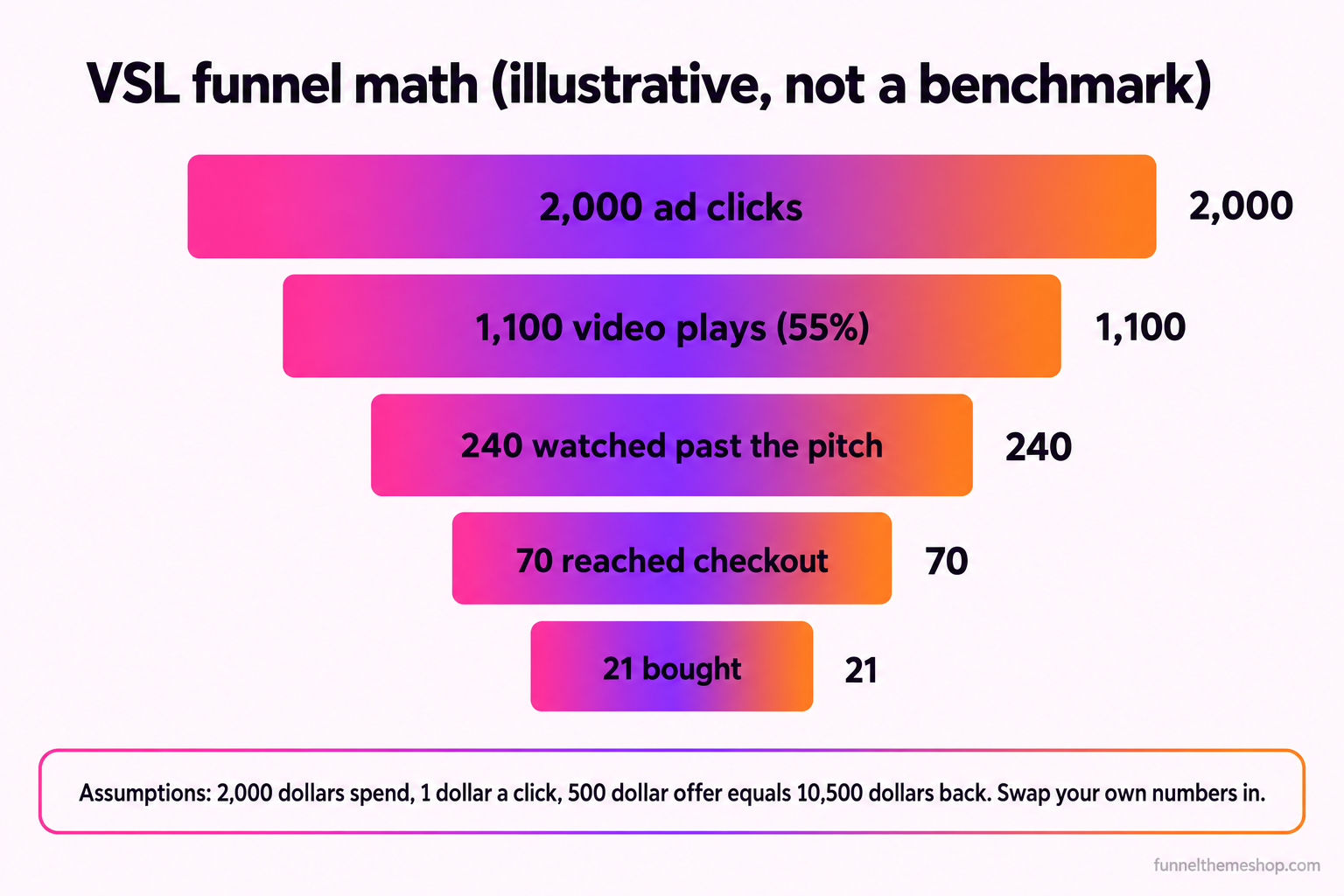
The rung most people never instrument is the one between reaching the checkout and actually paying. Across 50 studies, the Baymard Institute puts average documented cart abandonment at 70.22 percent (baymard.com/lists/cart-abandonment-rate, confirmed via search snippet, not independently fetched), which means roughly seven in ten people who start a checkout do not finish it. On a VSL funnel that number is the difference between a 21-sale week and a 7-sale week from the same video, and it is recoverable with a short abandoned-checkout sequence that the watch-time split already gives you the tagging to send. If you want to see exactly where your own ladder leaks, wiring up the measurement is step one, and GoHighLevel conversion tracking walks through the pixels, the UTMs and the attribution that make these rungs visible.
Four ways a VSL funnel leaks, and how to plug each
Leak 1: the buy button is visible from second zero
The symptom is plays with almost no sales, the exact pattern in the story at the top. The cause is asking a cold viewer to decide before the video has given them a reason to. The fix is a delayed buy button on cold traffic, revealed at the point in the script where the offer is made, and an always-on button only for warm retargeting audiences who already decided. If you can only build one version, build the delayed one, because cold traffic is where the money is lost.
Leak 2: the video is long and the first thirty seconds are dull
The symptom is a steep drop in your watch-time graph inside the first minute. The cause is almost always an opening that makes the viewer wait: a long introduction, a logo animation, a slow build to the point. The Wistia pattern is the warning here, with engagement falling off as length grows, so a long VSL has to hook hard and early to survive. The fix is to cut everything before the hook and open on the single most surprising, useful or specific thing you have. You can earn the right to a twenty-minute video, but only by making the first thirty seconds impossible to click away from.
Leak 3: autoplay with sound, or a dead player on mobile
The symptom is a play rate that looks fine on desktop and collapses on phones. The cause is usually a player set to autoplay with sound, which mobile browsers block outright, leaving a muted or frozen video and a confused visitor. The fix is a click-to-play poster frame with an obvious play button and captions on by default, because a large share of VSL viewing happens on a phone with the sound off. Test the page on an actual phone, not a desktop browser shrunk down, because the two behave differently and the phone is where the leak hides.
Leak 4: every watcher gets the same follow-up
The symptom is a follow-up sequence with a flat, mediocre open rate and almost no sales from it. The cause is treating an eight-second bounce and a full completion as the same lead and emailing them identically. The fix is the watch-time split above: four tags, four sequences, each matched to where the viewer stopped. This is the single highest-return change on most VSL funnels, because it costs nothing in ad spend and recovers sales from traffic you already paid for.
Three objections you are already making
"Nobody watches long sales videos anymore"
Some people do not, which is exactly why the written copy below the fold exists and why the watch-time split catches the ones who leave. A VSL funnel does not bet everything on the video. It bets the video on the people who will watch, and backs it with copy for the people who will not and sequences for the people who start and stop. The claim that video is dead usually comes from someone who built a page with a video and no funnel, got plays and no sales, and blamed the format rather than the missing machine around it.
"I hate being on camera"
Then do not be on it. A large share of effective VSLs are a screen recording of slides with a voiceover, or a recorded demo of the product with narration, and these often outperform a talking head because the viewer is looking at the thing being sold rather than at a face. The argument is what sells, not your jawline. Write the script, record your screen, narrate it, and you have a VSL without ever pointing a camera at yourself.
"Why not just run a webinar instead?"
Run a webinar when the teaching genuinely needs an hour and the live urgency of a scheduled event is worth the commitment you are asking people to make. Run a VSL when the argument fits in a few minutes to twenty and you would rather a stranger could watch within seconds of clicking your ad, at 2am, with no time slot to book. A VSL scales without you and catches intent while it is hot. A webinar converts harder on the people who show up but asks far more of them to get there. Many businesses run both: a VSL on cold paid traffic, a webinar for warmer audiences who will give you the hour.
Build it, or start from one that works
A VSL funnel is a small number of pages doing precise jobs: a sales page that holds attention on one video, a buy button timed to the pitch, a checkout that discloses its terms before payment, and a follow-up split four ways by watch time. You can build all of it by hand in GoHighLevel, and this guide is the order to do it in. If you would rather not start from an empty funnel builder, the snapshots for argument-led offers such as the business coaching funnel and the digital marketing funnel ship with the page structure and the automations already assembled, delivered as a share link and an installation PDF within 24 business hours. All sales are final, so the pre-purchase call is free and there is no clock on it. Build the machine or load one that is already built, but do not ship a video with a button and a hope.
Frequently asked
How long should a VSL be?
There is no fixed answer, but the data has a shape: Wistia finds engagement holds roughly flat to about five minutes then drops, and suggests around three minutes for straight sales presentations. A longer VSL can work, but every minute past five has to be earned with a strong early hook. Open on your most compelling point, not a slow introduction, and let the watch-time graph tell you where people actually leave.
Should the video play automatically or sit behind an email opt-in?
Ungate the video when your traffic is cold and you are buying volume, because the video itself qualifies the viewer and friction costs you watchers. Gate it behind a name and email when your traffic is warmer, your price is higher, or your follow-up sequence is where most sales close, because then a captured lead is worth more than an anonymous play. Many funnels run ungated on paid cold traffic and gated on a known email list.
When should the buy button appear?
At the moment the video makes the offer, not before. On cold traffic, keep the button hidden until the pitch so viewers are not asked to decide before they have a reason to. On warm retargeting traffic, show it from the start, because those people already decided and just need somewhere to click. If you are unsure of the exact timing, test it rather than guess.
What is a watch-time split and why does it matter?
It is tagging each viewer by how far they got into the video, then sending a different follow-up sequence to each group. Someone who bounced in the first quarter never heard your problem; someone who finished and did not buy is as warm as a lead gets. Emailing them the same message wastes both. Four buckets, at roughly 25, 50, 75 percent and completed, covers it and recovers sales from traffic you already paid for.
Is a VSL funnel better than a webinar?
Neither is better in general; they fit different jobs. A VSL scales without you and lets a stranger watch within seconds of clicking, which suits cold paid traffic and offers that argue in a few minutes. A webinar converts harder on attendees but asks them to commit to a scheduled hour, which suits teaching-heavy offers and warmer audiences. Plenty of businesses run both, a VSL on cold traffic and a webinar for people who will give up the time.
Related guides
More funnel guides
The GoHighLevel Webinar Funnel: From Registration to the Buy Button, Page by Page
A webinar is one hour. The funnel around it is six pages and three sequences, and it is the part that decides whether anyone shows up, stays to the offer, or ever buys.
14 min readStrategyThe High-Ticket Application Funnel: Filter Before You Book the Call
A calendar full of unqualified calls is not a win, it is a tax on your week. An application funnel puts the filter before the booking, not after it.
13 min readStrategyHigh-Converting Landing Page Anatomy: Every Block, Top to Bottom
A landing page is nine blocks doing nine jobs. Get the order right and the copy has somewhere to live. Get it wrong and you are decorating a page that argues with itself.
12 min readFunnel snapshots · done-for-you builds
Pick a funnel, or hand us the offer
Buy the snapshot and it lands within 24 business hours as a share link and an installation PDF, add the $175 install if you would rather not do it yourself, or hand us the offer and we build the whole thing.
All sales final once the snapshot link is sent · free updates for life · one licence covers every sub-account you own