Strategy
Winter HVAC funnels: catching the no-heat surge
A furnace dies at 9:40 on the first freezing night and the homeowner calls three companies in four minutes. The one that wins is not the cheapest or the closest. It is the one whose funnel answered while the other two rang out to voicemail.
It is the first properly freezing night of the season. Somewhere a furnace that was fine all autumn makes a noise, clicks, and stops. It is 9:40pm, the house is already cooling, there is a baby asleep upstairs, and the homeowner is standing in a cold kitchen with a phone in their hand. They type "no heat emergency repair near me", and in the next four minutes they call three companies off the first screen of results. They are not comparing quotes. They are looking for the first adult who will pick up and say "we can have someone to you tonight".
Company one rings out to a voicemail that says office hours are nine to five. Company two has a contact form that promises a reply the next working day, which is not a thing a person without heat is willing to wait for. Company three sends a text back inside thirty seconds, confirms the address, offers a 7am slot or an emergency call-out tonight, and books it. Company three wins the job, and because it handled a frightening night well, it also wins the furnace replacement in spring and the maintenance plan that follows. None of the three was cheaper or closer than the others. The difference was entirely in what happened in the first four minutes, and that is a funnel job, not a marketing one.
This piece is the winter HVAC funnel built for that night, page by page: what a cold snap actually does to your phone, the system that catches the surge instead of dropping half of it on the floor, the arithmetic that shows what a slow response costs you per freeze, the five places the money leaks, and the honest cases where a funnel is the wrong purchase. It is written to be built now, in the autumn, so it is already tested and answering before the first hard freeze finds the gap in it.
What a cold snap actually does to your phone
Heating demand does not arrive in a steady stream you can plan staffing around. It arrives in a wall. A furnace under light load through a mild October is a furnace whose failing igniter or tired blower motor never gets tested hard enough to quit. The first night the temperature drops below freezing, every marginal system in your service area gets asked to do its full job at the same time, and a predictable share of them fail within the same forty-eight hours. Your phone does not get busier. It gets slammed, overnight, without warning, and then goes quiet again until the next front moves through.
That shape matters because it changes what your constraint is. In a normal month your problem is getting enough leads. During a cold snap you have more demand than you can physically serve, and your problem flips to two different ones: answering fast enough to win the jobs worth winning, and triaging hard enough that the genuine no-heat emergency does not wait in the same queue as a request for a filter change. A funnel that only knows how to collect leads is useless here. You do not need more leads during a freeze. You need to catch, sort and respond to the wave you already have.
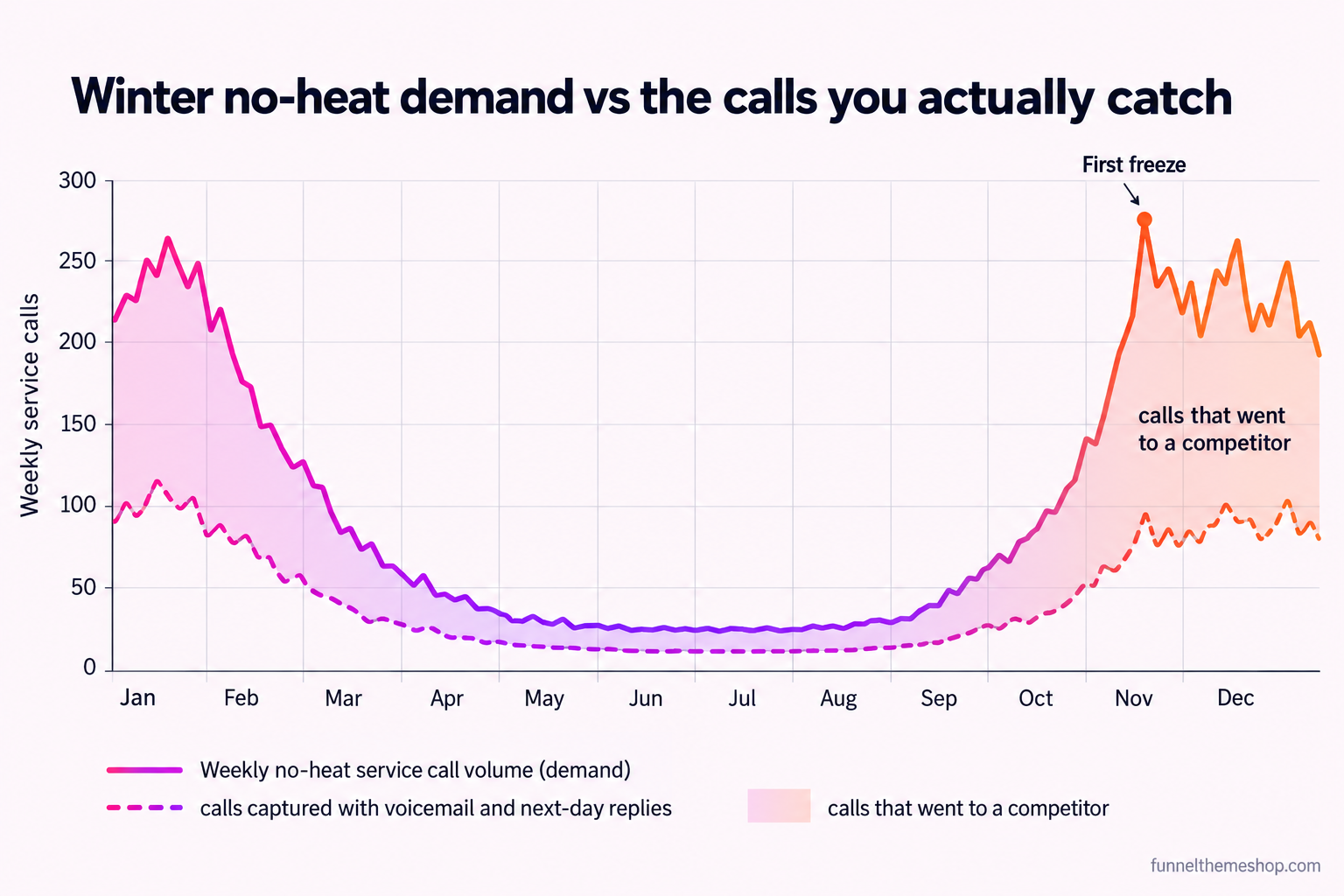
The person on the other end of that surge is also a very particular kind of buyer, and the funnel has to be built around their head rather than around yours. A no-heat caller is not shopping. They are mildly panicking. They have a cold house and a problem they cannot fix themselves, and the normal buying brain that compares three quotes and sleeps on it has switched off. In that state, price sensitivity collapses. What they are actually buying is relief and competence, delivered fast, and they will pay a fair emergency rate to the first firm that makes them feel the problem is now being handled. The same person, asking about a planned system replacement in April, is a careful comparison shopper. Winter is the one window where speed beats price outright, and a funnel that leads with a discount in an emergency is answering a question nobody asked.
The emergency funnel, page by page
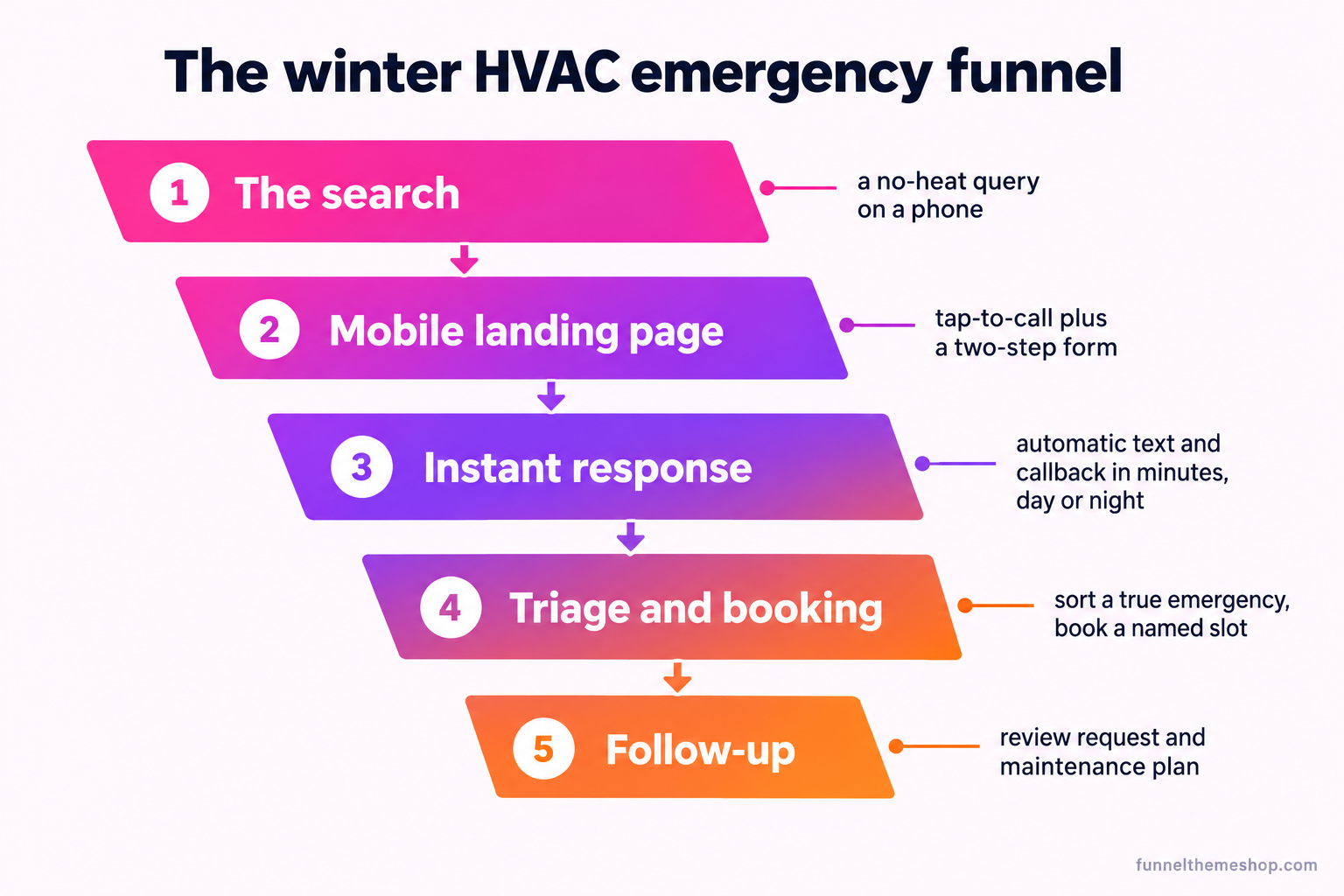
Here is the whole path, from the cold-kitchen search to the booked visit to the maintenance plan that turns one frightening night into a customer for years. It runs on the same logic as the rest of the GoHighLevel funnel builder approach: the offer and every page and automation that carries it are one system, and any step you skip does not vanish, it just leaks quietly in the dark while you are out on a call.
Two funnels, not one
The first mistake is trying to make one funnel do winter and summer. The no-heat emergency and the planned system replacement are two different buyers with two different funnels, and they should not share a landing page. The emergency funnel is built for speed and panic: one promise, a phone number the size of a thumb, and a booking in under a minute. The planned-work funnel is built for comparison and trust: it can afford a quote form, photos of past installs, financing options and a slower follow-up, because that buyer is not cold tonight. Run them as separate paths with separate pages and separate automations. A homeowner with a dead furnace who lands on your "request a free replacement estimate" page bounces, because you answered the wrong fear.
The landing page is a phone held in a cold kitchen
Design the emergency page for the device and the moment it is actually seen on. That is a phone, held one-handed, in low light, by someone who is cold and distracted and has two competitor tabs already open. The page carries one headline that names the exact problem and promises the exact relief ("No heat? We dispatch emergency repairs across [your area] tonight"), a tap-to-call button fixed to the top of the screen so it never scrolls away, and a short two-step form underneath for the people who would rather type than talk. Nothing else is above the fold. No hero video, no history of the company, no six-icon list of services. The full anatomy of a page that converts cold, impatient traffic is in the high-converting landing page breakdown, and every rule in it is sharper in an emergency because the visitor has the least patience they will ever have.
And because this is a phone, the page has to be genuinely fast and genuinely thumb-sized, not a desktop site the browser has shrunk. A tap target that is a pixel too small, a form field that fights the on-screen keyboard, a page that takes four seconds to paint over a weak signal in a rural kitchen, each of those is a competitor winning the job. The specific mobile failures that quietly kill a local-service funnel, and how to catch them, are laid out in why funnels convert on desktop and die on mobile. For an HVAC emergency page, mobile is not the secondary case. It is the only case that matters in the moment the job is won.
The instant response is the whole product
This is the stage that wins the job, and it is the one most HVAC businesses do not have. The instant a call is missed or a form is submitted, the funnel fires an automatic response that does real work: a text that confirms you received the request, names the next available slot, and gives a one-tap link to book or a number to reach a human now. Day or night. The automation is not pretending to be a person. It is buying the ninety seconds it takes a human to get to the phone, and in those ninety seconds it is stopping the caller from dialling the next company on the list.
The reason this works is not a growth-hacker opinion, it is one of the most durable findings in sales research. Harvard Business Review's study "The Short Life of Online Sales Leads" analysed roughly 1.25 million leads and found that firms which contacted a prospect within an hour were nearly seven times more likely to have a qualifying conversation than firms that waited just one hour longer, and more than sixty times more likely than firms that waited twenty-four hours or more (hbr.org/2011/03/the-short-life-of-online-sales-leads, confirmed via search snippet, not independently fetched, October 2026). That study measured hours. A no-heat emergency compresses the whole curve into minutes, because the caller is actively dialling your competitors while your voicemail plays. The business that answers first does not just get a head start. It usually gets the job before the others have finished ringing.
Two things have to be true for the instant response to actually fire. The workflow behind it has to be published and wired correctly, because the single most common reason an HVAC funnel goes silent on a lead is a trigger sitting in draft or watching the wrong form, the exact failure traced in when a form submits but the workflow never fires. And the texting has to be set up to send, which on any new sub-account means registering for A2P and 10DLC before the season, not discovering on the first freezing night that your emergency texts are being filtered. The groundwork for that is in the A2P and 10DLC setup guide, and it takes long enough to approve that autumn is the time to do it.
Triage and booking, not a single queue
During a surge, every enquiry landing in the same undifferentiated pile is how you lose the valuable job. The genuine no-heat emergency with a vulnerable household is a different priority from a request to look at a thermostat sometime next week, and the funnel should sort them before a human ever reads them. A single qualifying question on the form or in the booking flow ("Is the heat completely out right now?") routes the true emergency to a same-night or first-thing slot and a human callback, and routes routine work to the standard schedule. That one branch protects your capacity, gets your most skilled tech to the job that most needs them, and stops a filter change from accidentally jumping the queue ahead of a house at risk of frozen pipes.
The booking itself has to be a named, confirmed time, not a promise to "get back to you". A slot the customer can see and a confirmation they can hold on to is the thing that lets them stop searching and put the phone down, which is the real conversion. A vague "we have added you to the list" leaves the panic running, and a panicking customer keeps dialling.
The thank-you page and the maintenance rollover
The job that most HVAC funnels never do is turn the emergency into a relationship. The moment after booking is the warmest this customer will ever be toward you, and it is wasted on a bare "thanks, we will be in touch". The confirmation page should set expectations (who is coming, roughly when, what it may cost, what to do in the meantime to stay warm and safe) and plant the seed of the maintenance plan that stops this exact night from happening again. The plan offer does not close on the thank-you page. It closes with the technician in the home, backed by a follow-up sequence a few days later, once the house is warm and the fear has turned into gratitude. A customer on a maintenance plan is the one who calls you first next winter instead of searching again, which means you win next year's surge before it even arrives. The structure for building that confirmation step properly is in what the thank-you page is actually for.
The numbers, with the assumptions showing
The cost of a slow response is not abstract, and it is not spread thinly across the year. It lands in concentrated bursts on the handful of nights when demand spikes, which is exactly when a slow business is least able to cope and a fast one cleans up. Here is the arithmetic for a single cold snap, with every assumption on the table so you can swap in your own and watch the shape hold.
Say a hard freeze drives forty no-heat calls and web enquiries to your business across one week. Say that with the usual setup, after-hours calls hit voicemail and web forms wait until the next working morning, so you actually reach and book around 55% of them in time: twenty-two jobs. Now say the same forty enquiries run through the funnel above, where every missed call and form fill triggers an instant text and a booking link, and the ones that want a human get called back inside minutes. Reaching people while the intent is still hot lifts the booked share to around 85%: thirty-four jobs. Same freeze, same forty enquiries, same marketing. The response system alone just booked twelve more jobs that week.
Put a number on each job to see what that is worth. Say an average emergency repair ticket is $400. Twelve extra jobs is $4,800 of revenue in a single week, won not by spending more on ads but by answering a phone that was already ringing. Then add the tail: say one in four emergency customers takes a maintenance plan when it is offered properly at the visit and followed up, at $199 a year. Thirty-four jobs produces around three more plan customers than twenty-two does, which is roughly $600 a year in recurring revenue, and far more importantly it is three more households who will call you first next winter rather than opening a search and dialling your competitors. The one-week figure is the visible win. The plan tail is the one that compounds.
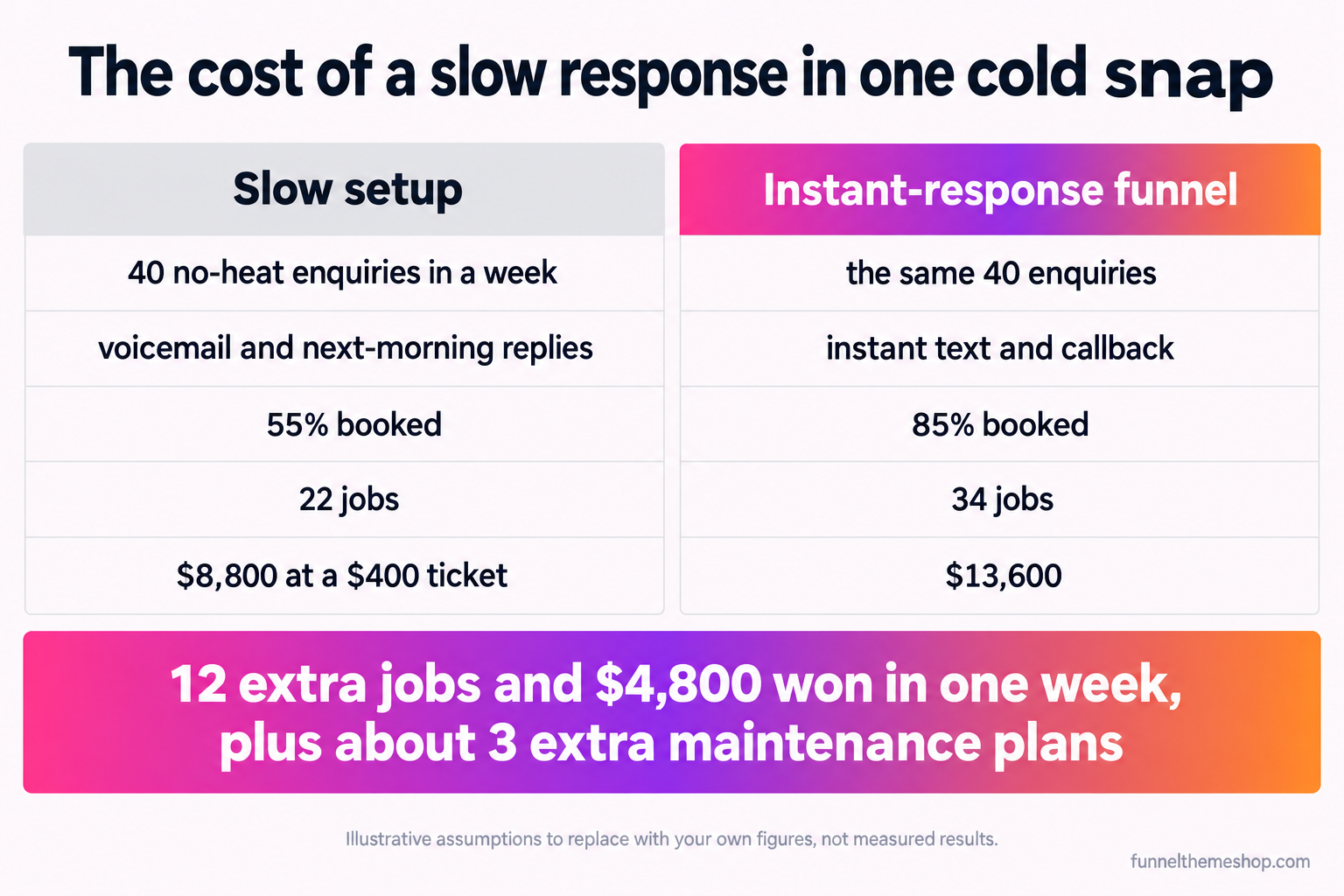
Those percentages are illustrative, not a promise and not measured results from our snapshots, and the web-form half of that surge obeys a rule worth respecting. Across fifty separate studies the Baymard Institute puts the average documented shopping-cart and checkout abandonment rate at 70.22% (baymard.com/lists/cart-abandonment-rate, confirmed via search snippet, not independently fetched, October 2026). Seven in ten people who begin a form or checkout do not finish it on an ordinary day, and a cold, distracted, late-night emergency runs worse, not better. That is the whole case for the two-step form: capture the name and number on step one, before the step people bleed out on, so an abandoned form is still a lead you can call rather than a ghost. If your winter funnel is getting traffic and not converting it, the diagnostic path in traffic but no opt-ins is where to start, and on an emergency page the fix is almost always the response speed, not the headline.
Where a winter HVAC funnel leaks
Five failure modes account for most of the money that runs out of a heating-season funnel. Each has a symptom you can see on your own call log, a cause underneath it, and a fix that lives in the funnel rather than in working the techs harder.
The after-hours call goes to voicemail
The symptom is a run of missed calls timestamped after 6pm and a quiet sense that winter was busy but not as busy as it should have been. The cause is that your emergency funnel stops when the office closes, which is the exact window a furnace is most likely to fail and a homeowner is most likely to be home to notice. The fix is an answer that never sleeps: an automatic text-back on every missed call that books or routes the caller, and a missed-call recovery sequence that chases the ones who did not engage. The snapshots we build carry that recovery as standard, and its missed-call recovery is tuned toward a 70% recovery target rather than left as a hopeful single text that nobody reads until morning.
The form fills and nothing happens for three hours
The symptom is web leads that felt lower quality than the phone ones, and a nagging suspicion that the website does not really work. Usually the leads were fine and they went cold waiting. A no-heat enquiry submitted at 10pm and first answered at 8am is not a warm lead any more, it is a customer who is already having their furnace looked at by whoever texted back at 10:01. The fix is the instant automated response above, firing the moment the form is submitted, doing something genuinely useful rather than saying "a member of our team will be in touch". Confirm, offer a slot, give a number. The automation holds the lead until a human can take over.
The site is built for a desktop and the customer is on a phone
The symptom is a decent-looking website and a conversion rate that falls off a cliff on the nights it matters. The cause is a page designed on a laptop and never truly tested on a cheap phone over a weak signal. Buttons too small to hit with a cold thumb, a form that scrolls sideways, a hero image that takes five seconds to load before the phone number appears. Every one of those is a job handed to a competitor. The fix is to build and test the emergency page mobile-first, on an actual phone, treating the tap-to-call button as the single most important pixel on the site.
Every call is treated the same, so the emergency waits behind a filter change
The symptom is a surge week where you were flat out and still lost the big jobs, because your best tech spent the morning on routine calls while a full system replacement went to someone who could come sooner. The cause is a funnel with no triage: one queue, first in first served, no sense of which job is urgent or valuable. The fix is the single qualifying branch above, sorting the true no-heat emergency and the high-value replacement from routine maintenance before anyone picks up the phone, so your capacity goes where it earns the most and does the most good.
The job gets done and the customer is never seen again
The symptom is spending every winter fighting for new emergency leads and never building a base that calls you first. The cause is a funnel that ends at the invoice. It fixed the furnace, took the payment, and did nothing to convert a one-off panic into a relationship. The fix is the maintenance rollover: the plan offered at the visit and followed up a few days later, the review request that turns a well-handled emergency into the social proof that wins the next one, and a yearly reminder that books the pre-season tune-up before the cold arrives. A base of maintenance-plan customers is the asset that makes next winter calmer and more profitable than this one, and it is built entirely in the last stage of the funnel most businesses never finish.
Which winter offer the funnel should carry
Winter is not one offer, it is a season with several, and the funnel should know which one it is carrying at any given week. Running the emergency offer in October before anything has broken wastes the season's best weeks, and running the tune-up offer during a freeze ignores what the caller actually needs. Use this to decide what the funnel leads with and when, then build each as its own path rather than hedging across all four on one page.
| The winter offer | What the funnel must nail | When to lead with it | The recurring payoff |
|---|---|---|---|
| Emergency no-heat repair | Instant response, tap-to-call, same-night triage and booking | From the first freeze through the depth of winter | The maintenance plan sold at a well-handled emergency |
| Furnace or system replacement | A trust-led quote path with financing and past installs | When a repair is uneconomic, often mid-winter after a failure | Years of service and tune-ups on the new system |
| Pre-season tune-up | A simple booking for a fixed-price inspection with a clear date | Early autumn, before anything has broken | Caught faults become booked repairs, not competitor emergencies |
| Maintenance plan | A low-friction sign-up and an automated yearly reminder | At every repair and tune-up, all season | The customer who calls you first next winter instead of searching |
The through-line is that the emergency funnel is the acquisition engine and the maintenance plan is the retention engine, and the two are joined at the thank-you page. The freeze brings you the customer in a panic. The follow-up turns that customer into a plan. The plan means next year's surge finds you already holding the relationship. Change the ticket sizes and the plan price to match your market, keep the shape, and the winter funnel stops being a scramble you survive and becomes a base you build on. This is the same local-service pattern the rest of the local-service category runs on, tuned to the one trade whose demand is set by the weather.
The objections you are already making
Three arguments come up every time an HVAC owner reads this, and all three are worth taking seriously rather than brushing off.
"My business runs on phone calls, a funnel is for people selling courses online." Half right, and it is the wrong half. A funnel is not a landing page for digital products, it is the system that decides what happens between a customer needing you and a customer booking you, and for an HVAC business most of that system is the phone, the text-back, the triage and the follow-up. The landing page is the smallest part. You already have a funnel. It is just a slow, manual, after-hours-voicemail one, and the question is only whether it answers in thirty seconds or thirty minutes.
"Winter is already my busiest season, I do not need more leads." Then winter is exactly when a funnel is worth the most, because your problem is not lead volume, it is that you are losing a chunk of the demand you already have to slow response and no triage. Catching an extra ten or fifteen per cent of a surge you were always going to get, and sorting it so your capacity lands on the jobs that pay, is a bigger number than most owners expect, and it needs no extra advertising at all. A funnel that helps you lose less of a wave you already catch beats one that chases a bigger wave you cannot serve.
And the honest one: "a pre-built snapshot cannot know my service area, my pricing or my on-call rota." Correct, and it is not meant to. A HVAC funnel snapshot gives you the structure already built and tested: the mobile emergency page, the two-step form, the instant text-back, the triage branch, the booking flow and the maintenance follow-up. You write your area, your rates and your schedule into a working machine instead of building the machine from scratch in October while the first front is already on the forecast. If you genuinely cannot serve an after-hours emergency and have no intention of offering maintenance plans, a funnel will only help you disappoint people faster, and you should fix the operation before you turn on the tap. A funnel accelerates whatever you point it at. Point it at a business that can answer the phone and show up, and the slow part, the build, is the part that is already done. Many owners who do run their own emergency line still take the snapshot install and customisation service so the whole thing is wired, branded and tested before the season, and if you also run a plumbing operation the same emergency structure carries straight across to burst-pipe season.
Frequently asked
When should I build my winter HVAC funnel?
In early autumn, before the first hard freeze. The funnel that wins the season is the one already tested and answering before demand arrives, with the A2P and 10DLC texting registration approved in advance so your emergency texts actually send. A funnel you are wiring up on the first freezing night while the calls come in drops its first surge on the floor, and that surge is the most valuable week of your year.
What is the best winter offer for an HVAC business?
There is no single best offer, there is a best offer for each part of the season. Lead with a pre-season tune-up in early autumn, switch to emergency no-heat repair from the first freeze onward, carry a replacement path for failures that are not worth repairing, and offer a maintenance plan at every single visit. The plan is the one that compounds, because it turns a one-off emergency into a customer who calls you first next winter.
How fast does the funnel need to respond to a no-heat lead?
In seconds, not hours. A homeowner without heat is calling several companies in the same few minutes, so a response that arrives the next morning arrives after the job is already booked with someone else. Harvard Business Review found firms that reached a lead within an hour were nearly seven times likelier to have a qualifying conversation than those that waited an hour longer, and an emergency compresses that whole curve into minutes. An automatic text-back on every missed call and form fill is what holds the lead until a human can take over.
Do I need an ad budget to run a winter HVAC funnel?
No. Winter demand largely arrives on its own through search and word of mouth the moment it gets cold, so the funnel mostly exists to catch more of a wave you already get and to sort it so your capacity lands on the jobs worth the most. If you do run ads, the same funnel converts them better, but the biggest return in heating season is in the response speed and the follow-up, not in buying more clicks.
What does an HVAC snapshot include?
The emergency funnel structure built and tested: the mobile-first no-heat landing page, the two-step form, the instant automated text-back, the triage branch that sorts a true emergency from routine work, the booking flow and the maintenance-plan follow-up. You write your own service area, pricing and schedule into it. It arrives as a snapshot share link and a PDF with the full installation instructions, and installation by us is an optional add-on rather than a requirement.
Related guides
More funnel guides
High-Converting Landing Page Anatomy: Every Block, Top to Bottom
A landing page is nine blocks doing nine jobs. Get the order right and the copy has somewhere to live. Get it wrong and you are decorating a page that argues with itself.
12 min readTroubleshootingYour Funnel Converts on Desktop and Dies on Mobile. Here Is Why
Split the funnel report by device and the floor drops out. Desktop is fine, mobile is a graveyard, and two in three of your visitors are on a phone. This is how to find the leak.
13 min readTroubleshootingGoHighLevel Funnel Gets Traffic But No Opt-Ins? The Fix
The analytics show 600 sessions and four opt-ins. Everyone reaches for more traffic. The traffic is almost never the problem, and this is how to find the one that is.
12 min readFunnel snapshots · done-for-you builds
Pick a funnel, or hand us the offer
Buy the snapshot and it lands within 24 business hours as a share link and an installation PDF, add the $175 install if you would rather not do it yourself, or hand us the offer and we build the whole thing.
All sales final once the snapshot link is sent · free updates for life · one licence covers every sub-account you own