Strategy
The year-end dental funnel: catching the December benefits rush
A patient has $900 of unused dental benefit, a crown their dentist flagged in March, and an FSA that empties on 31 December. Nobody from the practice has reminded them. The funnel that does remind them, in the right order and before the cliff, is the most profitable six weeks a dental practice has.
It is the first week of November. Somewhere in your patient list is a woman who came in for a cleaning in March, was told she needed a crown, said she would think about it, and never booked. She has around $900 of dental benefit left on a plan she pays for every month, a deductible she already cleared back in spring, and a health FSA at work that empties to zero at midnight on 31 December. If she books the crown before then, most of it is already paid for. If she waits until January, her benefit resets, her FSA money is gone, and the same crown suddenly costs her hundreds of dollars out of pocket. She does not know any of this. Nobody from the practice has told her. So she does nothing, the benefit expires, and in February she is a little surprised her teeth still hurt.
Two practices treat that woman very differently over the next eight weeks. The first does nothing, because December is already busy and the front desk is drowning, and quietly watches a six-figure pile of unused treatment plans reset to zero on New Year's Day. The second runs a simple, dated funnel that finds every patient with money on the table, reminds them in plain language that it expires, makes booking a single tap, and chases the no-shows that would otherwise eat the slots. Same patient list. Same town. The difference between them is not marketing budget or luck. It is whether a funnel did the reminding while the team was busy running the practice, and that is the whole subject of this piece.
This is the year-end dental funnel, built for the window between now and 31 December, page by page: why the calendar hands you this surge whether you ask for it or not, the system that converts unused benefit into booked treatment instead of letting it expire, the arithmetic that shows what a quiet December actually costs you, the five places the money leaks on its way to the chair, and the honest cases where this funnel is the wrong thing to build. It is written to be stood up this week, because every day you wait is a day closer to a deadline you cannot move.
Why the calendar hands you this surge
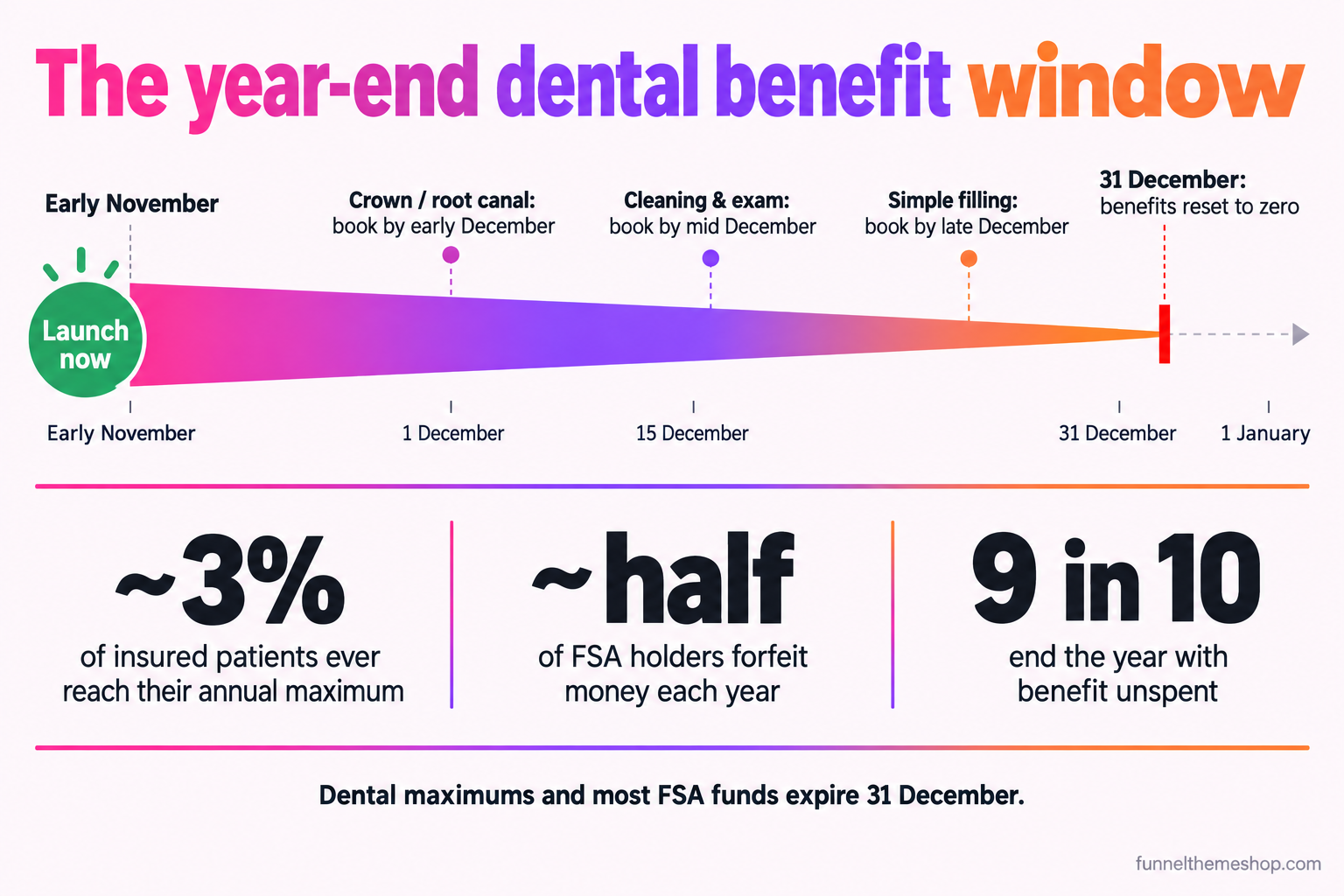
Dental demand in December is not like demand in a normal month, and the reason is written into how dental insurance works. Almost every plan runs on a calendar year with an annual maximum, commonly somewhere between $1,000 and $2,000, and a deductible. Whatever benefit a patient has not used by 31 December does not roll over. It vanishes, and the counter starts again at zero on 1 January. A patient who cleared their deductible in the spring and has most of their maximum untouched is, for the next eight weeks, sitting on treatment that is substantially pre-paid and about to stop being so. That is not a sales angle you invented. It is a real financial cliff your patients are walking toward, mostly without noticing.
And they overwhelmingly do not notice, which is the part that makes this a funnel problem rather than a demand problem. The National Association of Dental Plans, in its 2025 report covering 2024 data, found that the share of group dental PPO enrollees who reached their annual benefit maximum rose to 2.9%, the highest in six years (nadp.org, confirmed via search snippet, not independently fetched, November 2026). The American Dental Association's Health Policy Institute puts the figure similarly low, at roughly 3.4% of patients reaching the typical annual maximum, with another 3.3% landing within $100 of a common $1,000 or $1,500 cap (ada.org Health Policy Institute, confirmed via search snippet, not independently fetched, November 2026). Read those the other way around: more than nine in ten insured patients end the year with benefit still unspent. The money is there, they paid for it, and almost none of them use all of it, because nobody ever told them the clock was running.
Sitting on top of the dental maximum is a second deadline that hits the same night and is even more brutal, because this one is the patient's own cash. A health flexible spending account is funded from the employee's pre-tax pay, and for most plans anything left in it on 31 December is simply forfeited back to the employer. The Employee Benefit Research Institute, analysing millions of accounts, found that around half of FSA holders forfeit money every year, with recent average forfeitures in the region of $400 per person, down a little from $441 in its 2022 analysis (ebri.org, confirmed via search snippet, not independently fetched, November 2026). Money magazine, citing EBRI data, reported that American workers lose more than $4 billion in unspent FSA funds in a year (money.com, confirmed via search snippet, not independently fetched, November 2026). Dental work is one of the few things that money can be spent on at the last minute without a doctor's appointment wait, which makes a dental practice the natural place for an FSA-holder to rescue cash they are about to lose, if someone points them to the door.
Both deadlines land at once, on the quietest social week of the year, when your front desk is short-staffed for the holidays and your patients are distracted by everything except their teeth. That combination is what produces the surge, and it is also what makes the surge so easy to miss. The demand is latent. It does not call you. It sits in your own records as flagged-but-unbooked treatment, and it converts only if something reaches out, explains the clock, and makes saying yes effortless. That something is the funnel.
The year-end funnel, page by page
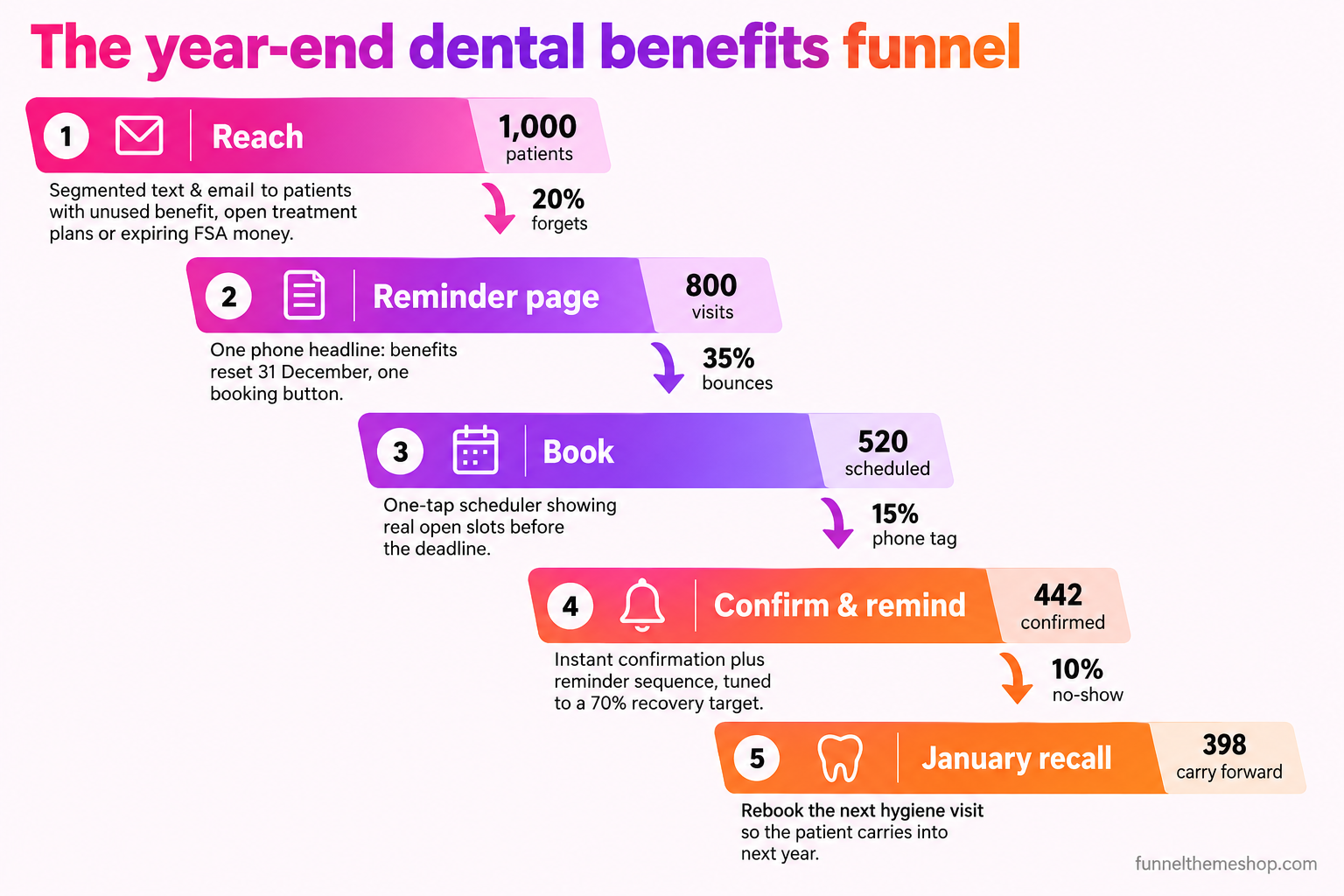
Here is the whole path, from a patient sitting on unused benefit without knowing it, to a booked and confirmed December appointment, to a January hygiene recall that starts next year's relationship on day one. It runs on the same principle as the rest of the GoHighLevel funnel builder approach: the offer and every message and automation that carries it are one system, and a step you skip does not disappear, it just leaks revenue quietly while the team is busy with the chair.
Three audiences, not one blast
The first mistake is sending one cheerful "happy holidays from the practice" email to the entire list and calling it a campaign. The year-end window contains at least three different patients, and each needs a different sentence. There is the patient with an open treatment plan already recommended by the dentist, who needs reminding that the crown or the root canal they were told about is mostly covered until the end of the month. There is the patient who is simply due or overdue for a cleaning and exam, who needs to know the visit is likely fully covered and the slots are filling. And there is the FSA-holder whose dental benefit may already be used but who has pre-tax cash about to be forfeited, who needs to hear that December is the time to get the work done they have been postponing. Three segments, three messages, pulled straight from your own data on who has what left. A single untargeted blast speaks to none of them clearly and converts like it.
The offer is a deadline, not a discount
This is the part most practices get backwards, because they reach for the marketing move they know, which is a price cut. A year-end whitening special or a discounted cleaning trains your best patients to wait for a deal and quietly insults the ones already sitting on a crown worth far more than the discount. The honest and far stronger offer here is not a lower price, it is the deadline itself. You are not inventing scarcity, you are reporting a real one: the benefit the patient already paid for expires on 31 December and will not come back. The entire persuasive job is to make that clear, specific and personal ("our records show you have treatment outstanding and benefit remaining this year"), and then to remove every obstacle between understanding it and booking. Urgency that is true needs no gimmick, and a deadline funnel that leads with a discount is answering a question the patient did not ask.
The landing page is a reminder, read on a phone between other things
Design the page for the moment it is actually opened: on a phone, in a spare minute, by someone who half-remembers getting a text about their dental benefit. It carries one headline that states the real thing ("Your dental benefits reset on 31 December. You may have treatment already covered."), one short explanation of why that matters in money terms, and one obvious action: book, or request a call back about what you have left. No stock photo of a model with perfect teeth above the fold, no history of the practice, no menu of twelve services. The full anatomy of a page that converts distracted, low-patience traffic is in the high-converting landing page breakdown, and every rule in it holds here, because a benefits reminder is competing with the entire distraction of December for about four seconds of attention.
Booking has to be one tap, or the deadline beats you
A patient who has understood that they have money expiring is, for about a minute, highly motivated. If the next step is "call the office during business hours", you have handed that minute back to the holidays and most of them will not call. The booking step has to be an online scheduler that shows real open slots before 31 December and lets the patient claim one in a single tap, or a one-tap request for the front desk to call them at a time that suits. The reason this matters so much is not opinion, it is one of the most durable findings in response research: Harvard Business Review's study "The Short Life of Online Sales Leads" analysed roughly 1.25 million leads and found that firms contacting a prospect within an hour were nearly seven times more likely to have a qualifying conversation than firms that waited just one hour longer, while an audit in the same work found only 37% of firms managed to respond within that hour (hbr.org/2011/03/the-short-life-of-online-sales-leads, confirmed via search snippet, not independently fetched, November 2026). A motivated dental patient in December cools just as fast. The scheduler exists so the booking happens while the intent is hot, not after a game of phone tag that outlasts their resolve.
And because the form and the scheduler are where motivated people still slip away, respect the drop-off rate on anything that asks for input. Across fifty separate studies the Baymard Institute puts the average documented shopping-cart and checkout abandonment rate at 70.22% (baymard.com/lists/cart-abandonment-rate, confirmed via search snippet, not independently fetched, November 2026). A booking form is not a checkout, but the psychology is the same: every extra field, every demand to create an account, every step that could wait is another share of motivated patients lost. Ask for the name and the mobile number first, so that even an abandoned booking is a lead the front desk can call, and leave the insurance details and the medical history for the confirmation that follows. If your year-end page is getting opened and not converting, the diagnostic path in traffic but no opt-ins is where to start.
The reminder sequence is where the booked slot survives to December
A booked December appointment is not a kept December appointment. The holidays are the single easiest time of year for a patient to forget, double-book or simply decide they cannot face it, and an empty chair in your busiest benefit week is pure loss, because that slot could have held another patient racing the same deadline. The funnel therefore does not stop at the booking. It fires an instant confirmation, then a short sequence of reminders over the following days, each giving a one-tap way to confirm, reschedule or reach a human. The snapshots we build carry that recovery as standard, and the reminder sequence is tuned toward a 70% recovery target rather than left as a single hopeful text nobody reads. Reminders that go by text have to be able to send, which on any newer sub-account means the A2P and 10DLC registration is approved in advance, not discovered to be pending on the day you need it, the groundwork for which is laid out in the A2P and 10DLC setup guide.
The January recall turns a rescue into a relationship
The job most year-end dental campaigns never do is use December to set up January. The moment a patient has had their crown done and is relieved it is handled is the warmest they will be toward the practice all year, and it is wasted on a bare "thanks, see you sometime". The confirmation and follow-up should book or at least schedule the reminder for their next hygiene visit, so that a patient who came in once chasing an expiring benefit leaves already pencilled in for the new year, with their fresh benefit maximum waiting. That is how a one-time benefit rescue becomes a recurring patient instead of a December fling, and the structure for building that follow-up step properly is in what the thank-you page is actually for. A practice that does this well spends next November reminding a list of already-loyal patients, not scrambling to win strangers.
The numbers, with the assumptions showing
The cost of a quiet December is not spread thinly across the year. It lands in a single eight-week window and then the door closes, which is exactly what makes it worth doing the arithmetic before the window rather than regretting it after. Here is the maths for one practice, with every assumption on the table so you can swap in your own and watch the shape hold.
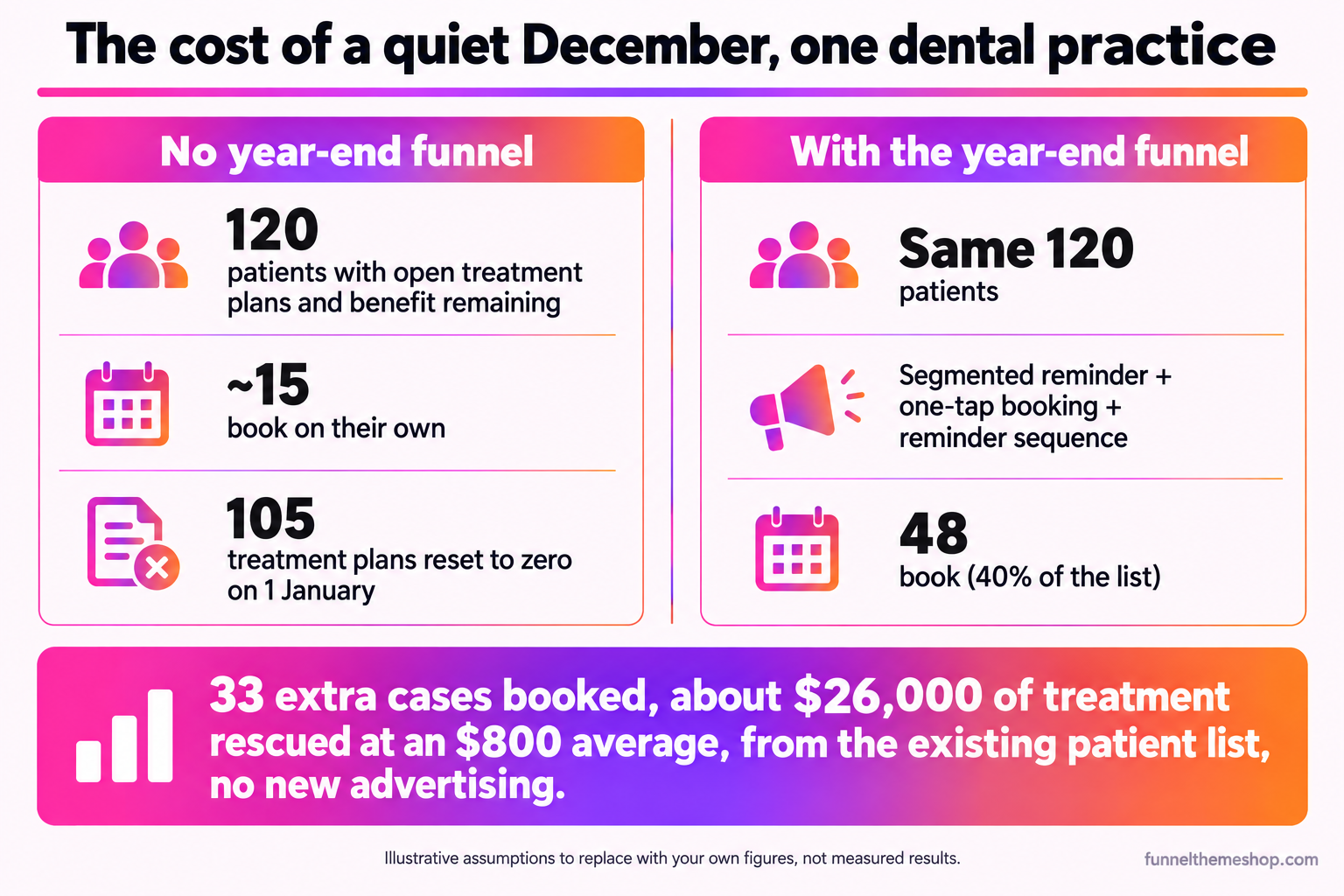
Say your practice has 1,200 active patients, and say that in line with the research above the overwhelming majority end the year with dental benefit unspent. You do not need all of them. Say that when you actually query your own records, 120 of those patients have both an open treatment plan the dentist already recommended and meaningful benefit remaining this year. With no year-end funnel, perhaps 15 of them happen to come in before the deadline on their own, because something reminded them or the pain got worse. That is the quiet-December baseline: 15 of 120 booked, and 105 treatment plans resetting to zero on 1 January.
Now run the same 120 patients through the funnel above: a segmented reminder that names their outstanding treatment and the deadline, a one-tap booking page, and a reminder sequence that protects the slots once they are taken. Say that lifts the booked share from 15 to 48, which is 40% of a warm, pre-qualified list taking action on treatment they had already been told they needed. That is 33 additional cases booked in December that would otherwise have expired. Put a conservative average of $800 on each of those treatment plans, well below the cost of a single crown, and the funnel has converted roughly $26,000 of otherwise-forfeited treatment into booked, mostly-covered work, from your own patient list, with no new advertising at all. Change the patient count, the open-plan share, the conversion rate and the ticket to match your own practice and the headline survives every substitution: the revenue was already sitting in your records, and the only question was whether anything reached out before the deadline.
Where a year-end dental funnel leaks
Five failure modes account for most of the revenue that runs out of a year-end campaign on its way to the chair. Each has a symptom you can see in your own schedule, a cause underneath it, and a fix that lives in the funnel rather than in working a tired front desk even harder in December.
It launches on 20 December, when the chair time is already gone
The symptom is a flurry of interest in the final week and a schedule that physically cannot absorb it, so motivated patients get told the first opening is in January, by which point their benefit is gone. The cause is treating the year-end push as a late-December promotion rather than an early-November campaign. The fix is the calendar: a crown or a root canal needs chair time and sometimes a lab turnaround before the 31st, so the reminder that names outstanding treatment has to go out in the first half of November while there are still bookable slots on the right side of the deadline. The whitening and the simple cleaning can be chased later. The high-value, chair-time-hungry treatment has to be reached first, which is why this funnel is built now and not during the last week.
It blasts the whole list with one generic message
The symptom is a campaign that got "sent" and produced almost nothing, and a lingering sense that email just does not work for the practice. The cause is a single untargeted message that speaks to no one in particular: the patient with a $1,200 open treatment plan and the patient who is simply due for a cleaning get the identical sentence, and neither feels it was about them. The fix is the segmentation above, driven by your own records. The patient with outstanding treatment hears about their specific unused benefit and the deadline. The overdue patient hears that their cleaning is likely covered and the December slots are filling. The FSA-holder hears that their pre-tax money is about to be forfeited. Relevance is the whole conversion lever here, and it costs nothing but the query.
Booking depends on calling the office during holiday hours
The symptom is strong open and click numbers and weak actual bookings, with the front desk swearing the phone barely rang. The cause is a funnel that builds motivation online and then dumps the patient into a phone call they have to make during shortened holiday opening hours, against a voicemail if they try in the evening. Every one of those is a motivated patient lost to the gap between wanting to book and being able to. The fix is an online scheduler that shows real open slots and takes the booking in the moment, backed by an automatic text-back on any missed call or after-hours enquiry that offers a time rather than asking the patient to try again tomorrow. The booking has to be catchable the instant the patient is ready, because in December they will not be ready twice.
The booked slots quietly fill with no-shows
The symptom is a December that looked fully booked in the diary and still had gaps on the day, each gap a benefit that expired in an empty chair. The cause is booking without a reminder sequence, in the one month where forgetting and rescheduling peak. The fix is the confirmation and reminder flow above, firing automatically from the moment the slot is taken, each message giving a one-tap confirm or reschedule so a patient who cannot make it frees the slot in time for someone else chasing the same deadline, rather than simply not turning up. A reminder system tuned toward a 70% recovery target is the difference between a diary that looks full and a practice that is actually full, and in December that gap is measured in expired benefit.
December ends and every one of those patients vanishes again
The symptom is a good December followed by a January that feels like starting from zero, chasing the same reactivations you just did. The cause is a funnel that stops at the completed treatment and never books the next step. The fix is the January recall: the next hygiene visit scheduled or at least firmly reminded before the patient leaves, turning a benefit-driven one-off into a patient on a normal recall rhythm with a fresh maximum to use through the coming year. The practices that find year-end easy are the ones that spent last December converting strangers into booked recalls, so this December they are reminding a warm list instead of rebuilding one.
Which year-end offer the funnel should carry
Year-end is not one message, it is several, and the funnel should know which patient it is talking to at any moment. Leading with the wrong one wastes the window: a whitening special aimed at a patient sitting on an unbooked crown ignores the far larger thing they could be doing with their benefit. Use this to decide what each segment hears and when, then build each as its own path rather than hedging across all of them in one email.
| The patient segment | What the message leads with | When to send it | The next-year payoff |
|---|---|---|---|
| Open treatment plan, benefit remaining | Your recommended treatment is mostly covered until 31 December | First half of November, while chair time before the deadline still exists | Completed treatment and a scheduled January hygiene recall |
| Due or overdue for a cleaning and exam | Your check-up is likely covered this year and slots are filling | Mid to late November, rolling through December | A reactivated patient back on a normal recall rhythm |
| FSA money about to be forfeited | Use your pre-tax dollars on dental before they expire on 31 December | Late November onward, when open enrolment reminders are fresh | A patient who learned the practice helps them not waste money |
| Treatment completed in December | Book your next visit now while your new benefit is fresh | At the appointment and in the days after | A booked recall that makes next year start from a list, not from zero |
The through-line is that the reactivation message is the acquisition engine and the January recall is the retention engine, and the two are joined at the confirmation step. The deadline brings the patient in. The follow-up turns that visit into a booked recall. The recall means next November you are reminding loyal patients rather than chasing lapsed ones. Change the segments and the wording to match your practice and your plans, keep the shape, and the year-end scramble becomes a dependable base you build on every December. This is the same appointment-based pattern the rest of the booking-funnels category runs on, tuned to the one trade whose busiest financial week is set by the tax calendar rather than the weather.
The objections you are already making
Three arguments come up every time a practice owner reads this, and all three deserve a straight answer rather than a brush-off.
"December is already our busiest month, the last thing we need is more demand." Then December is exactly when this funnel is worth the most, because its job is not to pour in strangers, it is to make sure the demand you were always going to get lands on the treatment worth the most and does not expire in a no-show. If your chairs are genuinely full with high-value work through the whole window, you do not need it this year. Most practices that say this are full of cleanings and small fillings while five-figure treatment plans quietly reset on 1 January, and sorting that is a funnel job, not a staffing one. The funnel helps you lose less of a surge you already have, which beats chasing a bigger one you cannot seat.
"Our patients mostly do not have insurance, we are largely fee-for-service." Fair, and it changes the message rather than cancelling the funnel. A fee-for-service practice has no insurance deadline to lean on, but it still has FSA and HSA holders racing a 31 December forfeiture, patients who planned to sort their teeth "this year" and are running out of year, and the same January recall opportunity as anyone else. The urgency is softer and the segmentation leans on treatment plans and FSA money rather than a resetting maximum, but the machine, the reminder, the one-tap booking, the no-show recovery and the recall, is identical. The deadline is the patient's own calendar either way.
And the honest one: "a pre-built snapshot cannot know my patients, my plans or my schedule." Correct, and it is not meant to. A dental funnel snapshot gives you the structure already built and tested: the segmented reminder paths, the mobile benefits-reminder page, the one-tap scheduler, the confirmation and no-show recovery sequence and the January recall. You pull your own patient data, write your own plans and slots into a machine that already works, rather than building that machine from scratch in November while the window is already open. If your front desk genuinely cannot answer a ringing phone or your diary has no bookable space before the deadline, a funnel will only help you disappoint motivated patients faster, and you should fix the capacity before you turn on the tap. A funnel accelerates whatever you point it at. Point it at a practice that can seat the work, and the slow part, the build, is already done. Many practices that run their own front desk still take the snapshot install and customisation service so the whole thing is wired, branded and tested before the reminders go out, and the same appointment-first structure carries straight across to a chiropractic practice with the same year-end benefit and FSA cliff.
Frequently asked
When should I launch my year-end dental funnel?
In the first half of November, not in December. Treatment that needs chair time and sometimes a lab turnaround, like a crown or a root canal, has to be booked and completed before 31 December, so the reminder that names outstanding treatment has to reach patients while bookable slots before the deadline still exist. The simple cleanings and whitening can be chased later in the month, but the high-value work has to be reached first, which is why the funnel is built and tested now rather than during the final week.
Why do dental patients have unused benefit at the end of the year?
Because almost no one uses their full annual maximum and almost no one is reminded that it expires. Most dental plans run on a calendar year with an annual maximum that resets to zero on 1 January, and research from the National Association of Dental Plans and the ADA Health Policy Institute puts the share of patients who actually reach that maximum at only around 3 percent. More than nine in ten insured patients end the year with benefit still on the table, mostly because nothing ever told them the clock was running.
What about patients with an FSA rather than dental insurance?
They have an even harder deadline, because it is their own pre-tax money. A health flexible spending account forfeits most unused funds back to the employer on 31 December for the majority of plans, and EBRI has found that around half of FSA holders forfeit money every year. Dental work is one of the few things that money can be spent on quickly at year-end, so a dental practice is a natural place to rescue it. The funnel simply segments those patients and leads with the FSA deadline rather than a resetting insurance maximum.
Should the year-end offer be a discount?
Usually not. The strongest year-end offer is the real deadline itself, not a price cut. A patient sitting on an open treatment plan and unused benefit does not need ten percent off, they need to be told clearly and personally that the benefit they already paid for expires on 31 December. A discount trains good patients to wait for deals and undersells treatment that is already mostly covered. Lead with the true deadline and remove every obstacle to booking, and you do not need a gimmick on top.
What does a dental funnel snapshot include for year-end?
The structure built and tested: the segmented reminder paths for patients with open treatment, overdue patients and FSA-holders, the mobile benefits-reminder landing page, the one-tap online scheduler, the confirmation and no-show recovery sequence tuned toward a 70% recovery target, and the January recall that rebooks the patient for next year. You write in your own patient data, plans and schedule. It arrives as a snapshot share link and a PDF with the full installation instructions, and installation by us is an optional add-on rather than a requirement.
Related guides
More funnel guides
High-Converting Landing Page Anatomy: Every Block, Top to Bottom
A landing page is nine blocks doing nine jobs. Get the order right and the copy has somewhere to live. Get it wrong and you are decorating a page that argues with itself.
12 min readStrategyYour GoHighLevel Thank-You Page Is Doing Nothing. Here Is What It Is For.
The page after conversion is the warmest thirty seconds in your funnel, and most of them say "thanks" and stop. Here are the five jobs that page can do and how to build them in order.
13 min readStrategyJanuary Intake Funnels for Gyms and Clinics: Catch the Surge, Survive February
A gym signs up 200 people in the first two weeks of January and half of them have vanished by March. That is not a marketing problem. It is a funnel with no floor under it, and this is how to build the floor.
14 min readFunnel snapshots · done-for-you builds
Pick a funnel, or hand us the offer
Buy the snapshot and it lands within 24 business hours as a share link and an installation PDF, add the $175 install if you would rather not do it yourself, or hand us the offer and we build the whole thing.
All sales final once the snapshot link is sent · free updates for life · one licence covers every sub-account you own